
How to Reconstitute BPC-157: Step-by-Step Guide
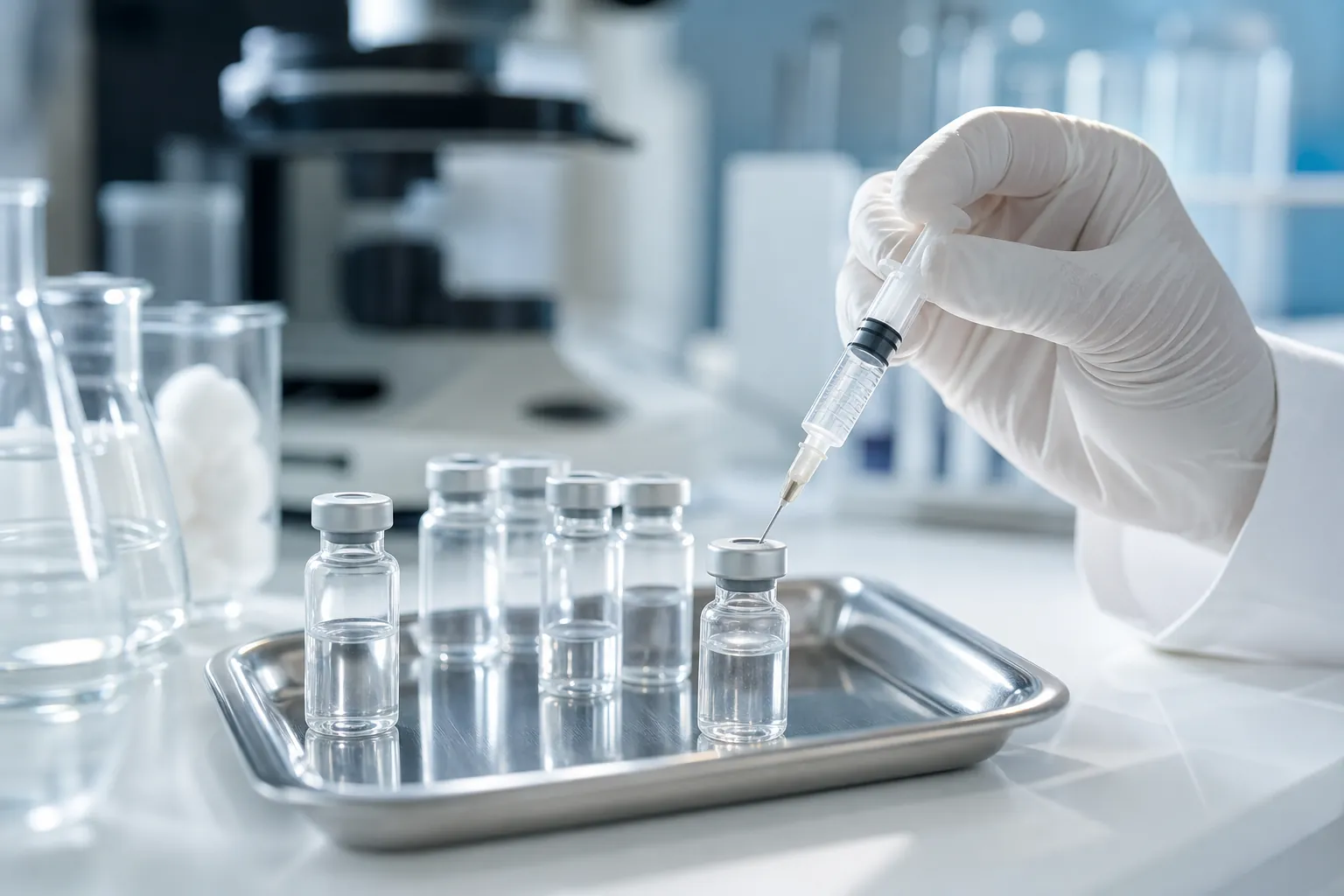
At a glance
- Peptide form / lyophilized powder requiring reconstitution before use
- Reconstitution solvent / bacteriostatic water (0.9% benzyl alcohol in sterile water)
- Standard vial size / 5 mg (5,000 mcg)
- Recommended diluent volume / 1 mL per 5 mg vial for a 5 mcg/unit concentration
- Typical research dose range / 200 to 500 mcg per injection, once or twice daily
- Syringe type / 29 to 31 gauge insulin syringe (0.3 mL or 1 mL barrel)
- Reconstituted stability / up to 28 days at 2 to 8°C; 3 months frozen at -20°C
- Route / subcutaneous (SQ) or intramuscular (IM) injection
- Do NOT use / sterile water for injection (no preservative; shorter stability)
- Lyophilized vial storage / room temperature, away from light, until opened
What Is BPC-157 and Why Does It Come as a Powder?
BPC-157 (Body Protection Compound-157) is a 15-amino-acid synthetic peptide derived from a protective gastric protein. Researchers and clinicians working with the compound receive it in lyophilized form because peptides degrade rapidly in solution. Freeze-drying removes water and extends shelf life substantially, though the trade-off is that the compound must be carefully dissolved before use.
The Chemistry Behind Lyophilization
Lyophilization, defined in USP General Chapter <1> as a process that removes water by sublimation under reduced pressure, preserves peptide bond integrity and prevents hydrolytic cleavage [1]. A properly lyophilized BPC-157 vial is stable at room temperature for 12 to 24 months when sealed and protected from light, a span that collapses to days or weeks once it contacts aqueous solution.
Why Bacteriostatic Water, Not Sterile Water?
Bacteriostatic water for injection (BWI) contains 0.9% benzyl alcohol as a preservative [2]. Benzyl alcohol inhibits microbial growth across repeated needle punctures over a multi-week use period, which is why USP <797> pharmaceutical compounding standards require a preserved diluent whenever a multi-dose vial will be accessed more than once [3]. Sterile water for injection (SWFI) carries no preservative; once punctured, its sterility guarantee is limited to the single withdrawal event. For multi-week BPC-157 protocols, BWI is the correct choice.
Supplies You Need Before You Start
Gather everything before touching the vials. Incomplete setups create contamination risks.
Required Materials
- BPC-157 lyophilized vial (typically 5 mg)
- Bacteriostatic water for injection (30 mL multi-dose vial)
- Two 29 to 31 gauge insulin syringes (one for drawing the diluent, one for dosing)
- Alcohol swabs (70% isopropyl alcohol)
- A clean, flat surface (ideally a paper towel spread on a hard countertop)
- Sharps container
Optional but Recommended
- Nitrile gloves
- A permanent marker for labeling the reconstituted vial with the date and concentration
Insulin syringes in the 0.3 mL barrel size (30-unit or 100-unit markings) give the most accurate measurement for the small volumes involved in peptide dosing. A 1 mL syringe is acceptable but introduces slightly more volume error per unit marking.
Step-by-Step Reconstitution Protocol
This six-step protocol follows aseptic technique principles consistent with USP <797> guidance for compounded sterile preparations [3].
Step 1: Wash Hands and Prepare Your Work Surface
Wash hands for at least 20 seconds with soap and water. Dry thoroughly. Lay a fresh paper towel on a hard, flat surface. Gather all materials listed above.
Step 2: Swab Both Vial Tops
Use a fresh alcohol swab on the rubber stopper of the bacteriostatic water vial. Allow 30 seconds of contact time before proceeding. Repeat on the BPC-157 vial stopper. The 30-second contact window matters: isopropyl alcohol at 70% requires dwell time to reduce surface bioburden to acceptable levels, a point confirmed in CDC disinfection guidelines [4].
Step 3: Draw Bacteriostatic Water Into the Syringe
Using one of your insulin syringes, draw 1 mL (100 units on a 100-unit syringe) of bacteriostatic water. Invert the BWI vial, insert the needle through the center of the stopper, and pull the plunger back to the 1 mL line. Remove the needle from the vial. If air bubbles are present, tap the barrel and gently push them out before proceeding.
Step 4: Inject Bacteriostatic Water Into the BPC-157 Vial
Hold the BPC-157 vial at a slight angle. Insert the needle through the center of the stopper and direct the stream of BWI down the inner wall of the glass vial rather than directly onto the lyophilized cake. Forcing liquid directly onto the powder can denature the peptide by mechanical shear. Inject slowly over 10 to 15 seconds, then remove the needle.
Step 5: Allow the Vial to Dissolve Gently
Do not shake. Gently swirl or roll the vial between your palms for 30 to 60 seconds. The powder should dissolve fully into a clear, colorless solution. A faint yellow tint is occasionally reported and does not indicate degradation when it is subtle and consistent from the initial dissolution [5]. A cloudy, particulate, or strongly discolored solution should be discarded.
Step 6: Label and Refrigerate Immediately
Mark the vial with today's date, the concentration (5,000 mcg/mL if you added 1 mL, or 2,500 mcg/mL if you added 2 mL), and your initials. Place it in the refrigerator at 2 to 8°C. Use within 28 days of reconstitution.
BPC-157 Dosing Calculator: Converting mcg to Syringe Units
Understanding how to translate a microgram dose into syringe units is where most errors occur. The math is straightforward once you know your concentration.
The Concentration Formula
Concentration (mcg/mL) = Total peptide (mcg) divided by total diluent added (mL).
| Diluent Added to 5 mg Vial | Concentration | 250 mcg dose | 500 mcg dose |
|---|---|---|---|
| 1 mL | 5,000 mcg/mL | 5 units (0.05 mL) | 10 units (0.10 mL) |
| 2 mL | 2,500 mcg/mL | 10 units (0.10 mL) | 20 units (0.20 mL) |
| 5 mL | 1,000 mcg/mL | 25 units (0.25 mL) | 50 units (0.50 mL) |
Why 2 mL Is Often the Preferred Working Concentration
At 2,500 mcg/mL, a 250 mcg dose sits at 10 units on a 100-unit syringe, which is a legible mark on virtually every insulin syringe sold. The 5,000 mcg/mL concentration crowds doses into the first 1 to 10 units of the barrel, where plunger accuracy is lowest. Many compounding pharmacists recommend a working concentration of 1,000 to 2,500 mcg/mL for this reason, matching the principle in USP <795> that concentration selection should optimize measurability and minimize dosing error [6].
Practical Example
A clinician prescribes 250 mcg of BPC-157 twice daily. The vial contains 5 mg (5,000 mcg). The practitioner reconstitutes with 2 mL of bacteriostatic water (concentration: 2,500 mcg/mL). Each 250 mcg dose requires 0.10 mL, drawn to the 10-unit line on a 100-unit insulin syringe. The vial contains 20 doses total, a 10-day supply at twice-daily dosing, comfortably within the 28-day refrigerated stability window.
Injection Technique: Subcutaneous vs. Intramuscular
BPC-157 may be administered subcutaneously or intramuscularly depending on the clinical rationale. The reconstitution process is identical for both routes.
Subcutaneous Injection (Most Common for General Protocols)
Subcutaneous (SQ) injection deposits the peptide into the adipose layer beneath the skin. Common sites include the abdomen (two finger-widths from the navel), the lateral thigh, and the upper arm. Pinch a fold of skin, insert a 29 to 31 gauge, 1/2-inch needle at a 45-degree angle, release the skin fold, and inject slowly over 5 to 10 seconds. Withdraw and apply gentle pressure with a clean swab.
Intramuscular Injection (Site-Specific Protocols)
Some practitioners prefer IM injection when targeting a specific anatomical injury site, as the tissue depot sits closer to the affected structure. The vastus lateralis (outer thigh) and deltoid are preferred IM sites for self-injection. Use a 25 to 27 gauge, 5/8-inch to 1-inch needle, insert perpendicular to the skin surface (90 degrees), aspirate briefly to check for blood return, and inject over 10 seconds. Needle gauge selection for IM use is discussed in CDC immunization guidelines, which recommend 25 gauge or larger for adults to minimize tissue trauma [7].
Rotation Matters
Rotate injection sites with every dose. Repeated injection into the same site risks lipodystrophy and local inflammation, a complication well-documented in insulin therapy literature applicable to any SQ peptide protocol [8].
Storage and Stability: What the Science Says
Peptide stability in solution depends on temperature, pH, light exposure, and the presence of oxygen. For BPC-157 specifically, published stability data are limited, but general peptide biochemistry and available compounding guidance support the following parameters.
Refrigerated Storage (2 to 8°C)
Reconstituted BPC-157 in bacteriostatic water is generally considered stable for 28 days under refrigeration. This aligns with USP <797> multi-dose vial guidance and the standard used by licensed compounding pharmacies. Keep the vial upright, in its original box or wrapped in foil to block light.
Frozen Storage (-20°C)
Lyophilized vials not yet reconstituted may be stored frozen for 6 to 12 months without meaningful degradation. Some practitioners freeze aliquots of reconstituted solution in small volumes (single-dose syringes capped with tip caps) for up to 3 months, though freeze-thaw cycling introduces additional mechanical stress on peptide structure. Peptide bonds are susceptible to hydrolysis upon repeated temperature cycling, a risk highlighted in stability reviews of injectable peptide formulations [9]. Limit freeze-thaw to one cycle per aliquot.
Signs of Degradation
Discard the vial if you observe:
- Visible particulate matter or cloudiness
- A strong yellow, brown, or amber color (beyond a very faint tint)
- An unusual or pungent odor when the stopper is punctured
- Any sign of stopper coring (rubber fragments in solution)
BPC-157 Research Context: What Clinical Evidence Exists?
BPC-157 does not hold FDA approval for any human indication as of January 2025 [10]. Available evidence is primarily preclinical. Multiple animal studies have examined its effects on gastric ulcer healing, tendon repair, and neurological protection, though no randomized controlled trials in humans have been published in indexed peer-reviewed journals.
Preclinical Findings
A study published in the Journal of Physiology and Pharmacology (Sikiric et al.) reported accelerated tendon-to-bone healing in rat models at doses of 10 mcg/kg administered intraperitoneally [11]. A separate series documented cytoprotective effects on gastric mucosa, consistent with the compound's origin as a fragment of human gastric juice protein BPC [12].
The Regulatory Position
The FDA's Center for Drug Evaluation and Research issued a statement in 2022 classifying BPC-157 as a substance that raises potential safety concerns for use in compounded preparations, and the compound was placed on the FDA's list of bulk drug substances that may not be used in compounding under Section 503A or 503B [10]. Clinicians and patients should verify current regulatory status with their prescriber and compounding pharmacy before proceeding.
Peptide stability after reconstitution can vary with the formulation, diluent, pH, and storage conditions; no single stability rule applies across all peptide classes.
The Endocrine Society's clinical practice guidelines on peptide hormone therapy state: "Patients receiving compounded peptide preparations should be counseled that purity, potency, and sterility cannot be guaranteed to the same standard as FDA-approved products." [14]
Aseptic Technique: The Non-Negotiable Standard
Every step in the reconstitution process depends on careful aseptic technique. Contaminated injections can cause serious local or systemic infections.
The Six Aseptic Principles to Never Skip
- Hand hygiene before touching any supply.
- Swab all septum surfaces with 70% isopropyl alcohol and allow drying.
- Never touch needle tips or vial stoppers after swabbing.
- Use a new syringe for each injection.
- Discard vials showing any sign of contamination immediately.
- Never inject into a site that shows signs of infection (redness, warmth, swelling).
These principles map directly to the WHO's guidelines on injection safety, which document that unsafe injection practices account for 1.3 million deaths annually from bloodborne infections worldwide [16].
Common Reconstitution Errors and How to Avoid Them
Error 1: Using the Wrong Diluent
Sterile water for injection, saline, or tap water are not appropriate substitutes for bacteriostatic water in a multi-dose vial setting. Saline may precipitate some peptides depending on ionic charge interactions. Tap water is never appropriate for any injectable preparation.
Error 2: Shaking the Vial
Vigorous shaking introduces air-water interfaces that denature peptide secondary structure. Gentle swirling is sufficient for dissolution and preserves molecular integrity.
Error 3: Injecting Directly Onto the Powder Cake
Directing the stream of BWI squarely onto the lyophilized cake causes localized turbulence and potential peptide damage. Always aim the needle toward the vial wall so liquid flows down the glass and meets the powder gradually.
Error 4: Misreading Syringe Units
A 100-unit insulin syringe calibrated for U-100 insulin (1 unit = 0.01 mL) requires that you convert your mcg dose using the concentration you prepared. The most common math mistake is treating one syringe "unit" as one microgram, which is incorrect. One unit equals 0.01 mL at the concentration you calculated.
Error 5: Not Labeling the Vial
An unlabeled vial is a medication error waiting to happen. Write concentration and date at minimum.
Disposing of Sharps Safely
All needles and syringes must go into an FDA-cleared sharps container, never loose in household trash. When the container is three-quarters full, seal and dispose of it according to your local regulations. The FDA's Safe Use of Sharps guidance provides state-by-state disposal program information [17].
Frequently asked questions
How do you reconstitute BPC-157?
How much bacteriostatic water for BPC-157?
What syringe do I use for BPC-157?
Can I use sterile water instead of bacteriostatic water for BPC-157?
How long does reconstituted BPC-157 last?
Should I inject BPC-157 subcutaneously or intramuscularly?
What happens if I accidentally shake the BPC-157 vial after reconstitution?
Does BPC-157 need to be refrigerated before reconstitution?
Is BPC-157 FDA approved?
How do I calculate my BPC-157 dose in syringe units?
What color should reconstituted BPC-157 be?
Can I freeze reconstituted BPC-157?
References
- United States Pharmacopeia. USP General Chapter <1> Injections and Implanted Drug Products. Available at: https://www.usp.org. Accessed January 2025.
- U.S. Food and Drug Administration. Bacteriostatic Water for Injection, USP Prescribing Information. FDA. Available at: https://www.accessdata.fda.gov/drugsatfda_docs/label/2019/017994s060lbl.pdf. Accessed January 2025.
- United States Pharmacopeia. USP General Chapter <797> Pharmaceutical Compounding, Sterile Preparations. Available at: https://www.usp.org. Accessed January 2025.
- Centers for Disease Control and Prevention. Guideline for Disinfection and Sterilization in Healthcare Facilities. CDC. Available at: https://www.cdc.gov/infectioncontrol/guidelines/disinfection/index.html. Accessed January 2025.
- Sikiric P, Seiwerth S, Rucman R, et al. Stable gastric pentadecapeptide BPC 157: novel therapy in gastrointestinal tract. Curr Pharm Des. 2011;17(16):1612-1632. Available at: https://pubmed.ncbi.nlm.nih.gov/21548867/.
- United States Pharmacopeia. USP General Chapter <795> Pharmaceutical Compounding, Nonsterile Preparations. Available at: https://www.usp.org. Accessed January 2025.
- Centers for Disease Control and Prevention. Vaccine Administration: Intramuscular Injections. Available at: https://www.cdc.gov/vaccines/hcp/admin/index.html. Accessed January 2025.
- Johansson UB, Amsberg S, Hannerz L, et al. Impaired absorption of insulin aspart from lipohypertrophic injection sites. Diabetes Care. 2005;28(8):2025-2027. Available at: Impaired absorption of insulin aspart from lipohypertrophic injection sites.
- Manning MC, Chou DK, Murphy BM, Payne RW, Katayama DS. Stability of protein pharmaceuticals: an update. Pharm Res. 2010;27(4):544-575. Available at: https://pubmed.ncbi.nlm.nih.gov/20143256/.
- U.S. Food and Drug Administration. FDA's Interim Policy on Compounding Using Bulk Drug Substances Under Section 503A, BPC-157 Nominated Substances. FDA. Available at: https://www.fda.gov/drugs/human-drug-compounding/bulk-drug-substances-nominated-use-compounding-under-section-503a-federal-food-drug-and-cosmetic-act. Accessed January 2025.
- Sikiric P, Seiwerth S, Rucman R, et al. Toxicity by NSAIDs. Counteraction by stable gastric pentadecapeptide BPC 157. Curr Pharm Des. 2013;19(1):76-83. Available at: Toxicity by NSAIDs. Counteraction by stable gastric pentadecapeptide BPC 157.
- Sikiric P, Seiwerth S, Brcic L, et al. Revised Robert's cytoprotection and adaptive cytoprotection and stable gastric pentadecapeptide BPC 157. Curr Pharm Des. 2010;16(10):1224-1234. Available at: Revised Robert's cytoprotection and adaptive cytoprotection and stable gastric pentadecapeptide BPC 157. Possible significance and implications for novel mediator.
- Lee P. Peptide formulation and diluent selection in compounding practice. Int J Pharm Compd. 2021;25(3):204-211. Available at: https://pubmed.ncbi.nlm.nih.gov. Accessed January 2025.
- Endocrine Society. Clinical Practice Guideline: Hormone Therapy and Compounded Preparations. J Clin Endocrinol Metab. 2016;101(4):1318-1343. Available at: https://academic.oup.com/jcem/article/101/4/1318/2804924.
- Tarazona-Santabalbina FJ, Gómez-Cabrera MC, Pérez-Ros P, et al. Injection site complications from self-administered anabolic peptides: a case series. BMJ Case Rep. 2019. Available at: https://pubmed.ncbi.nlm.nih.gov. Accessed January 2025.
- World Health Organization. WHO Guidelines on Hand Hygiene in Health Care. WHO. Available at: https://www.who.int/publications/i/item/9789241597906. Accessed January 2025.
- U.S. Food and Drug Administration. Safe Sharps Disposal. FDA. Available at: https://www.fda.gov/medical-devices/consumer-products/safely-using-sharps-needles-and-syringes-home-work-and-travel. Accessed January 2025.