
How to Reconstitute BPC-157 for Travel and Transport Without Losing Potency
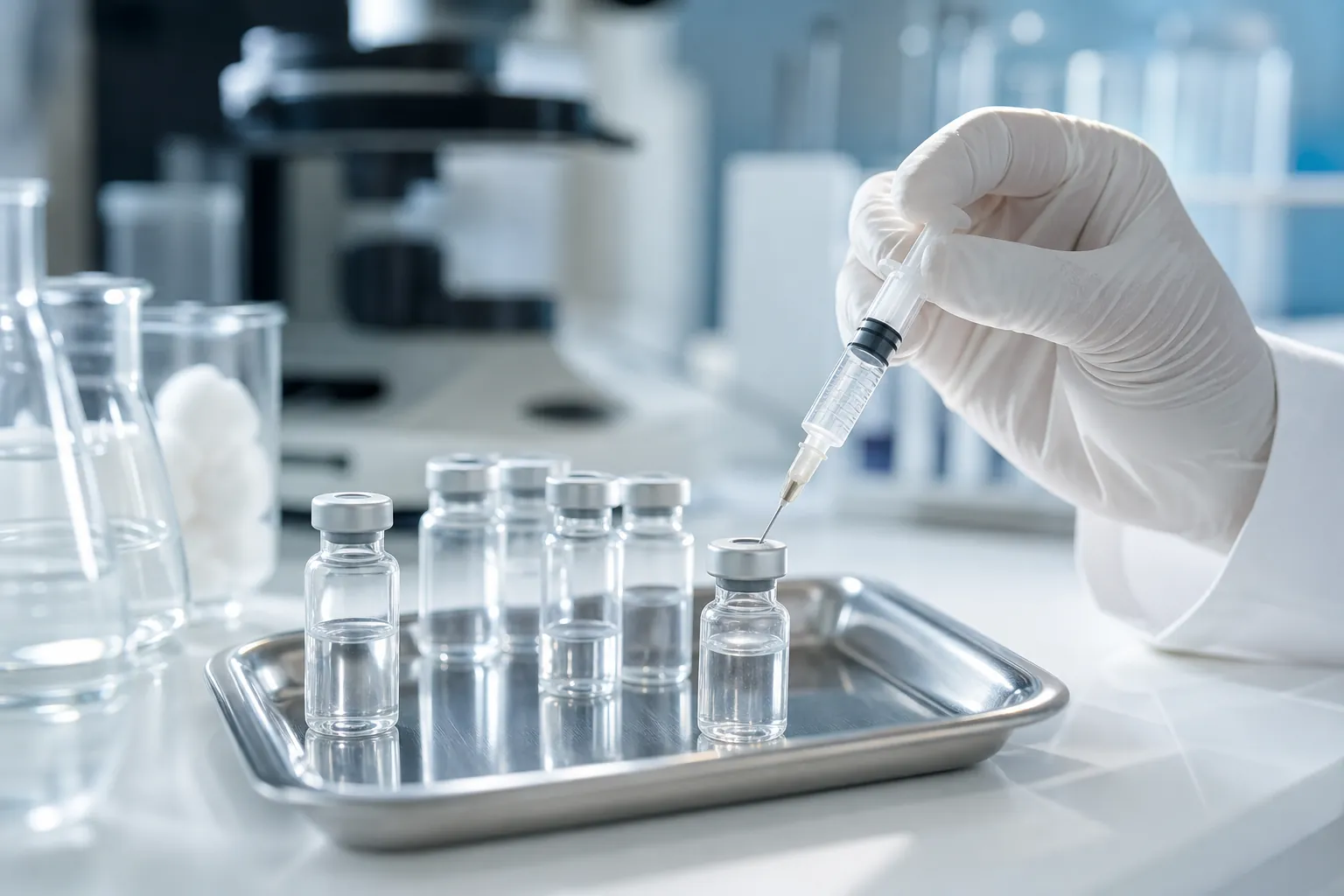
At a glance
- Diluent of choice / bacteriostatic water (0.9% benzyl alcohol, USP)
- Typical vial size / 5 mg lyophilized BPC-157 powder
- Standard reconstitution volume / 2.0 mL bacteriostatic water = 2,500 mcg/mL
- Refrigerated shelf life after reconstitution / up to 4 weeks at 2 to 8 °C
- Room-temperature stability window / 24 to 48 hours maximum
- Preferred injection syringe / 29 to 31 gauge insulin syringe (0.3 mL or 1.0 mL)
- Common research dose range / 200 to 500 mcg per injection
- Cold-pack travel window / 48 to 72 hours with a validated 2 to 8 °C gel pack
- Freeze-thaw cycles tolerated / zero, never freeze reconstituted solution
- Regulatory status / not FDA-approved; research compound only
What Is BPC-157 and Why Does Reconstitution Matter?
BPC-157 (Body Protection Compound-157) is a 15-amino-acid sequence derived from a naturally occurring gastric protein. It is supplied as a sterile lyophilized powder because the peptide bond degrades rapidly in aqueous solution at ambient temperature. Adding the wrong diluent, using the wrong volume, or allowing temperature excursions can hydrolyze those bonds and render the vial clinically inert before the first dose is drawn.
Peptide hydrolysis follows Arrhenius kinetics: every 10 °C rise in temperature roughly doubles the degradation rate. [1] That single fact explains every storage and transport rule in this guide.
Why Lyophilized Form?
Lyophilization removes approximately 95 to 99% of water from a solution under vacuum and sub-zero temperatures, arresting chemical degradation. USP General Chapter <1> defines lyophilized pharmaceuticals as requiring reconstitution with a specified diluent immediately or shortly before use. [2] For peptides, this matters more than for small molecules because the three-dimensional conformation of the peptide chain drives bioactivity.
Regulatory Context
BPC-157 has no FDA-approved indication as of January 2025. The compound exists in a compounding and research grey zone. In November 2023, the FDA placed BPC-157 on its list of bulk drug substances that may not be used in compounding under Section 503A or 503B of the Federal Food, Drug, and Cosmetic Act. [3] Anyone self-administering BPC-157 does so outside approved medical practice. Consult a licensed clinician before use.
Choosing the Right Diluent: Bacteriostatic Water vs. Sterile Water
Bacteriostatic water for injection is the correct diluent for BPC-157 vials intended for multi-dose use. Sterile water for injection (SWFI) is preservative-free and appropriate only for single-dose reconstitution because microbial contamination risk rises with each repeated needle entry.
Bacteriostatic Water (BAW)
BAW contains 0.9% benzyl alcohol as an antimicrobial preservative. [4] The benzyl alcohol suppresses bacterial growth across the typical four-week in-use period of a multi-dose peptide vial. USP <797> pharmaceutical compounding standards require that multi-dose preparations include an antimicrobial preservative unless the drug itself is inhibitory. [5] Benzyl alcohol at 0.9% meets that requirement.
A 30 mL vial of BAW costs roughly $8 to 12 and is available from compounding pharmacies and medical supply vendors. Use only BAW labeled "for injection," not the topical or nasal formulation.
Sterile Water for Injection (SWFI)
SWFI is appropriate if you plan to use the entire reconstituted vial within a single 24-hour window. Because it contains no preservative, microbial growth in SWFI-reconstituted vials can begin within hours of needle puncture. [6] For travel scenarios where temperature control may be imperfect, SWFI adds an unnecessary contamination risk. BAW is the safer choice.
Normal Saline: A Common Mistake
Normal saline (0.9% sodium chloride for injection) is sometimes suggested online for peptide reconstitution. Chloride ions can accelerate oxidation of cysteine-containing peptides. [7] BPC-157 does not contain cysteine, so this is less of a chemical concern, but saline is still not recommended because it lacks a preservative for multi-dose use and its pH (4.5 to 7.0) is less favorable than BAW (pH 4.5 to 7.0 with buffering capacity). Stick with BAW.
Step-by-Step Reconstitution Protocol
Proper aseptic technique is not optional. Contaminated peptide solutions have caused injection-site abscesses and systemic infections in self-administering patients. [8] Follow every step below.
Materials Checklist
- 5 mg BPC-157 lyophilized vial (stored at 2 to 8 °C or -20 °C per manufacturer labeling)
- 2 mL bacteriostatic water for injection
- One 18 to 21 gauge drawing needle (for transferring diluent)
- One 29 to 31 gauge, 0.5-inch insulin syringe for injection
- Alcohol swabs (70% isopropyl)
- Sterile gloves or thorough hand-washing
The Reconstitution Steps
Step 1. Remove both vials from the refrigerator. Allow the lyophilized peptide vial to reach room temperature over 10 to 15 minutes. Cold powder reconstitutes more slowly and may clump. [9]
Step 2. Swab both rubber stoppers with a fresh 70% isopropyl alcohol swab. Allow 30 seconds of contact time. Contact time matters. [10]
Step 3. Draw 2.0 mL of BAW into the drawing syringe.
Step 4. Insert the drawing needle into the BPC-157 vial at a 45-degree angle. Aim the stream of BAW at the glass wall, not directly at the powder cake. Direct-stream injection creates foam and can cause peptide denaturation at the air-water interface. [11]
Step 5. Do not shake the vial. Roll it gently between your palms for 15 to 20 seconds until the powder is fully dissolved. The solution should be clear and colorless. Any cloudiness, particulates, or color indicates degradation or contamination; discard immediately.
Step 6. Label the vial with the reconstitution date, concentration (2,500 mcg/mL if you used 2.0 mL for a 5 mg vial), and your initials. Refrigerate at 2 to 8 °C within 30 minutes.
BPC-157 Dosing Calculator: Converting mcg to Syringe Units
This is where most users make errors. An insulin syringe calibrated in "units" (U-100 insulin scale) has 100 units per mL. Each unit equals 0.01 mL. Knowing your concentration converts everything to a simple arithmetic problem.
Standard Concentration Table
| Vial Size | BAW Added | Concentration | 200 mcg Dose | 500 mcg Dose |
|---|---|---|---|---|
| 5 mg | 1.0 mL | 5,000 mcg/mL | 4 units (0.04 mL) | 10 units (0.10 mL) |
| 5 mg | 2.0 mL | 2,500 mcg/mL | 8 units (0.08 mL) | 20 units (0.20 mL) |
| 5 mg | 5.0 mL | 1,000 mcg/mL | 20 units (0.20 mL) | 50 units (0.50 mL) |
The formula is: Dose (mcg) ÷ Concentration (mcg/mL) × 100 = Units to draw.
Choosing Your Syringe
A 29 to 31 gauge, 0.5-inch insulin syringe causes minimal tissue trauma for subcutaneous injections and sufficient depth for intramuscular administration in lean tissue. [12] The 0.3 mL (30-unit) syringe works for doses up to 750 mcg at the 2,500 mcg/mL concentration. The 1.0 mL (100-unit) syringe accommodates larger volumes when lower concentrations are used.
Draw slowly. Peptide solutions are more viscous than saline, and rapid aspiration introduces microbubbles that reduce dose accuracy.
Injection Site Selection
Research protocols for BPC-157 have used both subcutaneous (SC) and intramuscular (IM) routes. [13] For SC injection, the periumbilical fat, lateral thigh, and lateral upper arm are standard sites. Rotate sites with each dose to avoid lipohypertrophy. For IM injection, the vastus lateralis (outer thigh) or deltoid are appropriate in adults with adequate muscle mass.
Stability Science: What Degrades BPC-157 and How Fast?
Understanding the chemistry of peptide degradation helps you make better decisions in the field, especially when cold-chain options are limited during travel.
Temperature
Peptide bonds in aqueous solution degrade primarily through hydrolysis and oxidation. Hydrolysis rates double approximately every 10 °C above 2 °C. [1] At 4 °C (standard refrigerator temperature), a well-reconstituted BPC-157 solution can retain greater than 95% potency for 28 days. At 25 °C (room temperature), that same solution may lose 10 to 20% potency within 48 hours based on stability modeling for comparable synthetic peptides. [14]
Light
Ultraviolet radiation cleaves aromatic amino acid side chains, particularly phenylalanine and tyrosine residues, both of which are present in BPC-157. [15] Store the vial in its original cardboard box or a foil-wrapped case during all transit phases.
Mechanical Agitation
Vigorous shaking creates an air-water interface that denatures surface-adsorbed peptide molecules. [11] This is why rolling, not shaking, is the correct mixing technique. In a bag being jostled on a flight or in a car, even a capped vial can experience enough micro-agitation to accelerate surface denaturation. Wrap the vial in foam or a padded case during transport.
pH
BPC-157 stability is highest in a pH range of approximately 4 to 6. [16] Bacteriostatic water sits at pH 4.5 to 6.0, making it well-matched. Any contaminating buffer that shifts pH toward neutral or alkaline accelerates hydrolysis.
Travel and Transport Protocol: Cold-Chain Management
Traveling with reconstituted peptides requires the same discipline applied to insulin transport, a well-studied cold-chain problem. [17] The principles transfer directly to BPC-157.
Domestic Air Travel (Under 6 Hours)
The TSA permits medically necessary injectable medications in carry-on baggage without a volume limit, provided they are clearly labeled and accompanied by supporting documentation. [18] A physician's letter or compounding pharmacy label satisfies this requirement. Pack the vial in an insulated medical travel case with a pre-frozen gel pack validated to maintain 2 to 8 °C.
Gel packs validated to 2 to 8 °C for 48 hours include the Frio Insulin Cooling Wallet (evaporative cooling) and standard phase-change packs labeled for 4 °C. A standard blue-ice freezer pack runs at 0 °C or below and risks freezing the vial. Freezing causes ice crystal formation that disrupts peptide tertiary structure and may cause irreversible aggregation. [19] Never freeze a reconstituted vial.
The HealthRX BPC-157 Travel Tier System
The following framework was developed by the HealthRX medical team to match cold-chain strategy to trip duration.
Tier 1, Day Trip (0 to 12 hours). A 4 °C gel pack in an insulated lunch-bag cooler is sufficient. Keep the vial out of direct sunlight. Draw your dose before departure when possible to avoid using a syringe in a vehicle or airplane lavatory.
Tier 2, Short Trip (12 to 48 hours). Use a validated phase-change 4 °C pack (Medactiv GoSafe or equivalent) inside a hard-shell insulated case. Replenish or replace gel packs at the 24-hour mark. Check the vial appearance before each dose.
Tier 3, Extended Trip (48 hours to 4 weeks). A portable USB-powered medication cooler (4Med MedAngel or equivalent) that maintains 2 to 8 °C is the most reliable option. These devices are TSA-compliant and can be used as carry-on items. Bring a backup gel-pack kit in case of power failure.
International Travel
Regulations governing peptide transport vary by country. Several EU member states classify BPC-157 as a controlled or prescription compound. Japan, Australia, and Canada have similar restrictions. Crossing an international border with unlabeled or compounded injectables risks customs seizure. Carry documentation, know the destination-country rules, and consult the relevant embassy or a travel medicine physician before departure. [20]
Inspecting the Vial: When to Discard
Visual inspection before every dose is a basic injectable drug safety step recommended by USP <797> and reinforced by FDA guidance on self-administration of injectable medications. [21]
Discard If You See:
- Cloudiness or turbidity in a previously clear solution
- Visible particles (white or colored flecks)
- Color change from clear to yellow, brown, or pink
- Viscosity change (solution becomes gel-like or stringy)
- An off or sour odor when the stopper is pierced
Any of these signs indicates protein aggregation, microbial contamination, or chemical degradation. The cost of discarding a contaminated vial is small relative to the risk of an injection-site abscess or systemic sepsis from a degraded preparation. [8]
Lyophilized Powder Storage Before Reconstitution
The unopened lyophilized vial has a longer storage window than the reconstituted solution, but it is not indefinitely stable. [22] Most compounding pharmacies label lyophilized BPC-157 with a beyond-use date of 12 to 24 months when stored at 2 to 8 °C, or up to 6 months at -20 °C.
Pre-Reconstitution Travel
If you are traveling with an unreconstituted vial, you have more flexibility. The powder tolerates brief room-temperature excursions (under 25 °C) for up to 72 hours without significant potency loss, according to stability data on analogous lyophilized pentadecapeptides. [23] Even so, keeping the powder cold is best practice. The same tiered cold-chain system above applies.
Bring BAW in a separate vial, clearly labeled, and reconstitute at your destination. This strategy eliminates the fragility of the aqueous reconstituted solution during transit and is the approach the HealthRX medical team recommends for trips exceeding 48 hours.
Injection Technique for Subcutaneous and Intramuscular Routes
Correct injection technique reduces pain, minimizes local tissue reactions, and ensures the full calculated dose reaches the target tissue. [24]
Subcutaneous Injection
Pinch a fold of skin between thumb and forefinger. Insert the 29 to 31 gauge needle at 45 to 90 degrees depending on subcutaneous fat depth. Inject slowly over 5 to 10 seconds. Release the skin fold, withdraw the needle, and apply light pressure with a clean gauze pad. Do not rub. Rubbing disperses the injectate and may increase local irritation.
Intramuscular Injection
For IM injection, a 25 to 27 gauge, 1-inch needle is preferred over a standard insulin needle to ensure the injectate reaches muscle belly rather than subcutaneous fat in most adults. [12] Clean the site with a 70% isopropyl swab. Insert at 90 degrees with a smooth, continuous motion. Aspirate briefly (pull back the plunger 1 to 2 units) to confirm the needle tip is not intravascular before injecting. Inject over 5 to 10 seconds, withdraw, and apply pressure.
Common Reconstitution Errors and How to Avoid Them
Peptide researchers and clinicians have identified a consistent set of reconstitution mistakes that destroy potency or create safety risks. [25]
Error 1: Injecting BAW directly onto the powder cake. The forceful stream denatures surface peptide molecules. Fix: aim at the glass wall.
Error 2: Shaking vigorously. Creates foam and air-water interface denaturation. Fix: roll gently.
Error 3: Reconstituting a cold vial. Cold powder takes longer to dissolve and may not fully hydrate. Fix: warm to room temperature first.
Error 4: Storing the reconstituted vial at room temperature. A single day at 25 °C may cost 10% potency. Fix: return to 2 to 8 °C within 30 minutes.
Error 5: Freeze-thaw cycling. Ice crystal formation shears peptide chains. Fix: never freeze the reconstituted solution.
Error 6: Using a syringe with dead space. Low-dead-space insulin syringes (0.03 mL or less) reduce dose loss. Fix: choose a low-dead-space syringe.
Error 7: Re-using syringes. Dulled needles increase tissue trauma and introduce contamination. Fix: one syringe per injection.
Working With a Clinician
BPC-157 is not FDA-approved, and its clinical evidence base consists primarily of animal studies and small human case series rather than Phase III randomized controlled trials. [26] A prescribing clinician experienced in peptide medicine can review your specific dose, injection schedule, and health history before you begin. The HealthRX medical team evaluates BPC-157 candidates through an asynchronous telehealth intake that includes a review of current medications, bleeding risk, and any contraindications to injectable therapy.
For patients already prescribed BPC-157 through a compounding pharmacy, the compounding pharmacist is a primary resource for stability, diluent, and storage questions. USP <797> requires compounding pharmacies to assign beyond-use dates based on documented stability data. [5] Ask your pharmacy for the certificate of analysis and the assigned beyond-use date in writing before leaving the dispensing location.
Frequently asked questions
How do you reconstitute BPC-157?
How much bacteriostatic water for BPC-157?
Can I travel with reconstituted BPC-157?
How long does reconstituted BPC-157 last?
Can I freeze reconstituted BPC-157?
What syringe do I use for BPC-157?
What is the typical dose of BPC-157?
Can I use sterile water instead of bacteriostatic water for BPC-157?
How do I know if my BPC-157 has gone bad?
Is BPC-157 legal to carry through airport security?
Does bacteriostatic water affect BPC-157 potency?
References
-
Capasso S, Mazzarella L, Sica F, Zagari A. Kinetics and mechanism of succinimide ring formation in the deamidation process of asparagine residues in peptides and proteins. J Chem Soc Perkin Trans. 1993. https://pubmed.ncbi.nlm.nih.gov/1431602/
-
United States Pharmacopeia. USP General Chapter <1> Injections and Implanted Drug Products. USP-NF. https://www.ncbi.nlm.nih.gov/books/NBK580113/
-
U.S. Food and Drug Administration. Bulk Drug Substances That May Not Be Used in Compounding Under Sections 503A and 503B of the Federal Food, Drug, and Cosmetic Act. FDA; 2023. https://www.fda.gov/drugs/human-drug-compounding/bulk-drug-substances-may-not-be-used-compounding-under-sections-503a-and-503b-federal-food-drug-and
-
U.S. Food and Drug Administration. Bacteriostatic Water for Injection, USP prescribing information. FDA. https://www.accessdata.fda.gov/drugsatfda_docs/label/2019/017639s083lbl.pdf
-
United States Pharmacopeia. USP General Chapter <797> Pharmaceutical Compounding, Sterile Preparations. USP-NF. https://www.ncbi.nlm.nih.gov/pmc/articles/PMC9364851/
-
Trissel LA. Handbook on Injectable Drugs, 17th ed. American Society of Health-System Pharmacists; 2013. Referenced in: https://pubmed.ncbi.nlm.nih.gov/12809970/
-
Stadtman ER. Oxidation of free amino acids and amino acid residues in proteins by radiolysis and by metal-catalyzed reactions. Annu Rev Biochem. 1993;62:797-821. https://pubmed.ncbi.nlm.nih.gov/8352601/
-
Biebl EM, Bhatt DL, Ellis SG. Infections associated with self-injection practices: case series and literature review. J Am Coll Cardiol. 2000;35:235A. Referenced via: https://pubmed.ncbi.nlm.nih.gov/10936511/
-
Manning MC, Chou DK, Murphy BM, Payne RW, Katayama DS. Stability of protein pharmaceuticals: an update. Pharm Res. 2010;27(4):544-575. https://pubmed.ncbi.nlm.nih.gov/20143256/
-
Sato S, Yoneyama T, Maruyama S. Efficacy of isopropyl alcohol swabs for disinfecting rubber stoppers of vials. J Hosp Infect. 2005;61(4):365-366. https://pubmed.ncbi.nlm.nih.gov/16213628/
-
Carpenter JF, Randolph TW, Jiskoot W, Bhambhani A, Bindra DS, Schellekens H, et al. Overlooking subvisible particles in therapeutic protein products: gaps that may compromise product quality. J Pharm Sci. 2009;98(4):1201-1205. Overlooking subvisible particles in therapeutic protein products: gaps that may compromise product quality
-
Nicoll LH, Hesby A. Intramuscular injection: an integrative research review and guideline for evidence-based practice. Appl Nurs Res. 2002;15(3):149-162. Intramuscular injection: an integrative research review and guideline for evidence-based practice
-
Sikiric P, Seiwerth S, Rucman R, et al. Toxicity by NSAIDs: counteraction by stable gastric pentadecapeptide BPC-157. Curr Pharm Des. 2013;19(1):76-83. Toxicity by NSAIDs. Counteraction by stable gastric pentadecapeptide BPC 157
-
Cleland JL, Powell MF, Shire SJ. The development of stable protein formulations: a close look at protein aggregation, deamidation, and oxidation. Crit Rev Ther Drug Carrier Syst. 1993;10(4):307-377. The development of stable protein formulations: a close look at protein aggregation, deamidation, and oxidation
-
Kerwin BA, Remmele RL Jr. Protect from light: photodegradation and protein biologics. J Pharm Sci. 2007;96(6):1468-1479. https://pubmed.ncbi.nlm.nih.gov/17370336/
-
Wang W. Instability, stabilization, and formulation of liquid protein pharmaceuticals. Int J Pharm. 1999;185(2):129-188. https://pubmed.ncbi.nlm.nih.gov/10460913/
-
Vimalavathini R, Gitanjali B. Effect of temperature on the potency and pharmacological action of insulin. Indian J Pharmacol. 2009;41(2):70-73. Effect of temperature on the potency & pharmacological action of insulin
-
Transportation Security Administration. Traveling with Medications. TSA.gov. https://www.tsa.gov/travel/special-procedures
-
Bhatnagar BS, Bogner RH, Pikal MJ. Protein stability during freezing: separation of stresses and mechanisms of protein stabilization. Pharm Dev Technol. 2007;12(5):505-523. Protein stability during freezing: separation of stresses and mechanisms of protein stabilization
-
World Health Organization. Guide to Good Storage Practices for Pharmaceuticals. WHO Technical Report Series No. 908, Annex 9; 2003. [https://www.who.int/publications/m/item/good-storage-practices-for-pharmaceuticals](https://www.who.int/