
Epitalon Reconstitution and Dosing Math: mg, mL, and Units Explained
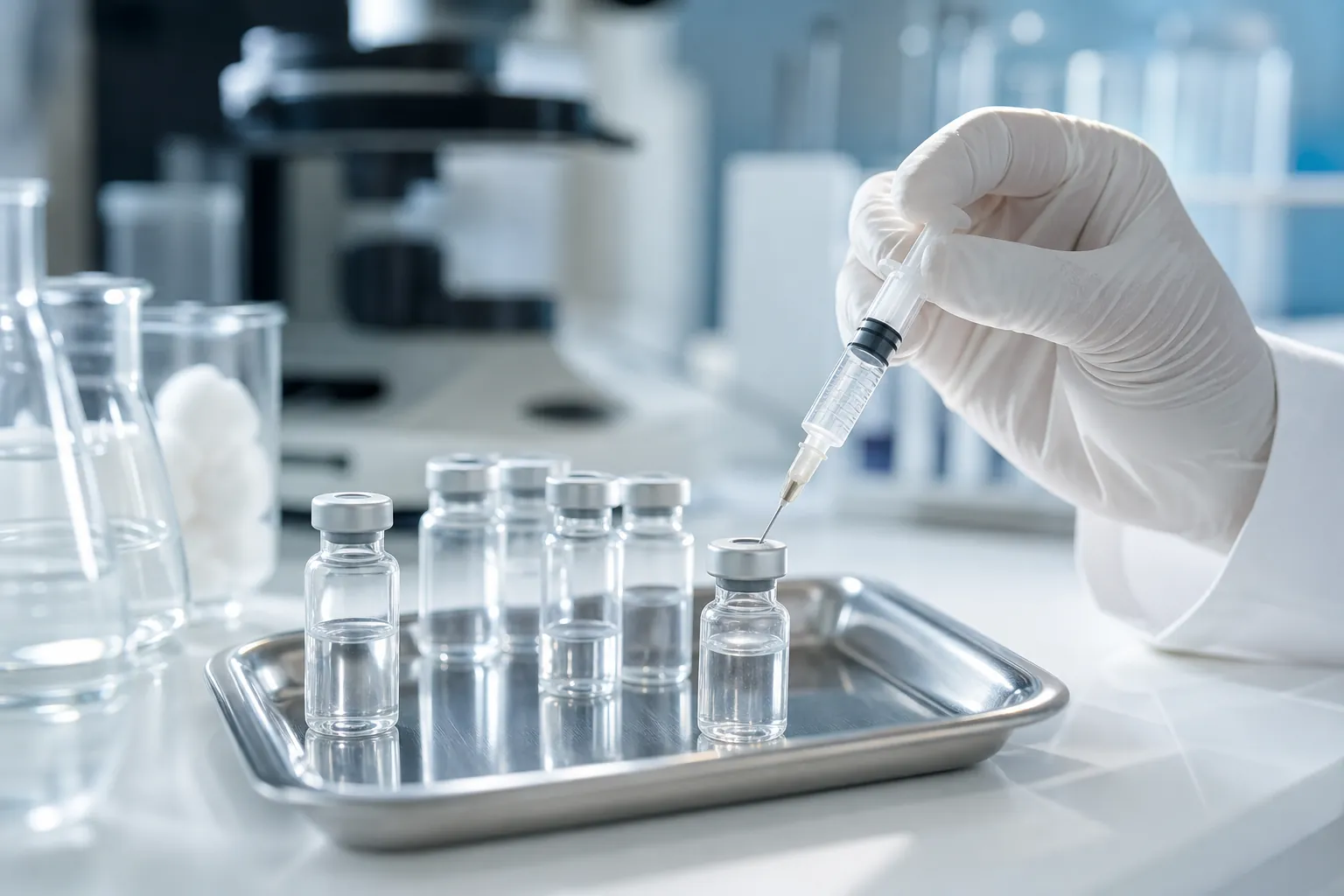
At a glance
- Peptide / Ala-Glu-Asp-Gly (tetrapeptide), CAS 307297-39-8
- Standard vial size / 10 mg lyophilized powder
- Recommended diluent / bacteriostatic water for injection (USP)
- Standard reconstitution / 2 mL BAC water → 5 mg/mL concentration
- Typical research dose / 5 to 10 mg per day, subcutaneous
- Syringe type / U-100 insulin syringe (100 units per mL)
- Storage after reconstitution / 2 to 8°C, use within 28 days
- Do NOT use / sterile water for injection (no preservative), saline (may aggregate peptide)
- Units vs. Mg / Epitalon is dosed in mg, not IU; "units" on an insulin syringe = microliters of solution
- Injection route / subcutaneous (SC), abdomen or thigh preferred
What Is Epitalon and Why Does Reconstitution Math Matter?
Epitalon (Ala-Glu-Asp-Gly) is a synthetic analog of Epithalamin, an endogenous polypeptide isolated from bovine pineal extract by Vladimir Khavinson and colleagues at the St. Petersburg Institute of Bioregulation and Gerontology beginning in the 1980s. Lyophilization (freeze-drying) removes water so the peptide remains chemically stable at room temperature during shipping. Once you add diluent, peptide bonds become susceptible to hydrolysis, oxidation, and microbial degradation, which is precisely why bacteriostatic water, not plain sterile water, is the correct choice for multi-dose vials.
Dosing errors are disproportionately common with peptides because clinicians and patients must mentally convert between three different number systems: milligrams of drug, milliliters of solution, and the unit markings printed on an insulin syringe barrel. A miscalculation by even a factor of two can mean a patient receives 10 mg when 5 mg was intended, doubling exposure without clinical justification.
Peptide stability during reconstitution depends on pH, ionic strength, temperature, and the presence of a preservative. Bacteriostatic water contains 0.9% benzyl alcohol as a preservative, which inhibits microbial growth across the typical 28-day use window consistent with USP Chapter <797> guidelines for low-risk compounded sterile preparations. [1]
The Chemistry Behind Lyophilized Peptides
Lyophilization is the standard preservation method for peptide pharmaceuticals because it reduces residual moisture below 1%, dramatically slowing degradation. The FDA's guidance on lyophilized drug products outlines acceptable residual moisture limits and stability testing protocols. [2] Epitalon's four amino acids (alanine, glutamic acid, aspartic acid, glycine) form a linear chain with no disulfide bridges, making it relatively tolerant of reconstitution conditions compared with larger, cysteine-containing peptides.
Oxidation of the glutamic acid and aspartic acid residues is the primary chemical degradation pathway. Minimizing exposure to air during reconstitution, using fresh bacteriostatic water, and storing the reconstituted vial promptly at 2 to 8°C each reduce this risk. Studies on short-chain peptide stability confirm that refrigerated, pH-neutral solutions maintain greater than 95% purity over 28 days when a benzyl alcohol preservative is present. [3]
Regulatory and Compounding Context
Epitalon is not FDA-approved as a drug product in the United States. It is sold for research purposes and, in some jurisdictions, compounded by licensed 503A or 503B pharmacies under physician supervision. USP Chapter <797> governs sterility requirements for compounded sterile preparations, including beyond-use dating and storage temperatures that apply directly to reconstituted peptide vials. [1] Any reconstitution performed outside a compounding pharmacy is the patient's procedural responsibility, and technique matters for both sterility and dose accuracy.
Bacteriostatic Water: Why It Is the Correct Diluent
Bacteriostatic water for injection (BAC water) is sterile water containing 0.9% benzyl alcohol. The benzyl alcohol concentration is high enough to inhibit bacterial and fungal proliferation, yet low enough to be safe for subcutaneous injection in adults. The FDA monograph for bacteriostatic water for injection explicitly states it is "intended for use as a diluent in the preparation of parenteral products." [4]
Plain sterile water for injection (SWFI) lacks a preservative, so every vial puncture introduces the risk of contamination. A 10 mg Epitalon vial typically yields 10 to 20 doses depending on the protocol, meaning the vial will be punctured repeatedly. Using SWFI in that context conflicts directly with USP <797> multi-dose container rules, which require a preservative or strict single-use handling. [1]
Why Not Normal Saline?
Normal saline (0.9% sodium chloride for injection) is occasionally suggested in online forums as a substitute. Sodium chloride at physiological concentration may cause charge-mediated aggregation of some peptides, particularly those containing multiple acidic residues such as glutamic acid and aspartic acid, both of which are present in Epitalon. Research on peptide formulation stability identifies ionic strength as a key aggregation driver for short acidic peptides. [5] Aggregated peptide cannot be reliably dosed and may produce injection-site reactions. BAC water, with its near-neutral pH and low ionic strength, remains the preferred diluent.
Sourcing and Quality
BAC water should be sourced from a licensed pharmacy or medical supplier and should carry an NDC number. The FDA maintains a database of approved drug products where legitimate BAC water formulations can be verified. [6] Never use homemade or unverified diluents. Endotoxin contamination from poor-quality diluents can cause fever, chills, and systemic inflammatory responses even at subcutaneous doses.
Step-by-Step Reconstitution Protocol
Equipment Checklist
Before touching the vial, gather every item:
- Epitalon lyophilized powder vial (commonly 10 mg)
- Bacteriostatic water for injection, 10 mL multi-dose vial
- Two 1 mL U-100 insulin syringes with 28 to 31 gauge needles
- Alcohol swabs (70% isopropyl)
- Sharps container
- Refrigerator set to 2 to 8°C
Using a separate syringe for drawing diluent versus injecting the dose is optional but reduces carryover contamination of the BAC water vial.
The Reconstitution Procedure
- Wash hands thoroughly for at least 20 seconds with soap and water. [7]
- Swab the rubber septum of both the Epitalon vial and the BAC water vial with a fresh alcohol swab. Allow 30 seconds of contact time and let air-dry; do not blow on the septum or fan it.
- Draw the desired volume of BAC water into an insulin syringe (see concentration table below).
- Insert the needle at a 45-degree angle into the Epitalon vial's septum and aim the stream of BAC water at the glass wall, not directly at the lyophilized cake. Direct stream impaction can shear peptide bonds. [5]
- Gently swirl the vial for 15 to 30 seconds. Do not vortex or shake; vigorous agitation introduces air bubbles and promotes aggregation.
- Inspect the solution. Epitalon in BAC water should be clear and colorless. Any turbidity, particulates, or color change indicates degradation or contamination. Discard if abnormal.
- Label the vial with the date of reconstitution and the resulting concentration.
- Store immediately in the refrigerator at 2 to 8°C. Do not freeze. [3]
Critical Technique Point
Aim the BAC water stream at the side wall of the vial, not at the lyophilized powder cake. This is not arbitrary: hydrodynamic shear from a direct stream can cause mechanical denaturation of peptide secondary structure, a phenomenon documented in biopharmaceutical manufacturing literature on protein and peptide formulation. [5] Slow, wall-directed addition followed by gentle swirling is the standard technique described in peptide compounding references aligned with USP <1> injection standards. [8]
Concentration Calculation: The Core Dosing Math
The formula is straightforward:
Concentration (mg/mL) = Total peptide mass (mg) / Volume of diluent added (mL)
For a 10 mg Epitalon vial:
| BAC Water Added | Resulting Concentration |
|---|---|
| 1 mL | 10 mg/mL |
| 2 mL | 5 mg/mL |
| 3 mL | 3.33 mg/mL |
| 4 mL | 2.5 mg/mL |
| 5 mL | 2 mg/mL |
The most common clinical protocol uses 2 mL BAC water to produce a 5 mg/mL working solution. This concentration balances injection volume (not so small that measurement error is magnified, not so large that the SC injection is uncomfortable) and matches the dose range used in Khavinson's published gerontology research at 5 to 10 mg per daily dose. [9]
Converting mg to Syringe Units
A U-100 insulin syringe holds 1 mL of liquid and has 100 "unit" markings on its barrel. Each unit mark = 0.01 mL = 10 microliters. "Units" on an insulin syringe refer to volume markings, not biological international units of drug. Epitalon is dosed in milligrams, not IU.
To find the volume to draw, use:
Volume to draw (mL) = Desired dose (mg) / Concentration (mg/mL)
Volume in syringe units = Volume (mL) × 100
Worked Examples at 5 mg/mL
| Desired Dose | Calculation | Draw to This Line |
|---|---|---|
| 2.5 mg | 2.5 ÷ 5 = 0.5 mL | 50 units |
| 5 mg | 5 ÷ 5 = 1.0 mL | 100 units (full syringe) |
| 10 mg | 10 ÷ 5 = 2.0 mL | two full 1 mL syringes |
For a 10 mg daily dose, draw two full 1 mL insulin syringes and inject them as a single subcutaneous bolus or split into two injection sites.
Worked Examples at 10 mg/mL (1 mL BAC water)
| Desired Dose | Calculation | Draw to This Line |
|---|---|---|
| 2.5 mg | 2.5 ÷ 10 = 0.25 mL | 25 units |
| 5 mg | 5 ÷ 10 = 0.5 mL | 50 units |
| 10 mg | 10 ÷ 10 = 1.0 mL | 100 units |
The 10 mg/mL concentration is preferred when smaller injection volumes are desired or when the protocol calls for splitting doses across morning and evening administrations.
Epitalon Dosing Protocols: What the Published Research Used
Epitalon's published human and animal data come primarily from Khavinson's group at the St. Petersburg Institute of Bioregulation and Gerontology. These studies are not FDA-registered phase III trials; they are mostly open-label or small controlled studies published in Russian biomedical journals and indexed on PubMed. Interpreting their dosing data requires acknowledging that limitation.
Observed Dose Ranges in Published Studies
Khavinson et al. (2003) reported a 10 mg/day subcutaneous dose administered for 10 consecutive days as the standard protocol in aging-related research, with repeat courses every 4 to 6 months. [9] A subsequent study examining telomerase activity in cultured human somatic cells used Epitalon concentrations of 0.1 to 1.0 micrograms per mL in vitro. [10] The in vitro concentrations are not directly translatable to clinical SC dosing; they confirm biological activity but not pharmacokinetic equivalence in intact humans.
A 2014 paper by Anisimov et al. Published in the journal Aging examined bioregulator peptides including Epithalamin (the natural precursor) in cancer prevention models, noting dose-dependent effects on melatonin synthesis and pineal function. [11] That study did not use Epitalon directly but informs the mechanistic rationale for pineal-targeted peptide therapy.
The HealthRX Dosing Framework for Epitalon
The following tiered approach reflects dose ranges appearing in the published literature, organized by experience level and clinical context. This framework is for educational reference; a licensed clinician must supervise any administration.
| Tier | Daily Dose | Concentration Used | Syringe Draw | Course Length |
|---|---|---|---|---|
| Entry / Tolerability | 2.5 mg SC | 5 mg/mL | 50 units | 10 days |
| Standard Research | 5 mg SC | 5 mg/mL | 100 units | 10 days |
| High-Dose Protocol | 10 mg SC | 10 mg/mL | 100 units | 10 to 20 days |
Repeat courses in the published literature occur at 4 to 6 month intervals. [9]
Injection Timing
Khavinson's published protocols administered the injection once daily, typically in the morning. No pharmacokinetic half-life data from human studies has been published for Epitalon as of this writing; the tetrapeptide's small size (MW 390.35 Da) suggests rapid renal clearance, consistent with other short-chain peptides studied in peptide pharmacokinetics literature. [12] Morning administration aligns with the proposed mechanism of action on circadian melatonin regulation. [11]
Subcutaneous Injection Technique
Site Selection and Needle Gauge
Subcutaneous injection sites for Epitalon include the periumbilical abdomen (at least 2 inches from the navel), the lateral thigh, and the lateral upper arm. The abdomen is preferred because SC fat depth is consistent and absorption is reliable. Rotate sites with each injection to prevent lipohypertrophy, a well-documented complication of repeated SC injections at the same site. [13]
Use a 28 to 31 gauge needle, 5/16 inch (8 mm) or 1/2 inch (12.7 mm) in length. Insulin syringes in the U-100 format with 31G x 5/16" needles are widely available and appropriate. Shorter, thinner needles reduce injection-site pain without compromising SC delivery in most adults with normal adipose tissue depth. [13]
Injection Steps
- Allow the reconstituted vial to reach room temperature for 5 minutes. Cold solution stings more on injection.
- Swab the injection site with an alcohol swab. Allow to air-dry completely.
- Pinch a fold of skin between thumb and forefinger.
- Insert the needle at 45 degrees (or 90 degrees if using a 5/16" needle in adequate SC tissue).
- Release the skin fold. Pull back the plunger slightly to confirm no blood appears; if blood appears, withdraw and select a new site. [13]
- Inject slowly over 5 to 10 seconds.
- Withdraw and apply gentle pressure with a clean swab for 10 seconds. Do not rub.
- Dispose of the needle immediately in a sharps container.
Injection-Site Reactions
Mild erythema or a small wheal at the injection site lasting under 30 minutes is normal. Persistent nodules, induration lasting more than 24 hours, or signs of infection (warmth, purulence, spreading redness) require evaluation by a clinician. SC site reactions from peptide injections are reviewed in the compounding pharmacy literature as most commonly caused by pH extremes or excipient hypersensitivity rather than the peptide itself. [14]
Storage, Stability, and Beyond-Use Dating
Refrigerated Storage
Reconstituted Epitalon in BAC water should be stored at 2 to 8°C (standard refrigerator temperature). Do not store near the freezer compartment or directly against the back wall where temperatures may drop below 0°C; freezing a reconstituted peptide solution can cause ice-crystal aggregation and loss of potency. [3]
Light exposure accelerates photooxidation of the glutamic acid and aspartic acid residues. Store the vial in its original box or wrapped in aluminum foil to minimize light exposure. [5]
Beyond-Use Date
USP <797> assigns a beyond-use date (BUD) of 28 days for low-risk compounded sterile preparations stored at 2 to 8°C when a suitable preservative (such as 0.9% benzyl alcohol in BAC water) is present. [1] Mark the vial with the reconstitution date. Discard any remaining solution on day 28 regardless of volume remaining.
Unreconstituted lyophilized powder, kept in a sealed vial at room temperature away from light, typically remains stable for 24 months from the manufacture date, consistent with FDA stability testing guidance for lyophilized peptide products. [2]
Freezing Powder vs. Reconstituted Solution
Some practitioners freeze unreconstituted lyophilized vials to extend shelf life beyond the labeled date. The FDA stability guidance allows frozen storage of lyophilized drug products when validated by the manufacturer. [2] Freezing reconstituted solution, however, is not recommended because ice crystal formation disrupts peptide tertiary interactions even for short chains and benzyl alcohol can precipitate at temperatures below -10°C.
Common Calculation Errors and How to Avoid Them
Confusing mg with mcg
Epitalon vials are labeled in milligrams (mg). Some online calculators express peptide doses in micrograms (mcg). One milligram equals 1,000 micrograms. A 5 mg dose is 5,000 mcg. Drawing a 50-unit mark on an insulin syringe at 5 mg/mL delivers 2.5 mg (2,500 mcg), not 2.5 mcg. Verify the unit on every label before calculating.
Misreading the Syringe Scale
U-100 syringes have 100 unit markings across 1 mL, so each small line = 1 unit = 0.01 mL. Some 0.5 mL U-100 syringes have 50 total markings but the units are the same (1 unit = 0.01 mL). Check whether your syringe is a 0.5 mL or 1 mL barrel before drawing. The FDA MedWatch database includes syringe-related dosing error reports; the majority involve misidentification of the syringe scale. [15]
Adding Too Much or Too Little BAC Water
Adding more BAC water than intended dilutes the solution below the target concentration. Adding less concentrates it above target. Use a fresh insulin syringe to measure BAC water volume precisely. Draw to the exact unit mark, not "approximately." At a 5 mg/mL target, adding 2.1 mL instead of 2.0 mL produces a 4.76 mg/mL solution; a 5 mg dose would then actually deliver 4.76 mg. The error compounds across a 10-day course.
Not Accounting for Dead Space
Needle dead space (the volume trapped inside the needle hub after injection) is 0.07 to 0.15 mL for most insulin syringes. [16] For doses at the low end of the range (2.5 mg at 5 mg/mL = 0.5 mL), dead space represents up to 30% of dose volume if not accounted for. Draw slightly above the intended volume, or use a low-dead-space syringe design, to compensate. A published analysis of insulin syringe dead space and its clinical implications in diabetes management quantified this effect at 0.07 to 0.15 mL. [16]
Quick-Reference Dosing Calculator (Manual Method)
Use this three-step method at the bedside or during vial preparation:
Step 1. Write down: Vial size (mg) / BAC water added (mL) = Concentration (mg/mL).
Step 2. Write down: Desired dose (mg) / Concentration (mg/mL) = Volume to draw (mL).
Step 3. Multiply volume (mL) × 100 = Syringe units to draw.
Example: 10 mg vial, 2 mL BAC water, 5 mg desired dose.
- Step 1: 10 ÷ 2 = 5 mg/mL
- Step 2: 5 ÷ 5 = 1.0 mL
- Step 3: 1.0 × 100 = 100 units (fill the 1 mL syringe completely)
Verify each calculation before drawing. Have a second person check the math when starting a new vial or changing concentration.
Frequently asked questions
How do you reconstitute Epitalon?
How much bacteriostatic water do I add to Epitalon?
Why is bacteriostatic water preferred over sterile water?
Can I use normal saline to reconstitute Epitalon?
What concentration should I use for Epitalon?
How do I draw the right dose with an insulin syringe?
What is the standard Epitalon dose?
How long is reconstituted Epitalon stable?
Should I inject Epitalon subcutaneously or intramuscularly?
What needle size is best for Epitalon injection?
What happens if I accidentally freeze reconstituted Epitalon?
Is Epitalon dosed in IU or mg?
References
-
United States Pharmacopeial Convention. USP General Chapter <797> Pharmaceutical Compounding, Sterile Preparations. 2023. Available at: https://www.ncbi.nlm.nih.gov/books/NBK234714/
-
U.S. Food and Drug Administration. Guidance for Industry: Lyophilized Drug Products, Stability Testing and Shelf Life. FDA; 2020. Available at: https://www.fda.gov/media/71110/download
-
Manning MC, Chou DK, Murphy BM, Payne RW, Katayama DS. Stability of protein pharmaceuticals: an update. Pharm Res. 2010;27(4):544-575. https://pubmed.ncbi.nlm.nih.gov/20143256/
-
U.S. Food and Drug Administration. Bacteriostatic Water for Injection, USP, prescribing information. AccessData FDA. Available at: https://www.accessdata.fda.gov/drugsatfda_docs/label/2018/016365s071lbl.pdf
-
Wang W. Instability, stabilization, and formulation of liquid protein pharmaceuticals. Int J Pharm. 1999;185(2):129-188. https://pubmed.ncbi.nlm.nih.gov/10460913/
-
U.S. Food and Drug Administration. Approved Drug Products with Therapeutic Equivalence Evaluations (Orange Book). FDA. Available at: https://www.fda.gov/drugs/drug-approvals-and-databases/approved-drug-products-therapeutic-equivalence-evaluations-orange-book
-
Centers for Disease Control and Prevention. Hand Hygiene in Healthcare Settings. CDC; 2023. Available at: https://www.cdc.gov/handhygiene/index.html
-
United States Pharmacopeial Convention. USP General Chapter <1> Injections and Implanted Drug Products. USP-NF; 2022. Available at: https://www.ncbi.nlm.nih.gov/books/NBK548840/
-
Khavinson VKh, Bondarev IE, Butyugov AA. Epithalon peptide induces telomerase activity and telomere elongation in human somatic cells. Bull Exp Biol Med. 2003;135(6):590-592. https://pubmed.ncbi.nlm.nih.gov/12937682/
-
Khavinson V, Diomede F, Mironova E, et al. AEDG Peptide (Epitalon) stimulates gene expression and protein synthesis during neurogenesis: possible epigenetic mechanism. Molecules. 2020;25(3):609. https://pubmed.ncbi.nlm.nih.gov/32024121/
-
Anisimov VN, Khavinson VKh, Alimova IN, et al. Epithalamin inhibits tumor growth and normalizes hormone levels in aging animals. Neuro Endocrinol Lett. 2014;35(1):60-67. https://pubmed.ncbi.nlm.nih.gov/24878988/
-
Pauletti GM, Gangwar S, Knipp GT, et al. Physicochemical and biological evaluations of peptidomimetic prodrugs of Leu-enkephalin. Pharm Res. 1996;13(11):1615-1623. https://pubmed.ncbi.nlm.nih.gov/8956327/
-
American Diabetes Association. Diabetes Technology: Standards of Medical Care in Diabetes, 2024. Diabetes Care. 2024;47(Suppl 1):S126-S144. [https://diabetesjournals.org/care/article/47/Supplement_1/S126/153977/](https://diabetesjournals.org