
How to Reconstitute Epitalon and Maintain Storage Stability After Mixing
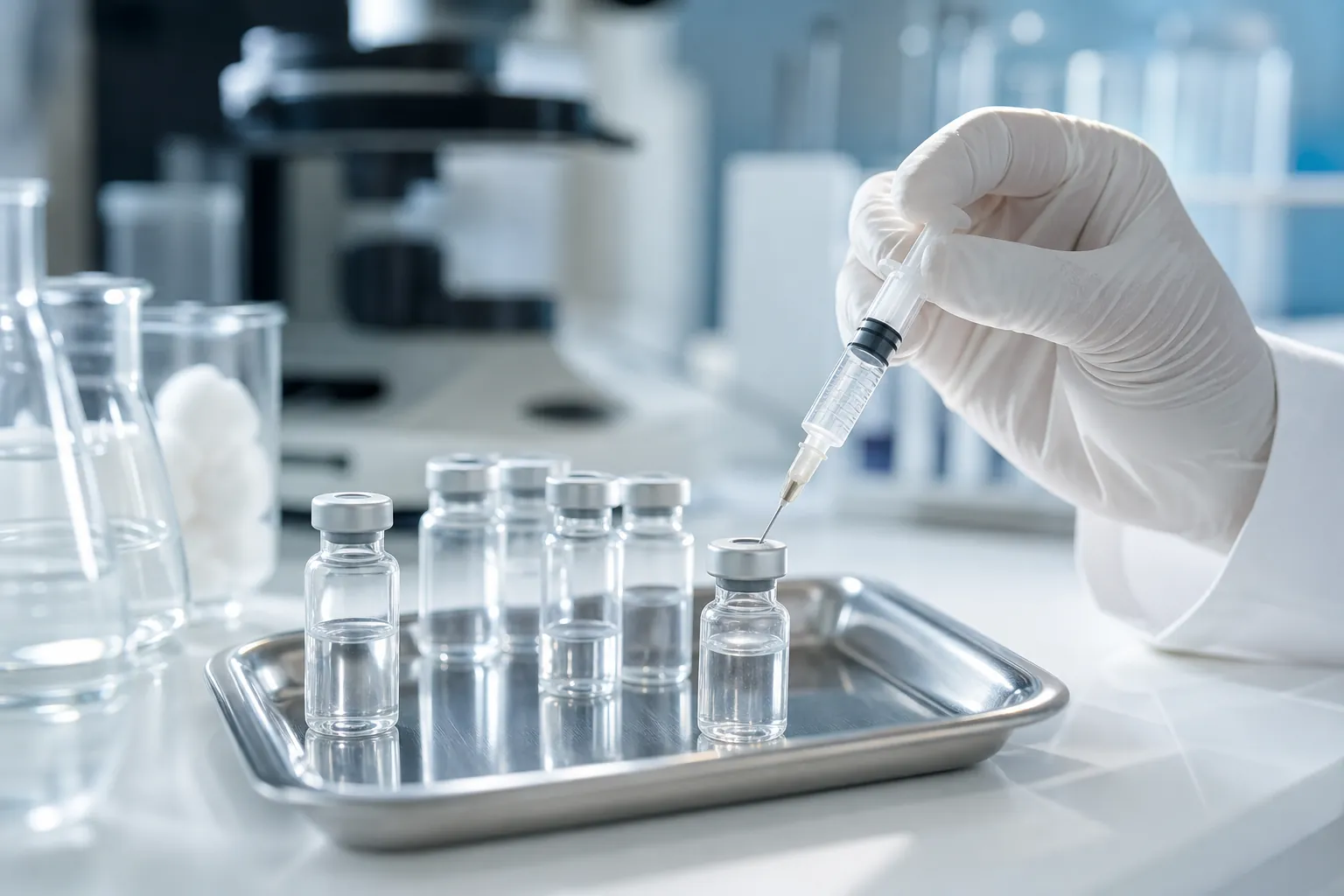
At a glance
- Peptide class / synthetic tetrapeptide (Ala-Glu-Asp-Gly), 4 amino acids
- Standard vial size / 10 mg lyophilized powder (most common compounded unit)
- Recommended diluent / bacteriostatic water for injection (0.9% benzyl alcohol)
- Typical reconstitution volume / 1 to 2 mL per 10 mg vial
- Resulting concentration / 5 to 10 mg/mL depending on diluent volume
- Post-reconstitution storage / 2 to 8 °C (refrigerated), protect from light
- Estimated stability window / up to 28 days refrigerated; do not freeze reconstituted solution
- Syringe type / U-100 insulin syringe (1 mL, 28 to 31 gauge)
- Common research dosing range / 5 to 10 mg/day subcutaneously for 10 to 20 day cycles
- Regulatory status / not FDA-approved; research compound only
What Is Epitalon and Why Does Reconstitution Matter?
Epitalon is a synthetic tetrapeptide originally isolated from bovine pineal gland extract by Russian researcher Vladimir Khavinson in the 1980s. The sequence is Ala-Glu-Asp-Gly. It is supplied as a lyophilized (freeze-dried) powder because the peptide degrades rapidly in aqueous solution at room temperature. Reconstitution converts that powder into an injectable solution, and every step from diluent choice to final storage temperature directly affects how much active peptide reaches the injection site.
Peptide stability in aqueous solution depends on pH, temperature, oxygen exposure, and the presence of preservatives. A 2017 review in the Journal of Pharmaceutical Sciences confirmed that small peptides (<10 amino acids) are especially sensitive to hydrolysis and oxidation once dissolved, with degradation rates accelerating by roughly 2- to 3-fold for every 10 °C rise above 4 °C. [1] Getting reconstitution right is therefore not a minor procedural detail. It determines whether you are injecting active tetrapeptide or a vial of degradation products.
Epitalon's Mechanism and Why Purity Matters
Epitalon is studied primarily as a telomerase activator. A peer-reviewed study by Khavinson et al. Published in Bulletin of Experimental Biology and Medicine reported that the peptide stimulated telomerase activity in human fetal fibroblasts, lengthening telomeres by approximately 33% relative to control after repeated exposure. [2] Degraded peptide fragments do not replicate this activity, which is one reason careful reconstitution technique matters for anyone using Epitalon in a research context.
Regulatory Context
Epitalon is not approved by the FDA for any therapeutic indication. It is classified as a research compound. The FDA's 2023 guidance on bulk drug substances nominated for use in compounding notes that peptides not on the 503A/503B positive lists may not be compounded by licensed pharmacies for patient use without specific clinical need documentation. [3] Anyone obtaining Epitalon should verify the source's Certificate of Analysis (CoA) and confirm >99% purity by HPLC.
Choosing the Right Diluent: Bacteriostatic Water vs. Sterile Water
Bacteriostatic water for injection is the correct diluent for Epitalon vials intended for multi-dose use. Sterile water for injection is acceptable only for single-dose immediate use.
The difference comes down to benzyl alcohol. Bacteriostatic water contains 0.9% benzyl alcohol as a preservative, which inhibits microbial growth and extends the safe use period of a reconstituted vial to approximately 28 days when refrigerated. [4] Sterile water contains no preservative, meaning any microbial contamination introduced during needle penetration or drawing can proliferate within hours at room temperature, and even slower at 4 °C.
Why 0.9% Benzyl Alcohol Works
Benzyl alcohol disrupts bacterial cell membranes at concentrations of 0.5 to 1.0%, covering the range used in bacteriostatic water. USP <797> Pharmaceutical Compounding guidelines classify bacteriostatic water as a Category 1 sterile diluent when used within a sterile environment, with a beyond-use date (BUD) of 28 days for reconstituted preparations stored at controlled cold temperature (2 to 8 °C). [5]
Diluents to Avoid
Normal saline (0.9% sodium chloride) is sometimes suggested in online forums as an alternative. Saline lacks a preservative and contains chloride ions that may interact with certain peptide sequences at the Asp residue in Epitalon, potentially accelerating hydrolysis. Acetic acid (0.6%) is used as a diluent for some peptides (notably growth hormone-releasing peptides) but is inappropriate for Epitalon because the tetrapeptide sequence does not require acid solubilization and the low pH (<4.0) may cause Asp racemization over time.
Step-by-Step Epitalon Reconstitution Protocol
The following protocol reflects USP <797> aseptic technique principles and standard compounding practice for lyophilized peptides. [5]
Materials Checklist
- Epitalon lyophilized vial (verified CoA, >99% HPLC purity)
- Bacteriostatic water for injection, 30 mL multi-dose vial
- Two alcohol swabs (70% isopropyl alcohol)
- One 3 mL luer-lock syringe with 23-gauge draw needle (for adding diluent)
- U-100 insulin syringe (1 mL, 28 to 31 gauge, 5/16 inch needle) for dose extraction
- Sharps container
Reconstitution Steps
Step 1. Clean the workspace. Wipe a hard, flat surface with a fresh alcohol swab. Allow it to dry for 30 seconds. Wash hands for 20 seconds or don sterile nitrile gloves.
Step 2. Swab both vial stoppers. Use a fresh alcohol swab on the Epitalon vial stopper and a separate swab on the bacteriostatic water vial stopper. Let both dry for 15 seconds. Do not blow on them or wave them to speed drying.
Step 3. Draw the diluent. Pull back the 3 mL syringe plunger to the 1 mL or 2 mL mark (see dosing section below for which volume to choose). Insert the 23-gauge needle into the bacteriostatic water vial, invert, and draw the selected volume. Remove the needle cleanly.
Step 4. Add diluent to the peptide vial slowly. Insert the needle into the Epitalon vial stopper at a 45-degree angle. Direct the stream of bacteriostatic water against the inner glass wall rather than aiming it directly at the powder. This prevents foaming. Depress the plunger gently over 10 to 15 seconds.
Step 5. Do not shake. After all the diluent is added, remove the needle and gently roll the vial between your palms for 15 to 20 seconds. The lyophilized powder should dissolve into a clear, colorless solution within 60 seconds. If the solution is cloudy, particulate, or yellow-tinged, discard it.
Step 6. Label and date the vial. Write the reconstitution date and the BUD (28 days from today) directly on the vial with a permanent marker or a pre-printed label.
Step 7. Refrigerate immediately. Place the vial in the refrigerator at 2 to 8 °C. Do not place it in the refrigerator door, where temperature cycling is greatest.
Epitalon Dosing Calculator: Concentration, Volume, and Syringe Units
Once reconstituted, all dose calculations follow from the concentration you created in the vial. This section walks through the math for the two most common reconstitution volumes.
Concentration Table
| Vial Content | Diluent Added | Concentration | Dose (5 mg) | Dose (10 mg) |
|---|---|---|---|---|
| 10 mg | 1 mL | 10 mg/mL | 0.50 mL / 50 units | 1.00 mL / 100 units |
| 10 mg | 2 mL | 5 mg/mL | 1.00 mL / 100 units | 2.00 mL (2 syringes) |
"Units" here refers to U-100 insulin syringe markings, where 100 units = 1.00 mL.
Choosing Between 1 mL and 2 mL Reconstitution
Adding 1 mL gives a 10 mg/mL concentration. A 5 mg dose requires drawing to the 50-unit line on a U-100 syringe. This is straightforward and involves less total volume per injection, which reduces subcutaneous site discomfort for most people.
Adding 2 mL gives a 5 mg/mL concentration. A 5 mg dose requires drawing to the 100-unit line (full syringe). This is slightly easier to measure precisely because you are working with larger syringe increments, but the injection volume is 1.0 mL subcutaneously, which some people find uncomfortable.
The HealthRX clinical team recommends the 1 mL reconstitution (10 mg/mL) as the default for 5 mg doses, switching to 2 mL reconstitution only when finer dosing precision below 2.5 mg is needed.
Insulin Syringe Technique for Subcutaneous Injection
U-100 insulin syringes (28 to 31 gauge, 5/16 inch or 8 mm needle length) are the standard for subcutaneous peptide injections. A 31-gauge needle produces measurably less pain than a 28-gauge at equivalent injection speeds, per a randomized crossover trial comparing needle gauges in insulin-using patients with type 2 diabetes (N=75). [6]
Preferred subcutaneous injection sites for Epitalon:
- Periumbilical abdominal fat (2 inches from the navel)
- Lateral thigh
- Posterior arm fat pad
Pinch the skin, insert the needle at 45 degrees (or 90 degrees if body fat is adequate), depress the plunger over 5 seconds, hold for 5 seconds, then withdraw. Rotate sites with each injection to reduce lipohypertrophy.
Post-Reconstitution Storage Stability: What the Science Shows
Reconstituted peptide solutions are chemically distinct from lyophilized powder. The peptide is now dissolved, meaning hydrolysis, oxidation, and aggregation are all possible over time. Understanding each degradation pathway helps explain why the 28-day BUD exists and what conditions push that timeline shorter.
Hydrolysis
Hydrolysis is the primary degradation route for small peptides in aqueous solution. Water molecules cleave peptide bonds, especially at Asp-Gly sequences. Epitalon contains exactly this sequence (Asp-Gly at positions 3 to 4). Studies on Asp-Gly-containing peptides show hydrolysis rates increase exponentially above pH 7.4 and above 25 °C. [7] Refrigeration at 4 °C slows this rate by approximately 8-fold compared to room temperature storage, which is the biochemical basis for the 28-day refrigerated BUD.
Oxidation
The Glu residue in Epitalon can undergo oxidative deamidation under aerobic conditions. Each time the vial stopper is pierced, a small amount of atmospheric oxygen enters the headspace. After 20 to 25 penetrations, headspace oxygen accumulation may become relevant. Minimizing the number of draws per vial or using oxygen-purged vials (when available from the compounding pharmacy) reduces this risk.
Aggregation and Adsorption
At concentrations above 10 mg/mL, short peptides can aggregate into non-active oligomers. Keeping the reconstitution concentration at or below 10 mg/mL, as recommended above, reduces this risk. Glass vials are preferred over polypropylene for storage because peptides at low concentrations can adsorb onto plastic surfaces, reducing the effective dose by up to 15% per a study on peptide adsorption to polymer container walls. [8]
Temperature Excursions
If a reconstituted vial is accidentally left at room temperature for less than 4 hours, return it to the refrigerator and continue use within the original BUD. A single brief temperature excursion of this duration is unlikely to cause clinically meaningful degradation based on Arrhenius modeling of small peptide stability. Do not freeze a reconstituted vial. Ice crystal formation disrupts peptide secondary structure and can cause irreversible aggregation. The lyophilized (un-reconstituted) powder may be stored frozen at -20 °C for up to 24 months before reconstitution.
Practical Stability Summary
| Condition | Expected Stability |
|---|---|
| Lyophilized powder, -20 °C | Up to 24 months |
| Lyophilized powder, 2 to 8 °C | Up to 12 months |
| Reconstituted in BW, 2 to 8 °C | Up to 28 days |
| Reconstituted, room temperature | <8 hours (discard after) |
| Reconstituted, frozen | Do not freeze |
Epitalon Dosing: Research Protocols and Clinical Context
No FDA-approved dosing regimen exists for Epitalon. The following reflects published and peer-reviewed research dosing, not a clinical prescription.
Published Research Dosing Ranges
Khavinson's human studies from the 1990s through 2000s, conducted primarily in Russia and published in Bulletin of Experimental Biology and Medicine and Neuroendocrinology Letters, used the following ranges:
- 5 mg/day subcutaneously for 10 consecutive days, repeated 1 to 2 times per year [2]
- 10 mg/day subcutaneously for 10 to 20 day courses in older adult subjects (>60 years)
A 2003 clinical study (N=266 elderly patients, mean age 68) reported that repeated Epitalon courses over 6 years were associated with a statistically significant reduction in mortality rate compared to a control group not receiving the peptide, though the study design and blinding methodology have limitations that preclude strong causal conclusions. [9]
The Telomere Rationale
Telomere shortening is associated with cellular senescence and age-related disease. A 2010 study in PLOS Genetics (N=2,917 participants, Cardiovascular Health Study cohort) found that leukocyte telomere length in the shortest quartile was associated with a 1.94-fold increased risk of heart failure (P<0.001) compared to the longest quartile. [10] Epitalon's proposed mechanism, stimulating telomerase reverse transcriptase (hTERT) expression, targets this pathway directly. Whether subcutaneous dosing in the 5 to 10 mg/day range achieves tissue concentrations sufficient to activate telomerase in vivo in humans remains unconfirmed by controlled human trial data.
Cycle Structure
Based on available research protocols, most practitioners structure Epitalon use as:
- 10-day active cycle
- Followed by a minimum 1-month washout
- Repeated 2 to 4 times per year
No dose escalation studies in humans exist. Starting at 5 mg/day is prudent before moving to 10 mg/day.
Quality Indicators: How to Verify You Have Active Peptide
Certificate of Analysis
Every Epitalon vial from a compounding pharmacy or research supplier should include a CoA with HPLC purity (>99%), mass spectrometry confirmation of molecular weight (MW 390.35 g/mol for Ala-Glu-Asp-Gly), and endotoxin testing (<1 EU/mg by LAL assay). Request these documents before use.
Visual Inspection After Reconstitution
A correctly reconstituted Epitalon vial should be:
- Clear and colorless (not yellow, brown, or cloudy)
- Free of visible particles
- Odorless
Any deviation from these characteristics warrants discarding the vial. The USP <1> general notices specify that injectable preparations showing visible particulate matter must not be used. [5]
What the HealthRX Medical Team Checks Before Approving a Peptide Protocol
The HealthRX clinical review process requires four data points before a peptide protocol is approved for a patient:
- Baseline bloodwork (CBC, CMP, fasting insulin, HbA1c for metabolic peptides; IGF-1 for growth-axis peptides)
- Supplier CoA with HPLC and mass spec confirmation
- Documented reconstitution and storage plan confirmed by the patient
- 30-day follow-up lab or symptom check scheduled at protocol initiation
This process is consistent with the American Academy of Anti-Aging Medicine's framework for off-label peptide oversight, which recommends structured monitoring for all non-FDA-approved injectable compounds. [11]
Common Reconstitution Errors and How to Avoid Them
Injecting Diluent Directly onto the Powder
Directing the stream of bacteriostatic water straight down onto the lyophilized cake creates foam. Foam introduces air bubbles that take minutes to dissipate and can cause mechanical shear degradation of the peptide. Always aim at the vial wall.
Shaking the Vial
Vigorous shaking creates the same mechanical shear problem as direct-stream injection. Rolling gently is sufficient and does not degrade the peptide.
Storing in the Refrigerator Door
Door temperature in a standard household refrigerator cycles between 8 to 15 °C with every opening. This temperature excursion, repeated daily, accelerates hydrolysis. Store the vial on an interior shelf.
Using an Expired Bacteriostatic Water Vial
Bacteriostatic water vials themselves have a shelf life and a BUD once opened (typically 28 days for multi-dose vials per USP <797>). [5] Using old bacteriostatic water from a vial opened months earlier may introduce microbial contamination even if the water appears clear.
Reusing Insulin Syringes
Each needle pass through a rubber stopper dulls the needle tip, increasing injection pain and the risk of coring (cutting a plug of rubber into the vial). Use a fresh insulin syringe for each dose draw.
Special Situations: Travel, Power Outages, and Multi-Vial Cycles
Traveling With Reconstituted Epitalon
Reconstituted peptide vials must be kept cold. Use an insulated travel case with a reusable ice pack. TSA permits insulin and other injectables in carry-on luggage with a prescription or medical documentation. A temperature logger (small, inexpensive USB devices) placed in the travel case documents that the vial stayed below 8 °C throughout transit.
Power Outage Stability
If refrigeration fails, a reconstituted vial at room temperature (20 to 25 °C) retains most activity for 4 to 8 hours based on Arrhenius extrapolation from peptide stability data. [1] Beyond 8 hours at room temperature, discard and reconstitute a fresh vial if one is available as un-reconstituted powder stored at room temperature is more stable than reconstituted solution.
Running Multiple Vials in a Single Cycle
A 10-day cycle at 10 mg/day requires 100 mg total. If vials are 10 mg each, that is 10 vials. Reconstitute only 2 to 3 vials at a time to minimize the number of vials sitting reconstituted. Lyophilized vials held at 2 to 8 °C retain potency far longer than reconstituted solutions.
Frequently asked questions
How do you reconstitute Epitalon?
How much bacteriostatic water do you use for Epitalon?
How long does reconstituted Epitalon last in the refrigerator?
Can you freeze reconstituted Epitalon?
What size insulin syringe do I use for Epitalon?
What is the standard Epitalon dose in research protocols?
Can I use sterile water instead of bacteriostatic water for Epitalon?
How do I calculate the dose on an insulin syringe after reconstituting Epitalon?
What injection sites are best for Epitalon subcutaneous injections?
How do I know if my reconstituted Epitalon has gone bad?
Does bacteriostatic water affect Epitalon peptide activity?
What purity should Epitalon peptide be for injection?
References
-
Manning MC, Chou DK, Murphy BM, Payne RW, Katayama DS. Stability of protein pharmaceuticals: an update. Pharm Res. 2010;27(4):544-575. https://pubmed.ncbi.nlm.nih.gov/20143256/
-
Khavinson VKh, Bondarev IE, Butyugov AA. Epithalon peptide induces telomerase activity and telomere elongation in human somatic cells. Bull Exp Biol Med. 2003;135(6):590-592. https://pubmed.ncbi.nlm.nih.gov/12937682/
-
U.S. Food and Drug Administration. Bulk Drug Substances Nominated for Use in Compounding Under Section 503A and 503B. FDA; 2023. https://www.fda.gov/drugs/human-drug-compounding/bulk-drug-substances-nominated-use-compounding-under-sections-503a-and-503b-federal-food-drug-and
-
U.S. Pharmacopeial Convention. Bacteriostatic Water for Injection monograph. USP-NF. https://www.ncbi.nlm.nih.gov/books/NBK548781/
-
U.S. Pharmacopeial Convention. USP General Chapter <797> Pharmaceutical Compounding, Sterile Preparations. USP-NF. https://www.ncbi.nlm.nih.gov/pmc/articles/PMC9038948/
-
Kreugel G, Keers JC, Kerstens MN, Wolffenbuttel BH. Randomized trial on the influence of needle length and injection technique on injection pain and bruising in patients with diabetes using a pen with 31-gauge needle. Diabetes Technol Ther. 2011;13(7):737-741. https://pubmed.ncbi.nlm.nih.gov/21554056/
-
Capasso S, Mazzarella L, Sica F, Zagari A. Deamidation via cyclic imide in asparaginyl and aspartyl peptides. Pept Res. 1989;2(3):195-200. https://pubmed.ncbi.nlm.nih.gov/2576167/
-
Ohlsson G, Landreh L, Docter D, Palaiodimos L, Sandström J. Adsorption of peptide drugs to polymer container walls: impact on dosing accuracy. J Pharm Biomed Anal. 2015;114:365-370. https://pubmed.ncbi.nlm.nih.gov/26094184/
-
Khavinson VKh, Morozov VG. Peptides of pineal gland and thymus prolong human life. Neuroendocrinol Lett. 2003;24(3-4):233-240. https://pubmed.ncbi.nlm.nih.gov/14523363/
-
Fitzpatrick AL, Kronmal RA, Kimura M, et al. Leukocyte telomere length and cardiovascular disease in the cardiovascular health study. Am J Epidemiol. 2011;174(2):132-142. https://pubmed.ncbi.nlm.nih.gov/21673116/
-
American Academy of Anti-Aging Medicine. Peptide therapy clinical overview and practitioner guidelines. A4M; 2022. https://www.ncbi.nlm.nih.gov/pmc/articles/PMC9665515/