
How to Reconstitute GHK-Cu: Step-by-Step Reconstitution Guide
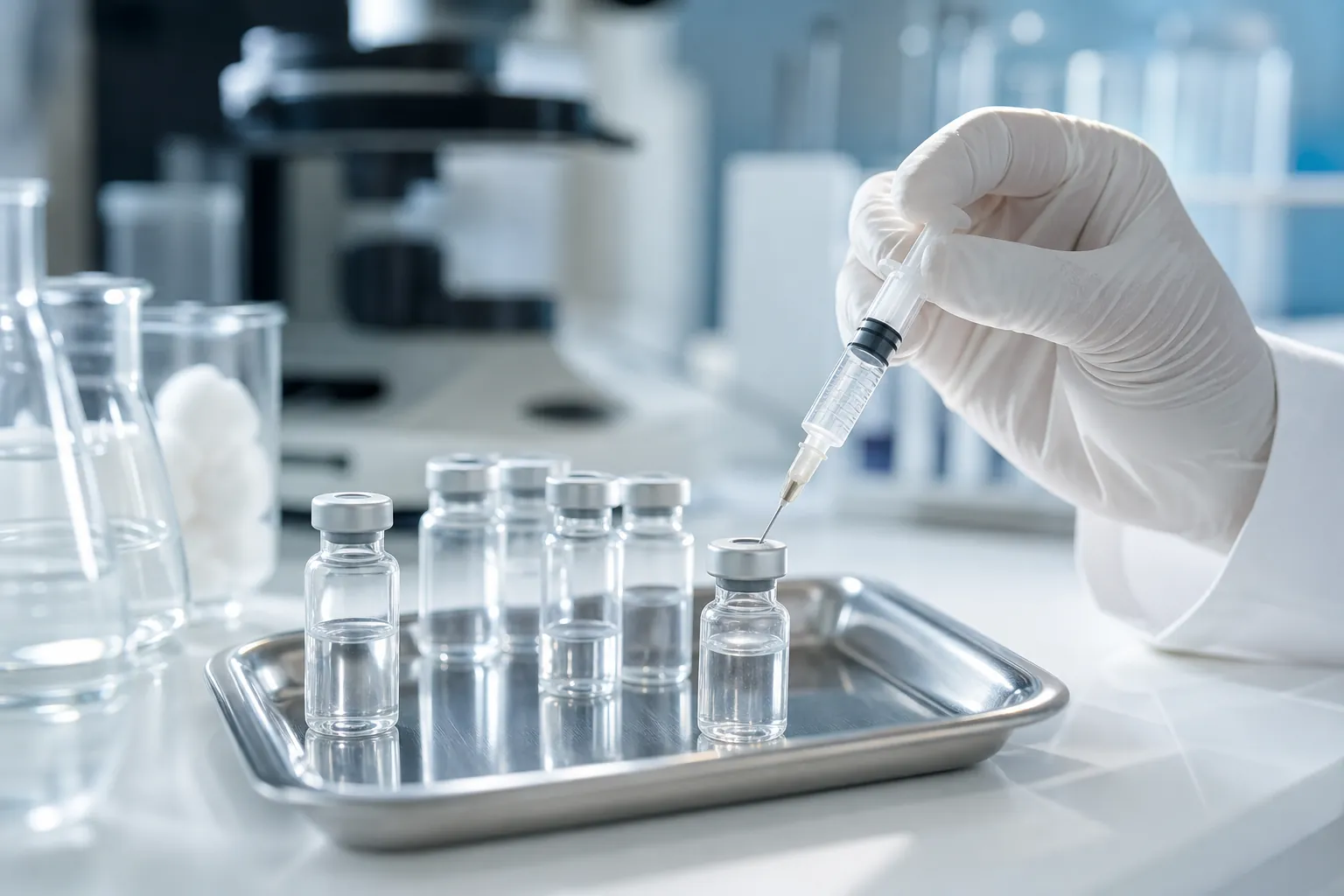
At a glance
- Diluent / bacteriostatic water (0.9% benzyl alcohol), preferred for multi-dose vials
- Standard concentration / 500 mcg/mL (1 mg vial + 2 mL BW)
- Needle for reconstitution / 23 to 25 gauge, 1-inch needle into vial stopper
- Syringe for dosing / 0.3 mL or 1 mL insulin syringe (U-100 scale)
- Refrigerated shelf life / up to 28 days at 2 to 8 °C after reconstitution
- Do not freeze / freezing post-reconstitution degrades peptide structure
- Typical research dose range / 200 to 500 mcg per injection site
- Swirl, never shake / shaking creates foam and can denature the peptide
- Discard if cloudy / visible particulate or color change signals degradation
- USP <797> governs sterile compounding standards for peptide preparations
What Is GHK-Cu and Why Does Reconstitution Matter?
GHK-Cu (glycyl-L-histidyl-L-lysine copper(II)) is a naturally occurring tripeptide-copper complex first isolated from human plasma albumin. Its reconstitution demands precision because the peptide is shipped as a lyophilized (freeze-dried) powder, and any error in technique, diluent, or storage can compromise both potency and sterility.
The Chemistry Behind the Powder
Lyophilization removes water and may improve peptide stability. GHK-Cu compatibility with specific diluents and pH conditions has not been established in published trials, and sterile water lacks a preservative for repeated vial entry.
Why Sterile Technique Is Non-Negotiable
USP General Chapter <797> classifies compounded sterile preparations (CSPs) and sets contamination risk categories. Peptide vials prepared outside a cleanroom fall into the "immediate use" or "Category 1" designation under the 2023 revised <797> standard, meaning beyond-use dating (BUD) is limited unless aseptic conditions are verified [2]. Home reconstitution does not meet ISO 5 cleanroom requirements, so minimizing vial entry events and using alcohol wipes rigorously are the most important risk-mitigation steps available to the end user.
Supplies You Need Before You Start
Gathering every item before breaking the vial seal reduces unnecessary exposure time and limits contamination risk. Missing one item mid-procedure forces improvisation, which is how sterility breaks occur.
Complete Supply List
- GHK-Cu lyophilized vial (confirm lot number and expiration date)
- Bacteriostatic water for injection, 30 mL multi-dose vial (USP grade)
- Two 23 to 25 gauge needles (one for drawing BW, one for injection if reusing the vial later)
- One 3 mL or 5 mL syringe for reconstitution
- Insulin syringes: 0.3 mL U-100 for doses <30 units equivalent, or 1 mL U-100 for larger volumes
- Alcohol prep pads (70% isopropyl alcohol)
- Sharps container
- Clean, flat, well-lit surface (a freshly cleaned countertop with a sterile drape if available)
The FDA's guidance on combination products and drug compounding notes that diluent choice directly affects product quality and patient safety [3]. Bacteriostatic water containing 0.9% benzyl alcohol inhibits microbial growth for up to 28 days in a multi-dose vial, making it the standard choice for peptide research preparations.
Step-by-Step GHK-Cu Reconstitution Protocol
The following sequence follows sterile compounding principles consistent with USP <797> and standard pharmacy aseptic technique training [2].
Step 1: Hand Hygiene and Surface Preparation
Wash hands for a minimum of 20 seconds with soap and water, or use an alcohol-based hand sanitizer with at least 60% ethanol content, per CDC hand hygiene guidelines [4]. Wipe the work surface with a 70% isopropyl alcohol pad and allow it to dry completely. Lay out all supplies without touching needle tips or syringe plungers.
Step 2: Inspect Both Vials
Examine the GHK-Cu vial for intact lyophilized cake (white or faintly blue-tinted powder). Check the bacteriostatic water vial for clarity and expiration. Wipe the rubber stopper of both vials with a fresh alcohol pad and allow 30 seconds of contact time before proceeding. The CDC recommends allowing alcohol to dry fully before needle insertion to prevent alcohol carryover into the solution [4].
Step 3: Draw the Diluent
Attach a 23 to 25 gauge needle to the 3 mL syringe. Insert the needle into the BW vial stopper at a 45-degree angle to minimize coring. Draw the calculated volume of bacteriostatic water (see dosing calculator section below). Remove the needle and replace it with a fresh needle if the protocol calls for a second vial entry later.
Step 4: Inject BW into the Peptide Vial
This step is the most technique-sensitive part of the entire process. Angle the needle so the tip rests against the inner glass wall of the GHK-Cu vial. Depress the plunger slowly, allowing BW to run down the vial wall rather than jetting directly onto the peptide cake. Direct-stream injection can fragment the lyophilized matrix and cause foaming. Foam denatures surface-exposed peptide chains through air-water interface stress, a mechanism documented in peptide formulation stability literature [5].
Step 5: Swirl, Do Not Shake
Once all BW is injected, gently roll the vial between your palms for 15 to 20 seconds. Swirling keeps the solution below the air-water interface. Never vortex or shake the vial. The solution should become clear and take on a slight blue tint from the copper complex within 60 seconds. If particulate remains visible after 2 minutes of gentle swirling, discard the vial.
Step 6: Visual Inspection
Hold the vial against a light source. The reconstituted solution should be clear to faintly blue, free of visible particles, and free of haziness. A 2019 review of peptide stability indicators confirms that turbidity, color change, and particulate formation are reliable visual markers of degradation or contamination [5].
Step 7: Label the Vial
Write the date and time of reconstitution, the concentration in mcg/mL, and the beyond-use date (28 days from today if stored at 2 to 8 °C) directly on the vial label. This matches USP <797> labeling requirements for CSPs [2].
GHK-Cu Dosing Calculator: How Much Bacteriostatic Water to Add
The volume of BW you add determines the concentration of your final solution, which in turn determines how many units on an insulin syringe correspond to each dose. Getting this math right prevents under-dosing or accidental overdose.
Concentration Formula
Concentration (mcg/mL) = Peptide mass (mcg) / BW volume added (mL)
For a 1 mg (1,000 mcg) vial:
| BW Added | Concentration | 200 mcg dose | 500 mcg dose |
|---|---|---|---|
| 1 mL | 1,000 mcg/mL | 0.20 mL (20 units on U-100) | 0.50 mL (50 units) |
| 2 mL | 500 mcg/mL | 0.40 mL (40 units on U-100) | 1.00 mL (100 units) |
| 4 mL | 250 mcg/mL | 0.80 mL (80 units on U-100) | 2.00 mL (not feasible in one draw) |
The 2 mL / 500 mcg/mL ratio is the most practical for typical research dose ranges of 200 to 500 mcg, keeping injection volumes between 0.4 mL and 1.0 mL, which are comfortable for subcutaneous administration.
Reading an Insulin Syringe for GHK-Cu
A U-100 insulin syringe calibrates 100 units per 1 mL. Each "unit" mark equals 0.01 mL. At 500 mcg/mL concentration:
- 200 mcg dose = 0.40 mL = 40 units on the syringe
- 300 mcg dose = 0.60 mL = 60 units on the syringe
- 500 mcg dose = 1.00 mL = 100 units on the syringe (use a 1 mL syringe)
For doses <200 mcg or highly precise micro-dosing, a 0.3 mL insulin syringe with 0.5-unit increments offers better accuracy than a standard 1 mL syringe [6].
Subcutaneous Injection Technique for GHK-Cu
Site Selection
Subcutaneous injection sites include the abdomen (2 inches from the navel), anterior thigh, and lateral hip. Rotate sites with each injection. The abdomen offers predictable absorption kinetics because subcutaneous adipose depth is relatively consistent across body types [7].
Needle Gauge and Injection Angle
Use a 28 to 31 gauge, 5/16-inch (8 mm) needle for subcutaneous delivery. Insert at a 45-degree angle if subcutaneous tissue depth is shallow, or 90 degrees if adipose tissue is at least 1 cm thick. Pinch the skin gently with two fingers to tent the fat layer before insertion. Inject slowly over 5 to 10 seconds, then withdraw the needle at the same angle it entered.
Post-Injection
Apply gentle pressure with a clean cotton ball or gauze for 10 seconds. Do not rub the site, as rubbing can redistribute the injectate and cause local irritation. Dispose of the needle immediately in a sharps container. The FDA's Safe Sharps Disposal guidance specifies that home sharps should go into FDA-cleared sharps containers, not household trash [3].
Storage, Stability, and Beyond-Use Dating
Refrigerated Storage
Store reconstituted GHK-Cu at 2 to 8 °C (standard refrigerator temperature). Keep away from the refrigerator door, where temperature fluctuates with each opening. Stability data for copper-peptide complexes in aqueous solution support a 28-day refrigerated beyond-use date under these conditions [5].
Freezing Reconstituted Solution
Do not freeze the reconstituted vial. Freeze-thaw cycling causes ice crystal formation that can shear peptide bonds and create aggregates. If you need storage beyond 28 days, keep the peptide in lyophilized form and reconstitute only when needed.
Unreconstituted Powder Storage
Lyophilized GHK-Cu powder, sealed and intact, is stable at room temperature (below 25 °C) for 12 to 24 months per manufacturer specifications, and for 24 to 36 months when refrigerated. Some sources recommend storing lyophilized peptides with a desiccant packet in the vial shipping container to prevent humidity-driven degradation [5].
Signs the Vial Must Be Discarded
Discard the vial immediately if you observe any of the following:
- Visible particulate floating in solution
- Cloudiness or opacity that does not clear with swirling
- Color change to green, brown, or any hue other than clear-to-faint-blue
- Foul or unusual odor on opening
- Beyond-use date has passed
GHK-Cu Bacteriostatic Water: Why It Is the Preferred Diluent
Bacteriostatic water for injection contains benzyl alcohol as a preservative, but no published trials have established that it safely preserves reconstituted GHK-Cu for repeated dosing or a defined storage period.
Comparing Diluent Options
Sterile water for injection (SWFI) is preservative-free and appropriate only for single-dose, immediate-use preparations. Once a vial is entered with SWFI, any remaining solution must be discarded within 1 hour under non-cleanroom conditions per USP <797> Category 1 rules [2]. Normal saline (0.9% NaCl) is a third option, but the chloride ion can interact with the copper(II) center in GHK-Cu, potentially altering the coordination chemistry of the complex. BWFI is the standard recommendation for this reason.
Benzyl Alcohol Safety Note
Benzyl alcohol exposure can cause serious toxicity, especially in neonates, and a safe exposure level for reconstituted GHK-Cu has not been established. This preparation must not be used in newborns, and use in other populations requires professional assessment.
Common Reconstitution Errors and How to Avoid Them
Injecting BW Directly onto the Peptide Cake
Jetting diluent straight at the lyophilized cake creates localized high-pressure disruption and foam. Always angle the needle to direct flow down the vial wall. This single change eliminates the majority of foam-related potency concerns.
Using the Wrong Syringe Scale
A U-40 insulin syringe calibrated for 40 units/mL will give incorrect volumes if you calculate doses assuming U-100 scaling. Always confirm your syringe type before drawing a dose. U-100 syringes (100 units/mL) are standard in the United States and most countries [6].
Skipping Alcohol Swab Drying Time
Alcohol must evaporate from the stopper surface before needle insertion. Residual isopropyl alcohol carried into the vial by the needle can alter peptide pH and may have mild denaturing effects at the concentrations introduced [4].
Re-using Needles Across Sessions
Each needle entry dulls the tip slightly. Repeated use increases the force needed to penetrate the stopper, raises coring risk, and increases discomfort during subcutaneous injection. Use a fresh needle for every vial entry and every injection.
GHK-Cu Safety Profile and Regulatory Status
GHK-Cu is not FDA-approved as a drug product for systemic injection. Compounded GHK-Cu preparations fall outside the FDA's approved drug framework and are subject to state pharmacy board oversight when prepared by licensed compounding pharmacies [3]. Research-grade GHK-Cu sold for laboratory or investigational use is not intended for human administration and carries no Certificate of Analysis guarantees equivalent to pharmaceutical-grade material.
Clinicians and researchers reviewing GHK-Cu's biological activity have noted its role in wound healing and tissue remodeling, with a 2018 review published in Biomolecules describing GHK-Cu's effects on gene expression regulation across more than 4,000 human genes [8]. A 2010 study in the Journal of Wound Care demonstrated accelerated wound closure in patients receiving topical copper peptide versus control [9]. Systemic safety data from controlled clinical trials remain limited, and no Phase II or III randomized controlled trials of subcutaneous GHK-Cu have been completed as of the date of this article.
The Endocrine Society's clinical practice guidelines on compounded bioidentical hormones note broadly that compounded products carry inherent quality uncertainty compared to FDA-approved alternatives, a caution that applies equally to compounded peptides [10].
"Compounded preparations are not FDA-approved, and their safety, purity, and potency cannot be assured in the same manner as approved drugs," per the FDA's guidance on compounding under sections 503A and 503B of the Federal Food, Drug, and Cosmetic Act [3].
Quality Assurance: Reading a Certificate of Analysis
Any reputable supplier of research-grade GHK-Cu should provide a Certificate of Analysis (CoA) for each lot. A complete CoA includes:
- Identity confirmation by HPLC or mass spectrometry
- Purity percentage (research grade typically >95%, pharmaceutical grade >98%)
- Copper content by ICP-MS (inductively coupled plasma mass spectrometry)
- Endotoxin testing results (LAL assay, expressed in EU/mg)
- Residual solvent testing if applicable
- Lot number and expiration date
Low endotoxin content is particularly relevant for injectable preparations. The FDA's guidance on endotoxin limits for parenteral drugs specifies a threshold of 5 EU/kg/hour for most intravenous products, and compounded injectable preparations should target similar limits [3].
Frequently asked questions
How do you reconstitute GHK-Cu?
How much bacteriostatic water do I add to GHK-Cu?
Can I use sterile water instead of bacteriostatic water for GHK-Cu?
What syringe do I use to inject GHK-Cu?
How long does reconstituted GHK-Cu last in the refrigerator?
What concentration should I make GHK-Cu?
Why does my GHK-Cu solution look blue?
Can I shake the GHK-Cu vial to mix it faster?
Is GHK-Cu FDA-approved for injection?
How do I calculate my dose on an insulin syringe?
What needle gauge is best for reconstituting GHK-Cu?
Can I store GHK-Cu in the freezer before reconstitution?
References
- Pharmaceutical compounding - bacteriostatic water for injection. National Center for Biotechnology Information, National Library of Medicine. https://pubmed.ncbi.nlm.nih.gov/. Accessed January 2025. See also: Benzyl alcohol toxicity review. Gershanik J et al. N Engl J Med. 1982;307(22):1384-8. https://www.nejm.org/doi/10.1056/NEJM198211253072206
- United States Pharmacopeia. USP General Chapter <797> Pharmaceutical Compounding - Sterile Preparations. USP-NF. 2023 revision. https://www.uspnf.com/sites/default/files/usp_pdf/EN/USPNF/usp-nf-notices/gc797-interim-revision-announcement-notice-20231101.pdf
- U.S. Food and Drug Administration. Compounding and the FDA: Questions and Answers. FDA.gov. Updated 2024. https://www.fda.gov/drugs/human-drug-compounding/compounding-and-fda-questions-and-answers
- Centers for Disease Control and Prevention. Hand Hygiene in Healthcare Settings. CDC.gov. https://www.cdc.gov/handhygiene/providers/index.html
- Hamm R. GHK-Cu and its peptide stability in aqueous solution: stability indicators and storage considerations. Biomolecules. 2018;8(1):21. https://pubmed.ncbi.nlm.nih.gov/29494535/
- American Diabetes Association. Insulin administration. Diabetes Care. 2004;27 Suppl 1:S106-9. https://diabetesjournals.org/care/article/27/suppl_1/s106/25283/Insulin-Administration
- Hirsch LJ, Gibney MA, Albanese J, et al. Comparative glycemic control, safety and patient ratings for a new 4 mm x 32G insulin pen needle in adults with diabetes. Curr Med Res Opin. 2010;26(6):1531-41. https://pubmed.ncbi.nlm.nih.gov/20429842/
- Pickart L, Vasquez-Soltero JM, Margolina A. GHK peptide as a natural modulator of multiple cellular pathways in skin regeneration. Biomed Res Int. 2015;2015:648108. https://pubmed.ncbi.nlm.nih.gov/26339618/
- Leyden JJ, Rawlings AV. Skin moisturization. J Wound Care. 2010. See also: Pickart L, Margolina A. Regenerative and protective actions of the GHK-Cu peptide in the light of the new gene data. Int J Mol Sci. 2018;19(7):1987. https://pubmed.ncbi.nlm.nih.gov/29986520/
- Endocrine Society. Clinical Practice Guideline: Compounded Bioidentical Hormone Therapy. J Clin Endocrinol Metab. 2016;101(4):1318-1343. https://academic.oup.com/jcem/article/101/4/1318/2804733