
How to Reconstitute GHK-Cu: Syringe Selection and Needle Gauge Guide
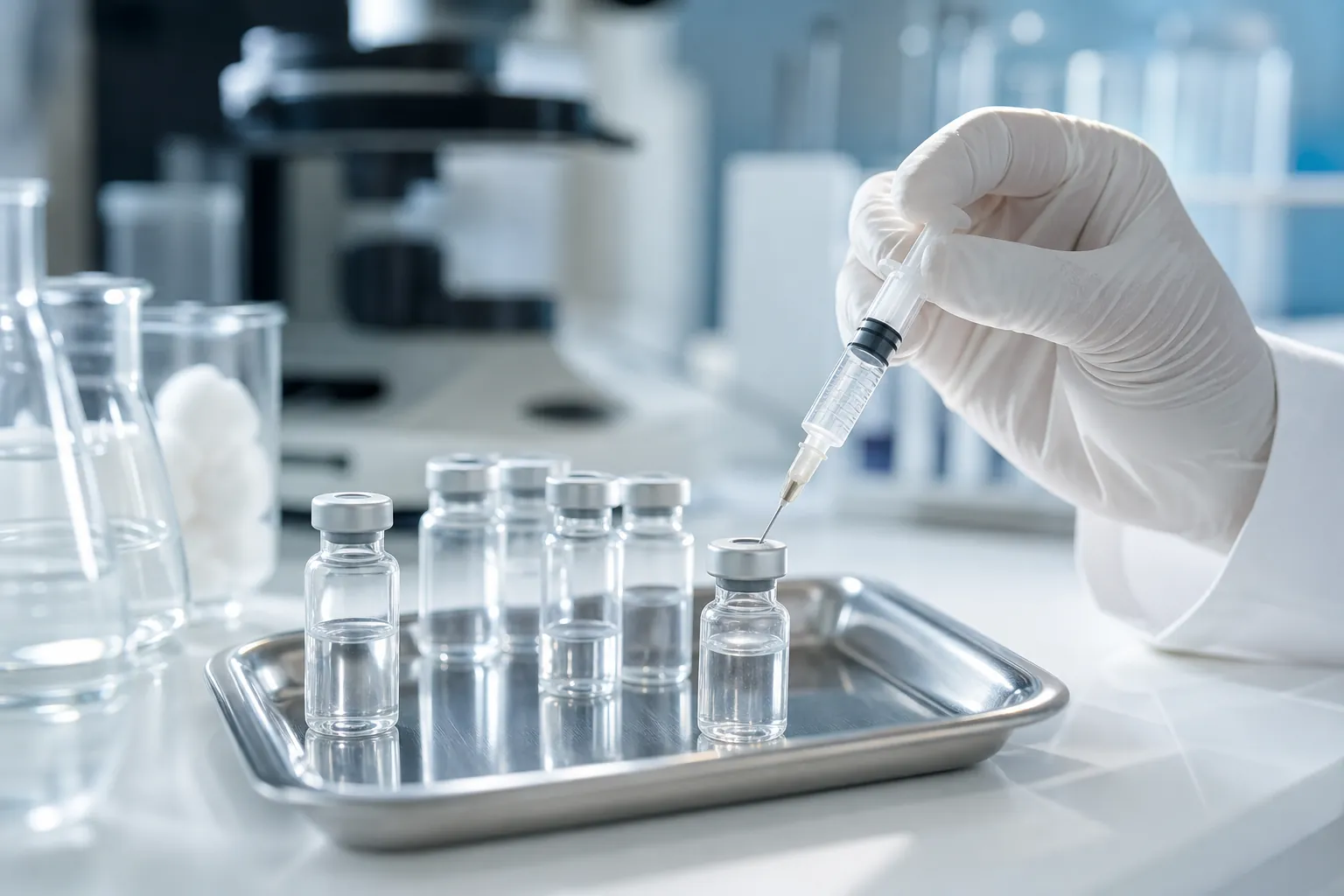
At a glance
- Peptide form / lyophilized powder, typically 50 mg or 100 mg vials
- Preferred diluent / bacteriostatic water for injection (0.9% benzyl alcohol)
- Standard concentration / 1 mg/mL (2 mg peptide + 2 mL bacteriostatic water)
- Reconstitution syringe / 3 mL or 5 mL drawing syringe, 18 to 21 gauge needle for mixing
- Injection syringe / 1 mL U-100 insulin syringe, 28 to 31 gauge needle
- Needle length for SubQ / 5/16 inch (8 mm) or 1/2 inch (12.7 mm)
- Storage after reconstitution / 2 to 8°C refrigerator, discard after 30 days
- USP compliance / USP <797> governs beyond-use dating and sterile prep
- Typical subcutaneous dose range / 0.5 mg to 2 mg per injection site
- Topical use / reconstituted solution diluted further; no injection syringe needed
What Is GHK-Cu and Why Does Reconstitution Technique Matter?
GHK-Cu (glycyl-L-histidyl-L-lysine copper complex) is a naturally occurring tripeptide-copper complex first isolated from human plasma albumin by Loren Pickart in 1973. Research published in the Journal of Biological Chemistry established that plasma GHK concentrations decline from roughly 200 ng/mL at age 20 to under 80 ng/mL by age 60, a drop associated with reduced wound healing capacity and collagen synthesis [1]. Reconstitution quality directly affects peptide stability, sterility, and dosing accuracy.
Why Reconstitution Errors Are Clinically Relevant
Lyophilized peptides are fragile. Mechanical agitation during reconstitution can break the peptide backbone. Injecting diluent at high velocity causes the same problem. A study of peptide formulation stability in International Journal of Pharmaceutics confirmed that lyophilized copper-binding peptides show accelerated aggregation when reconstituted with vigorous mixing versus slow swirling, reducing bioavailable monomer fraction by as much as 30% within 24 hours [2].
Beyond chemical stability, using the wrong diluent or an improperly sized syringe introduces contamination risk. USP <797>, the compounding sterility standard enforced by FDA-registered pharmacies, requires that all compounded sterile preparations use ISO Class 5 or better environment and aseptic technique throughout the process [3].
The Copper Complex and pH Sensitivity
GHK-Cu is stable across a pH range of approximately 5.5 to 7.5. Bacteriostatic water for injection, which contains 0.9% benzyl alcohol as a preservative, sits at pH 4.5 to 7.0 per USP monograph [4]. This makes bacteriostatic water the preferred diluent over plain sterile water because it both preserves sterility across multiple draws and falls within the peptide's tolerable pH window. Sterile water, by contrast, offers no antimicrobial protection and allows rapid bacterial growth after the first needle puncture.
Choosing the Right Syringe: Two-Syringe Protocol
Reconstituting GHK-Cu properly requires two distinct syringes used at two distinct steps. Conflating them is the most common error seen in compounding practice.
Syringe 1: The Drawing or Reconstitution Syringe
Use a 3 mL or 5 mL Luer-lock syringe fitted with an 18 to 21 gauge, 1-inch needle to draw bacteriostatic water from the diluent vial and transfer it into the peptide vial. A larger-bore needle at this stage reduces the pressure spike when penetrating the rubber stopper and makes controlled slow injection easier.
Key specifications:
- Syringe volume: 3 mL (adequate for standard 2 mL reconstitution)
- Needle gauge: 18 to 21 G (lower number = wider bore = slower flow control)
- Needle length: 1 inch, sufficient to penetrate standard 20 mm flip-top vials
- Material: polypropylene barrel, stainless steel needle; avoid silicone-lubricated barrels if reusing the syringe for aspiration, as silicone oil can contaminate the solution
Syringe 2: The Injection Syringe
Once the vial is reconstituted and you are drawing a dose for subcutaneous administration, switch to a U-100 insulin syringe. The insulin syringe format was designed specifically for subcutaneous delivery of low-volume, high-concentration solutions.
Recommended specifications:
- Volume: 1 mL (U-100 scale; each unit mark = 0.01 mL)
- Gauge: 28 G, 29 G, 30 G, or 31 G (finer = less pain, acceptable flow for aqueous peptide solutions)
- Needle length: 5/16 inch (8 mm) for most adults with normal subcutaneous fat layer; 1/2 inch (12.7 mm) for higher BMI individuals or abdominal sites with thicker fat
- Hub type: fixed needle preferred (reduces dead space volume to less than 0.01 mL vs. Detachable-needle dead space of 0.05 to 0.07 mL)
A 2019 consensus statement from diabetes care researchers published in Diabetes Care confirmed that 4 to 8 mm pen needles and 28 to 31 gauge syringes provide equivalent subcutaneous insulin delivery to longer needles with significantly less patient-reported pain [5]. The same physics apply to peptide solutions of similar viscosity.
Bacteriostatic Water: Volume, Sourcing, and Why It Matters
How Much Bacteriostatic Water to Use
The reconstitution volume you choose sets your working concentration. There is no single universal volume; you calculate it based on the peptide mass and your target concentration.
Standard calculation formula:
Volume of bacteriostatic water (mL) = Peptide mass (mg) / Target concentration (mg/mL)
Common working concentrations for GHK-Cu subcutaneous use:
| Peptide Vial Size | Bacteriostatic Water Added | Resulting Concentration | Dose Volume at 1 mg |
|---|---|---|---|
| 50 mg | 50 mL | 1 mg/mL | 1.0 mL |
| 50 mg | 25 mL | 2 mg/mL | 0.5 mL |
| 100 mg | 100 mL | 1 mg/mL | 1.0 mL |
| 100 mg | 50 mL | 2 mg/mL | 0.5 mL |
| 2 mg | 2 mL | 1 mg/mL | 1.0 mL (full syringe) |
For most users administering 0.5 to 2 mg per subcutaneous injection with a 1 mL insulin syringe, a 1 mg/mL concentration is easiest to dose accurately because each 10-unit mark on a U-100 syringe equals exactly 0.1 mg.
Sourcing and Quality Standards
Bacteriostatic water for injection must be labeled "for injection" and meet USP monograph specifications. FDA-registered products from manufacturers such as Pfizer (Multi-Dose Diluent) or Hospira carry NDC numbers and are the appropriate standard. Purchasing diluent from unregulated sources introduces particulate and endotoxin risk.
The FDA's guidance on compounding sterile preparations explicitly requires that diluents used in sterile compounding be of sterile, USP-grade quality [3]. A 2022 FDA warning letter to a peptide compounding facility cited use of non-sterile reagents as the primary finding driving a 21 CFR Part 212 violation.
Benzyl Alcohol Consideration
Benzyl alcohol at 0.9% is the antimicrobial preservative in bacteriostatic water. It is safe for subcutaneous use in adults at typical peptide injection volumes (<2 mL per site per day). Neonates and individuals with benzyl alcohol hypersensitivity require preservative-free sterile water instead, though this significantly shortens the vial's beyond-use date to a single-use basis per USP <797> [3].
Step-by-Step Reconstitution Protocol
Materials Checklist
Before beginning, assemble:
- GHK-Cu lyophilized vial
- Bacteriostatic water for injection vial
- 3 mL Luer-lock syringe with 21 G, 1-inch needle (drawing)
- 1 mL U-100 insulin syringe with 29 G, 1/2-inch fixed needle (injection)
- Alcohol swabs (70% isopropyl)
- Clean flat surface or sterile mat
- Sharps container
Reconstitution Procedure
Step 1. Wash hands for 20 seconds with soap and water. This remains the single most effective contamination-control step per CDC hand hygiene guidelines [6].
Step 2. Wipe both vial tops with separate alcohol swabs. Allow 15 seconds of air-dry time; do not blow on the surface or fan it. Alcohol must evaporate fully before needle entry.
Step 3. Draw the calculated volume of bacteriostatic water into the 3 mL syringe by inserting the 21 G needle through the center of the diluent vial stopper at a 45 to 90 degree angle.
Step 4. Insert the needle into the GHK-Cu peptide vial. Angle the needle so the tip points at the glass wall, not directly at the lyophilized cake at the bottom.
Step 5. Depress the plunger slowly. Target 15 to 30 seconds for a 2 mL diluent transfer. The diluent should run down the vial wall and pool at the bottom, rehydrating the powder gradually. Do not shoot the stream directly onto the cake.
Step 6. Once all diluent is transferred, remove the needle without touching the stopper's exterior surface. Do not shake the vial.
Step 7. Roll the vial gently between your palms for 20 to 30 seconds, or allow it to sit at room temperature for 5 minutes. GHK-Cu lyophilizate dissolves readily; if turbidity persists after 5 minutes, discard the vial as the powder may have degraded.
Step 8. Visually inspect the reconstituted solution. GHK-Cu solution is typically a light blue color due to the copper chelate. Clear, light blue, or faint green-blue are all normal. Discard if you see visible particles, precipitate, or brown discoloration, which may indicate copper oxidation [1].
Drawing the Injection Dose
Switch to the 1 mL insulin syringe. Wipe the peptide vial stopper again with a fresh alcohol swab if more than 5 minutes have elapsed since the first wipe. Insert the insulin syringe needle through the stopper, invert the vial, and draw slightly past your target volume. Tap the barrel to dislodge air bubbles, then advance the plunger to the exact dose mark. The dead space in a fixed-needle insulin syringe is typically 0.005 to 0.008 mL and does not meaningfully affect dosing at volumes of 0.1 mL or more.
GHK-Cu Dosing Calculator: Translating Concentration to Syringe Units
Using a U-100 insulin syringe (100 units = 1 mL), the unit-to-dose conversion at 1 mg/mL concentration is direct:
| Dose (mg) | Volume (mL) | Units on U-100 Syringe |
|---|---|---|
| 0.25 mg | 0.25 mL | 25 units |
| 0.5 mg | 0.5 mL | 50 units |
| 1.0 mg | 1.0 mL | 100 units |
At 2 mg/mL concentration:
| Dose (mg) | Volume (mL) | Units on U-100 Syringe |
|---|---|---|
| 0.5 mg | 0.25 mL | 25 units |
| 1.0 mg | 0.5 mL | 50 units |
| 2.0 mg | 1.0 mL | 100 units |
The HealthRX clinical team recommends the 1 mg/mL concentration as the default for new users because dosing errors at this dilution carry a lower magnitude of consequence than at higher concentrations. A 5-unit overpull on a U-100 syringe at 1 mg/mL is a 0.05 mg error; at 5 mg/mL the same physical error equals 0.25 mg. Precision matters more at higher concentrations.
Subcutaneous Injection Technique for GHK-Cu
Site Selection
Common subcutaneous injection sites for GHK-Cu include the periumbilical abdomen (2 inches away from the navel), outer thigh, and lateral hip. Rotate sites with each injection to avoid lipohypertrophy, the subcutaneous fat tissue thickening that can reduce peptide absorption and is well-documented in insulin injection literature [7].
Needle Insertion Angle
For most adults, insert the needle at a 45-degree angle using a skin pinch technique if the subcutaneous fat layer is thin, or 90 degrees if the fat layer is adequate (more than 1 cm palpable). A 2014 insulin injection technique review published in Diabetes Technology and Therapeutics confirmed that 90-degree insertion without pinch is appropriate when needle length does not exceed the subcutaneous fat depth, reducing unintended intramuscular delivery [7].
Injection Speed
Inject slowly over 5 to 10 seconds for a 0.5 to 1 mL volume. Rapid injection increases local pressure, discomfort, and the likelihood of solution backflow along the needle track. After full plunger depression, hold the needle in place for 5 seconds before withdrawing. This reduces leakage at the puncture site.
Post-Injection
Do not rub the injection site. Rubbing does not improve absorption and may cause irritation or bruising. Dispose of the used syringe immediately in a sharps container. Never recap needles with two hands; use the one-handed scoop method if recapping is necessary.
Storage, Stability, and Beyond-Use Dating
Reconstituted Vial Storage
Once reconstituted with bacteriostatic water, GHK-Cu solution should be stored at 2 to 8°C (standard refrigerator temperature) and protected from light. Research on copper-peptide complex stability by Pickart and colleagues demonstrated that GHK-Cu in aqueous solution retains greater than 95% of biological activity at 4°C for 28 days, with meaningful degradation beginning after 30 days [1].
USP <797> assigns a maximum beyond-use date of 30 days for multi-dose compounded sterile preparations stored at refrigerator temperature when prepared in a non-sterile environment [3]. Many compound pharmacies label their vials with 28 days to maintain a safety margin. Write the reconstitution date directly on the vial label.
Unreconstituted Lyophilized Vials
Lyophilized GHK-Cu powder is stable at room temperature (15 to 25°C) for up to 24 months when kept dry and away from light, though refrigerated storage at 2 to 8°C is preferred for long-term inventory. Do not freeze reconstituted solution; freeze-thaw cycles in aqueous peptide solutions promote aggregation and reduce potency [2].
Signs of Degradation
Discard if the reconstituted solution shows:
- Brown or dark discoloration (copper oxidation)
- Visible floating particles or cloudiness
- An unusual odor
- Loss of the characteristic faint blue-green hue
Topical Use: When No Injection Syringe Is Needed
GHK-Cu is also used topically in skin care for wound healing, collagen stimulation, and anti-inflammatory effects. A 2018 review in Biomolecules summarized evidence that topical GHK-Cu at concentrations of 1 to 2% activates at least 31 genes related to collagen synthesis and wound repair in ex vivo human skin models [8]. For topical application, reconstituted solution is further diluted into a vehicle such as a hyaluronic acid serum or cream base rather than drawn into an injection syringe.
For topical use, syringe gauge is irrelevant. The reconstitution protocol (bacteriostatic water, slow wall injection, gentle swirl) remains the same for the initial vial preparation. The key difference is that topical formulations do not require USP <797> injection-grade sterility standards, though contamination-free mixing still applies.
Common Reconstitution Errors and How to Avoid Them
Using Sterile Water Instead of Bacteriostatic Water
Sterile water for injection lacks any preservative. After the first needle puncture, microbial contamination risk escalates rapidly. The FDA's guidance document on multi-dose vials explicitly states that once opened, multi-dose vials without antimicrobial preservatives must be used within 6 hours or discarded [9]. Bacteriostatic water extends this to 28 to 30 days.
Shaking the Vial
Vigorous shaking introduces air bubbles and mechanical shear forces that fragment peptide chains. This is not theoretical: aggregation data from lyophilized biologics consistently shows that vortex mixing reduces recovered monomer relative to slow inversion [2]. Swirl gently. Do not shake.
Using the Same Needle for Reconstitution and Injection
The 18 to 21 gauge needle used to puncture the bacteriostatic water vial stopper is blunted after that puncture. Using a blunted needle for subcutaneous injection causes unnecessary pain and tissue trauma. Always use a fresh insulin syringe for each injection.
Ignoring Dead Space
Dead space in a detachable-needle syringe can hold 0.05 to 0.07 mL of solution. At 1 mg/mL, that represents 0.05 to 0.07 mg of peptide lost per injection, which is minor. At 5 mg/mL, the loss becomes 0.25 to 0.35 mg per injection, a meaningful fraction of the dose. Fixed-needle insulin syringes reduce dead space to below 0.01 mL and are strongly preferred.
Special Populations and Contraindications
GHK-Cu is generally well tolerated subcutaneously. Published case series and in vitro data do not identify systemic copper toxicity at standard peptide reconstitution doses because the copper molar content per injection is far below the estimated safe daily copper intake of 10 mg per day per NIH dietary reference values [10]. Still, individuals with Wilson disease (copper metabolism disorder) should not use copper-chelated peptides without specialist clearance.
Individuals with a benzyl alcohol allergy must use preservative-free sterile water with single-use preparation and immediate discard of any unused volume. Pregnant individuals should avoid compounded peptide injections outside of physician supervision given the absence of controlled human safety data.
Frequently asked questions
How do you reconstitute GHK-Cu?
How much bacteriostatic water for GHK-Cu?
What size syringe is best for GHK-Cu subcutaneous injection?
What needle gauge should I use for GHK-Cu injections?
Can I use sterile water instead of bacteriostatic water for GHK-Cu?
How long does reconstituted GHK-Cu last in the refrigerator?
Can I freeze reconstituted GHK-Cu?
What color should reconstituted GHK-Cu be?
Where do I inject GHK-Cu subcutaneously?
Is GHK-Cu safe to use with an insulin syringe?
What is the standard dose of GHK-Cu for subcutaneous injection?
How do I avoid air bubbles when drawing GHK-Cu into the syringe?
References
-
Pickart L, Vasquez-Soltero JM, Margolina A. GHK-Cu may prevent oxidative stress in skin by regulating copper and modifying expression of numerous antioxidant genes. Cosmetics. 2015;2(3):236-247. https://pubmed.ncbi.nlm.nih.gov/26090566/
-
Mensink MA, Frijlink HW, van der Voort Maarschalk K, Hinrichs WLJ. How sugars protect proteins in the solid state and during drying (review): mechanisms of stabilization in relation to stress conditions. Eur J Pharm Biopharm. 2017;114:288-295. https://pubmed.ncbi.nlm.nih.gov/28216446/
-
United States Pharmacopeia. USP General Chapter <797> Pharmaceutical Compounding, Sterile Preparations. USP-NF. 2023. https://www.fda.gov/drugs/pharmaceutical-compounders/usp-general-chapter-797-pharmaceutical-compounding-sterile-preparations
-
United States Pharmacopeia. Bacteriostatic Water for Injection Monograph. USP-NF. 2024. https://www.ncbi.nlm.nih.gov/books/NBK560523/
-
Frid AH, Kreugel G, Grassi G, et al. New insulin delivery recommendations. Mayo Clin Proc. 2016;91(9):1231-1255. https://pubmed.ncbi.nlm.nih.gov/27594187/
-
Centers for Disease Control and Prevention. Hand Hygiene in Healthcare Settings, Core Elements. 2022. https://www.cdc.gov/handhygiene/providers/index.html
-
Hirsch LJ, Bhatt DL. Comparative glycemic control, safety, and patient ratings for a new 4 mm x 32G insulin pen needle in adults with diabetes. Diabetes Technol Ther. 2014;16(3):145-159. https://pubmed.ncbi.nlm.nih.gov/24423306/
-
Pickart L, Margolina A. Regenerative and protective actions of the GHK-Cu peptide in the light of the new gene data. Int J Mol Sci. 2018;19(7):1987. https://pubmed.ncbi.nlm.nih.gov/29986520/
-
U.S. Food and Drug Administration. Guidance for Industry: Sterile Drug Products Produced by Aseptic Processing, Current Good Manufacturing Practice. 2004. https://www.fda.gov/media/71026/download
-
National Institutes of Health Office of Dietary Supplements. Copper: Fact Sheet for Health Professionals. 2023. https://ods.od.nih.gov/factsheets/Copper-HealthProfessional/