Stopping Rosuvastatin: Three Studies Answer Three Different Questions
Stopping rosuvastatin raises several questions: How quickly might cholesterol rise? Does stopping increase cardiovascular risk? If muscle pain improves, was the medicine responsible? Each question needs different evidence. A blood test cannot establish heart-attack risk, and a symptom diary cannot measure the protection lost when treatment ends.
Three studies help separate these issues. None provides an exact personal forecast for someone stopping Crestor, the brand-name version of rosuvastatin. Together, they explain why the reason for a medication change, the replacement plan, and the measurements used to evaluate it matter.
What the studies actually measured
| Study | Population | Measurement | Time | Main limitation |
|---|---|---|---|---|
| Alvarez-Jimenez, 2024 | 10 men taking statins; average age 62, average BMI 31 | Fasting blood lipids during withdrawal and after restarting | Withdrawal measurements on days 4, 7, 15, and 30; another measurement 20 days after restarting | Small study, not limited to rosuvastatin; no cardiovascular-event endpoint or randomized comparison |
| Giral, 2019 | 120,173 people turning 75 in France, without cardiovascular disease and previously adherent to statins | Cardiovascular hospital admissions associated with discontinuation | Stopping meant three consecutive months without exposure; average follow-up 2.4 years | Observational association, not proof of causation; not rosuvastatin-specific |
| Howard/SAMSON, 2021 | 60 people who had stopped statins because of side effects; 49 completed the trial | Daily symptom scores during atorvastatin, placebo, and no-treatment months | Twelve months in randomized order | Tested atorvastatin, not rosuvastatin; group averages cannot diagnose an individual's symptoms |
LDL can rise during a brief interruption
Alvarez-Jimenez and colleagues studied statin withdrawal in ten men, whose mean age was 62 years, with a standard deviation of seven. Their mean BMI was 31, with a standard deviation of three. The researchers measured fasting lipids before withdrawal and at specified visits afterward, then measured them again after treatment resumed.
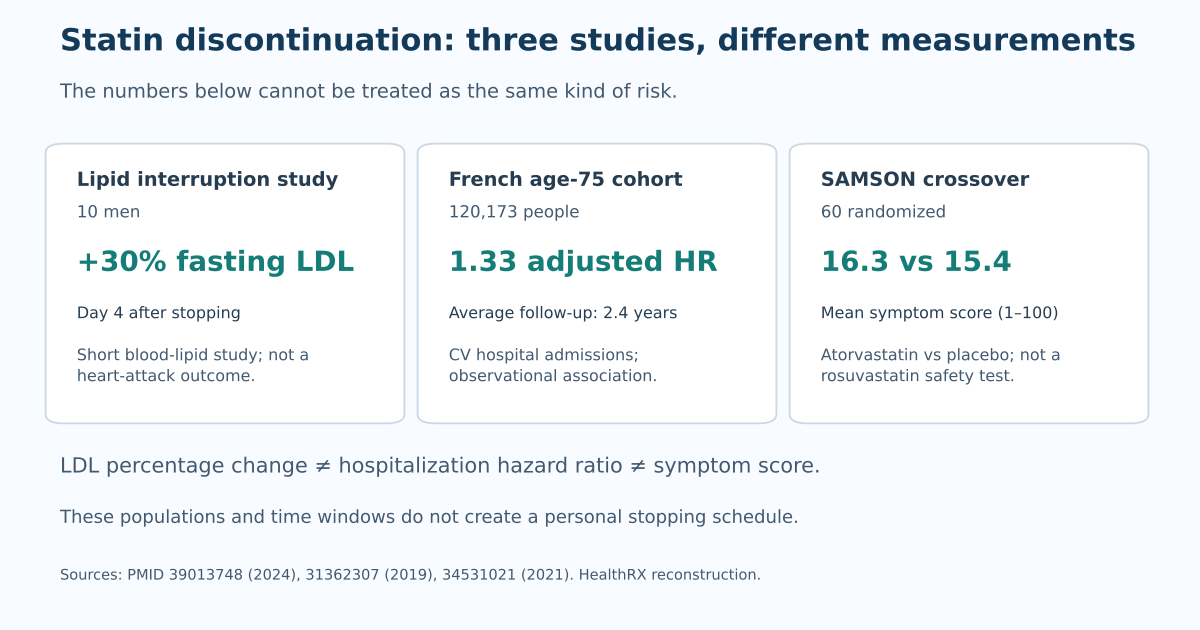
Mean fasting LDL cholesterol was 30% higher by day four. Mean lipid levels peaked between days seven and fifteen.[2] This is evidence that the biochemical effect of statin treatment can diminish quickly during an interruption, even before someone notices any physical change.
It does not establish a smooth daily rebound curve. Measurements on selected days leave the intervals between them unobserved. The small sample also cannot predict how much a particular person's LDL will rise, especially when their medicine, dose, starting LDL, or health differs from the study participants'.
Most importantly, a 30% increase in measured LDL is not a 30% increase in heart-attack risk. The study did not measure heart attacks. It also did not test a tapering strategy or establish a new dose to use after stopping.[2]
Rosuvastatin's approximately 19-hour half-life describes drug elimination, not a countdown to the day cardiovascular protection disappears. The prescribing information allows LDL assessment as early as four weeks after starting treatment; that is not an instruction to wait four weeks before addressing a discontinuation.[1]
Longer-term outcomes come from a different kind of evidence
Giral and colleagues examined French health records for people turning 75 who had no cardiovascular disease. To enter the cohort, participants had to have medication possession of at least 80% in each of the preceding two years. This was therefore a study of previously consistent statin users receiving primary prevention, rather than occasional users or people with a previous cardiovascular event.
Discontinuation meant three consecutive months without statin exposure. Over an average 2.4 years of follow-up, discontinuation was associated with an adjusted hazard ratio of 1.33 for any cardiovascular hospital admission, with a 95% confidence interval of 1.18–1.50.[3]
That estimate describes a relative association in the rate of admissions over follow-up. It is not an absolute event rate or a statement that 33% of people who stopped were hospitalized. It also cannot identify the cardiovascular consequences of a four-day interruption.[3]
Because treatment was not randomly assigned, differences between people who continued and stopped may partly explain the result, despite statistical adjustment. The study supports taking a prolonged interruption seriously in this population. It does not establish that everyone should continue indefinitely, or that reaching 75 is a reason to stop.
Symptom improvement needs its own comparison
SAMSON addressed a different problem: interpreting symptoms attributed to statins. Sixty participants were randomized to twelve one-month periods using four bottles of atorvastatin 20 mg, four of placebo, and four empty bottles, in random order. Forty-nine completed the trial. Participants recorded symptoms through an app on a 1–100 scale.
Mean symptom scores were 8 during no-treatment months, 16.3 during atorvastatin months, and 15.4 during placebo months. The difference between atorvastatin and placebo was not statistically significant, with P=0.388. The reported nocebo ratio was 0.90, indicating that much of the additional symptom burden seen with statin tablets was also seen with placebo tablets.[4]
This does not mean that 90% of patients invent pain, or that muscle symptoms are harmless. Symptoms experienced with placebo are still real. The trial also cannot exclude an individual drug reaction or serious muscle injury, and it tested atorvastatin rather than rosuvastatin.
Its practical lesson concerns attribution: symptoms improving after stopping, by themselves, do not reliably identify the drug as their cause. Suspected myopathy or serious liver injury requires prompt clinician assessment; an internet taper or unsupervised rechallenge is inappropriate.[1,4]
Make the medication change interpretable
A useful change record preserves enough information to judge what happened:
- Original prescription: why rosuvastatin was prescribed, the actual dose, and the most relevant pretreatment and on-treatment lipid results.
- Actual change: the date and dose change, including whether treatment ended completely and why.
- Continuing treatment: which medicines remain unchanged, and any replacement medicine with its dose and start date.
- Comparison measurements: which lipid results will be compared and the agreed follow-up, rather than an invented universal post-stop calendar.
- Symptoms: location, severity, onset, weakness, activity limitations, and changes over time.
If warfarin is involved, stopping rosuvastatin requires closer INR monitoring. Keep exact medication changes coordinated.[1]
The 2026 dyslipidemia guideline retains statins as foundational treatment while allowing individualized choices, including ezetimibe, bempedoic acid and PCSK9 inhibitors.[5,6] A replacement should not be assumed equivalent before its LDL effect and suitability are assessed. Pregnancy also changes the discussion: most pregnant patients stop statins, although rare high-risk exceptions require individualized care. Early unintended exposure alone does not establish fetal harm. FDA advises against breastfeeding when ongoing statin treatment is required.[7]
Frequently asked questions
Do I need to taper Crestor?
There is no universal rosuvastatin withdrawal taper in the prescribing information. The appropriate change depends on why treatment is ending and what will replace it. Suspected serious adverse effects need prompt assessment rather than a self-directed taper. People taking warfarin need closer INR monitoring when rosuvastatin is stopped.[1]
Can diet and exercise replace it?
They can improve cholesterol and cardiovascular health, but they do not reliably reproduce rosuvastatin's LDL reduction. Whether lifestyle changes alone are sufficient depends on the original treatment reason, cardiovascular risk, and measured response. If another medicine is chosen, its effect should be assessed rather than assumed equivalent.[6]
Should everyone stop at age 75?
No. Age 75 is not an automatic stopping point. The French cohort found an association between discontinuation and cardiovascular hospitalization in previously adherent 75-year-olds without cardiovascular disease. That finding does not prove causation, but it argues against stopping solely because of a birthday. Benefits, adverse effects, health status, and preferences still matter.[3]
Does improvement in muscle pain prove rosuvastatin caused it?
No. Improvement provides useful information, but symptoms may fluctuate or improve for other reasons. In SAMSON, symptom scores were similar during atorvastatin and placebo months. That does not rule out a rosuvastatin reaction in an individual. Severe pain, weakness, or dark urine warrants prompt medical assessment, not a self-directed experiment.[4]
References
Sources checked October 14, 2026.
- U.S. Food and Drug Administration. CRESTOR (rosuvastatin) prescribing information. Revised April 2026. Prescribing information.
- Alvarez-Jimenez L, et al. Time-course atherogenic blood lipid response to statin discontinuation in dyslipidemic adults. 2024. PubMed.
- Giral P, et al. Cardiovascular effect of discontinuing statins for primary prevention at the age of 75 years: a nationwide population-based cohort study in France. 2019. PubMed.
- Howard JP, et al. Side Effect Patterns in a Crossover Trial of Statin, Placebo, and No Treatment. 2021. PubMed.
- Writing Committee Members, Blumenthal RS, Morris PB, et al. 2026 Dyslipidemia Guideline. 2026. PubMed.
- American College of Cardiology. ACC, AHA Issue Updated Guideline for Managing Lipids, Cholesterol. March 13, 2026. Official summary.
- U.S. Food and Drug Administration. FDA requests removal of strongest warning against using cholesterol-lowering statins during pregnancy. 2021. Drug safety communication.