Rosuvastatin Drug Interactions: Why the Exact Other Medicine Matters
Rosuvastatin has little clinically significant CYP3A4 involvement, but hepatic uptake and drug efflux still influence its exposure. Hepatic uptake and efflux involve transporter pathways described in the experimental and pharmacogenetic literature.[2,6] A medicine need not block CYP3A4 to change how much rosuvastatin reaches the circulation.
This page uses the April 2026 US CRESTOR prescribing information [1], rather than treating every rosuvastatin formulation or country’s instructions as interchangeable. It addresses selected interactions, not a complete list. The practical question is the exact co-medication: a class name such as “antiviral” is not enough to select an action.[1]
Transport is different from metabolism
Metabolism chemically changes a drug; transport moves it across cell membranes. Experiments in transporter-expressing cells and human hepatocytes identified several OATP-family transporters and NTCP as routes of rosuvastatin uptake.[2] These findings help explain why looking only for CYP3A4 inhibition misses an important interaction mechanism.
They also have a boundary. Demonstrating uptake in cells does not determine a particular person’s dose or predict whether that person will develop muscle injury. Transporter expression and genetic variation help explain exposure differences, but laboratory mechanisms are not patient-outcome measurements.[2]
What exposure studies establish—and what they do not
The table separates measured concentrations from prescribing decisions. Its rows should not be read as a ranking of which combination is safest.
| Study setting | Exposure finding | Current action or evidence boundary |
|---|---|---|
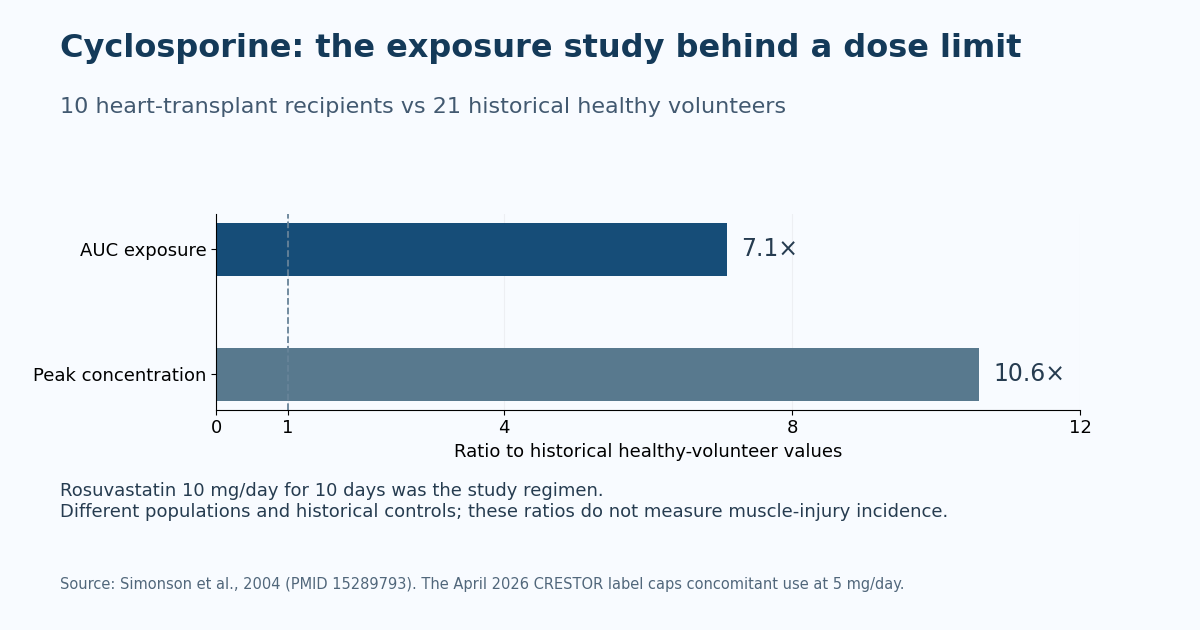
| Ten stable heart-transplant recipients receiving cyclosporine-containing treatment; historical healthy-volunteer comparison | Rosuvastatin AUC was 7.1 times higher and peak concentration 10.6 times higher.[3] | The current label instruction is separate from the study’s doses; see the cyclosporine FAQ.[1] This was not a randomized comparison of muscle-injury rates.[3] |
| Six healthy, HIV-negative volunteers receiving boosted antiviral regimens | Atazanavir/ritonavir increased AUC by 213%, or to 3.13 times baseline; peak rose to seven times baseline. Fosamprenavir/ritonavir produced no significant pharmacokinetic change.[4] | These short-term measurements do not establish clinical outcomes in people with HIV or a universal antiviral rule.[4] |
| Fourteen healthy men in a short crossover study of fenofibrate and rosuvastatin | AUC increased 7% and peak concentration 21%.[7] | Small concentration changes do not establish long-term rhabdomyolysis risk. Fenofibrate can still add muscle risk.[1,7] |
The cyclosporine study used rosuvastatin 10 mg for ten days, with five recipients later assessed at 20 mg. Its comparator consisted of historical data from 21 healthy volunteers. Different populations and a historical comparison limit causal precision. Rosuvastatin did not change cyclosporine blood concentrations in that study.[3] Those research doses are not permission to exceed today’s label limit.
Exposure results need a study context
An AUC result describes total exposure over time; a peak result describes the highest measured concentration. Neither is itself a count of adverse events.[3,4,7]
Genetic evidence adds another layer rather than replacing the medication review. In 32 healthy volunteers, the SLCO1B1 c.521CC group had 65% greater AUC and 79% greater peak exposure than the TT group after a single 10 mg dose.[5] CPIC addresses how available genotype results can inform statin prescribing; it does not mean everyone needs testing.[6] The FAQs below distinguish these mechanisms and study findings from combination-specific label instructions.
Frequently asked questions
What is the mechanism of action of rosuvastatin (Crestor)?
Rosuvastatin inhibits HMG-CoA reductase, reducing cholesterol synthesis. Uptake into liver cells is a separate process involving transporters such as OATP1B1.[2] The drug’s cholesterol-lowering target alone therefore does not explain changes in its circulating concentration.
Is rosuvastatin metabolized by CYP3A4 like atorvastatin?
CYP3A4 is not clinically significant to rosuvastatin clearance.[1] That does not exclude interactions. Uptake experiments show why transport across liver-cell membranes matters independently of chemical metabolism.[2] Checking only whether the other medicine inhibits CYP3A4 would leave that mechanism out.
Can I take Crestor with cyclosporine?
The April 2026 label generally discourages this combination and limits rosuvastatin to 5 mg/day if used.[1] That cap does not remove the interaction. The transplant study measured higher exposure, not a muscle-injury probability at the current capped dose.[3]
What is the rosuvastatin dose cap with gemfibrozil?
Avoid the combination. Only if unavoidable, start rosuvastatin at 5 mg and do not exceed 10 mg/day.[1] A maximum dose is not the same as a recommendation to use the combination.
Does rosuvastatin interact with warfarin?
Yes. The label calls for INR before starting and frequent reassessment after initiation, dose changes or stopping until stable.[1]
Can I take antacids with rosuvastatin?
Take an aluminum/magnesium hydroxide combination antacid at least two hours after rosuvastatin.[1] This instruction concerns that antacid combination; it should not be broadened into one timing rule for every magnesium-containing product.
What HIV medications interact with rosuvastatin?
Atazanavir/ritonavir is one example; its label maximum is rosuvastatin 10 mg/day.[1] In six HIV-negative volunteers, it raised total exposure to 3.13 times baseline, whereas fosamprenavir/ritonavir did not significantly change exposure.[4] That small pharmacokinetic study neither measured HIV treatment outcomes nor makes boosted regimens interchangeable.
Does the SLCO1B1 gene affect rosuvastatin metabolism?
More precisely, SLCO1B1 affects hepatic uptake rather than simply metabolism. The c.521CC volunteers in one study had higher rosuvastatin exposure than TT volunteers.[5] CPIC considers transporter genetics when interpreting statin exposure and muscle-symptom risk, but these findings do not make injury inevitable or independently require genetic testing.[6]
Is rosuvastatin safe with hepatitis C antivirals?
The exact regimen matters. Avoid rosuvastatin with ledipasvir/sofosbuvir or sofosbuvir/velpatasvir/voxilaprevir.[1] Do not transfer those instructions—or another regimen’s dose limit—to every hepatitis C treatment.
What was the JUPITER trial?
JUPITER compared rosuvastatin 20 mg with placebo in 17,802 apparently healthy adults with LDL below 130 mg/dL and high-sensitivity CRP at least 2 mg/L. It tested cardiovascular prevention and stopped after a median 1.9 years.[9] It was not an interaction-tolerability trial or a universal recommendation to take 20 mg.
Can I drink grapefruit juice while taking Crestor?
Current NHS rosuvastatin guidance allows normal eating and does not set a grapefruit restriction.[10] Check the instructions for other medicines taken with it; food advice for one drug does not automatically apply to the full regimen.
Does rosuvastatin interact with ezetimibe?
Combining cholesterol-lowering treatments intentionally is different from proving there is no pharmacokinetic interaction. IMPROVE-IT demonstrated cardiovascular benefit from adding ezetimibe to simvastatin after acute coronary syndrome.[8] It did not study rosuvastatin plus ezetimibe, so it cannot establish that combination’s exposure effects or justify a zero-interaction claim.
What monitoring is needed when rosuvastatin is combined with an interacting drug?
Use the co-medication’s specific monitoring instructions. Warfarin needs INR reassessment; unexplained muscle pain or weakness, particularly with fever or malaise, warrants prompt assessment.[1] Genotype guidance does not create a weekly CK, liver-test or genetic-testing schedule.[6]
Why does darolutamide have the strictest rosuvastatin dose cap?
It is not uniquely strictest. Darolutamide, cyclosporine and belumosudil each have a 5 mg/day rosuvastatin maximum in this label.[1] A shared numerical cap does not establish identical mechanisms, identical clinical risk or interchangeable monitoring.
References
Sources checked October 14, 2026.
- FDA. CRESTOR prescribing information. Revised April 2026. Current US label
- Ho RH, Tirona RG, Leake BF, et al. Drug and bile acid transporters in rosuvastatin hepatic uptake: function, expression, and pharmacogenetics. 2006. Primary record
- Simonson SG, Raza A, Martin PD, et al. Rosuvastatin pharmacokinetics in heart transplant recipients administered an antirejection regimen including cyclosporine. 2004. Primary record
- Busti AJ, Bain AM, Hall RG, et al. Effects of atazanavir/ritonavir or fosamprenavir/ritonavir on the pharmacokinetics of rosuvastatin. 2008. Primary record
- Pasanen MK, Fredrikson H, Neuvonen PJ, et al. Different effects of SLCO1B1 polymorphism on the pharmacokinetics of atorvastatin and rosuvastatin. 2007. Primary record
- Cooper-DeHoff RM, Niemi M, Ramsey LB, et al. The Clinical Pharmacogenetics Implementation Consortium Guideline for SLCO1B1, ABCG2, and CYP2C9 genotypes and Statin-Associated Musculoskeletal Symptoms. 2022. Primary record
- Martin PD, Dane AL, Schneck DW, et al. An open-label, randomized, three-way crossover trial of the effects of coadministration of rosuvastatin and fenofibrate on the pharmacokinetic properties of rosuvastatin and fenofibric acid in healthy male volunteers. 2003. Primary record
- Cannon CP, Blazing MA, Giugliano RP, et al. Ezetimibe Added to Statin Therapy after Acute Coronary Syndromes. 2015. Primary record
- Ridker PM, Danielson E, Fonseca FA, et al. Rosuvastatin to prevent vascular events in men and women with elevated C-reactive protein. 2008. Primary record
- NHS. Rosuvastatin. Reviewed June 29, 2026. Current patient guidance