Stopping Spironolactone for Acne: Separate Recurrence From Treatment Changes
If acne changes after a prescribed reduction or stop, record what changed in the whole regimen. Was a topical treatment interrupted too? Did a contraceptive change? Studies of improvement while taking spironolactone cannot predict your post-treatment course or establish which taper works best.
A useful starting point is the actual prescription change. Ask the prescriber whether the plan is to stop, reduce treatment, or replace it, and what should continue alongside that change. An observation record can help explain what happens afterward; it cannot select a taper or authorize restarting.
Establish the reason and the full indication
Write down the reason for considering a change: side effects, pregnancy plans, satisfactory acne control, limited benefit, or another concern. These reasons lead to different conversations. Possible pregnancy or concerning symptoms warrant prompt contact rather than waiting to see whether acne changes.
Confirm every condition spironolactone is treating. Its labeled uses include heart failure, hypertension, edema, and primary hyperaldosteronism. An acne-focused stopping plan must not govern treatment for those conditions; the prescribing clinician needs to account for their consequences.[4]
Also describe the acne pattern before treatment and now. Include where breakouts occur, whether they fluctuate with menstrual cycles, and whether painful lesions or scarring have been concerns. Record current topical products and how consistently they are used. “My skin is clear” means something different when a topical regimen is also contributing.
What the evidence can answer
These sources address treatment benefits, tolerability, and monitoring. Their study designs leave important stopping questions unresolved.
| Reader question | Source and study type | What was measured | Remaining uncertainty |
|---|---|---|---|
| What treatments have guideline support? | AAD guideline.[1] | Strong recommendations for topical retinoids and benzoyl peroxide; conditional recommendations for spironolactone, azelaic acid, and combined oral contraceptives. | These recommendations establish neither a taper nor guaranteed maintenance after stopping. |
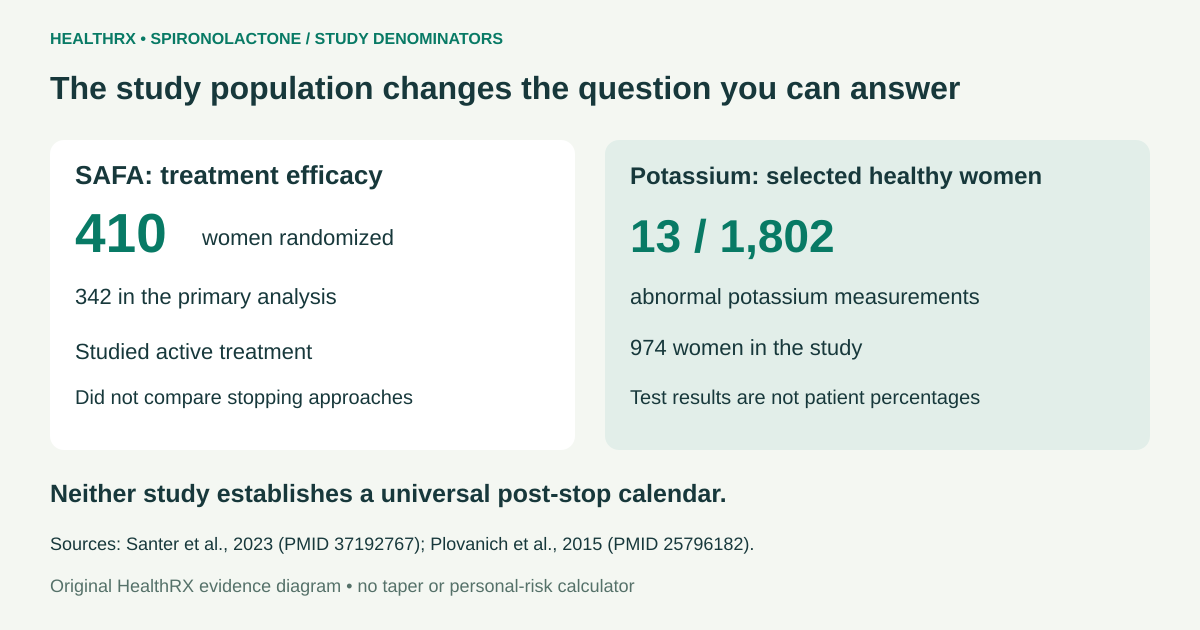
| Does spironolactone improve acne during treatment? | SAFA randomized trial: 410 women randomized; 342 in the primary analysis.[2] | Acne outcomes during active treatment, with greater improvement at the later assessment. | It did not study a stopping protocol or compare tapers. |
| Has relapse been observed? | Retrospective series of 110 patients.[3] | Improvement in 94, clearance by CASS in 61, and relapse after initial improvement in six. | These observations cannot supply a specific post-stop recurrence rate or predict an individual's course. |
| Who needs attention to potassium risk? | Prescribing label.[4] | Monitoring requirements and risks involving potassium, renal function, and interacting medicines. | The initiation rule does not establish testing after the final dose. |
| What does lower-risk monitoring evidence show? | Study of 974 healthy young women.[5] | Thirteen abnormal results among 1,802 potassium measurements; cardiovascular disease, renal failure, and medicines affecting the renin-angiotensin-aldosterone system were excluded. | Measurement counts are not patient counts; findings do not define higher-risk care or a post-stop calendar. |
| What is known about longer use? | Follow-up survey with 91 completed responses from 210 surveys sent.[6] | Reported side effects and discontinuation; no serious illness attributed to spironolactone was observed in that sample. | Limited survey evidence cannot guarantee long-term safety for everyone. |
Keep a before-and-after record
Use two periods: the period before the prescribed change and the period afterward. It needs no lesion-count threshold or mandatory recording interval.
Before the change, note the prescription, topical use, recent acne pattern, and symptoms motivating the discussion. Afterward, record what treatment actually changed and what you notice: location and character of breakouts, discomfort, scarring concerns, and effects on daily life. Photos taken under similar conditions may help make the account more concrete.
Include other changes, especially a new or discontinued contraceptive, other medicines, and interruptions in topical use. A breakout following discontinuation does not establish its cause. These details help the clinician distinguish recurrence from changes in the surrounding regimen.
Make follow-up questions specific
Ask which topicals should continue or be introduced, what would justify reassessment, and whom to contact if side effects persist. Guideline-supported treatment options offer a basis for discussion, without promising that maintenance will prevent recurrence.[1] Pregnancy plans require a separate review of the whole regimen.
For laboratory questions, bring the full medication list and relevant kidney or potassium history. The label calls for potassium testing within a week of initiation and regularly thereafter; that instruction should not be repurposed as a final-dose schedule.[4] Agree on follow-up with the actual prescriber, using the record to describe events rather than to direct a home taper or restart.
Frequently asked questions
Can I stop spironolactone cold turkey when it is used only for acne?
The cited evidence does not establish a preferred stopping method for acne alone. Confirm the indication and have the prescriber select the plan rather than choosing abrupt cessation or a taper yourself.[1–4]
Is reducing by 25 mg every two weeks evidence-based?
The cited studies did not test that taper or compare it with other stopping approaches. Treatment-study dosing should not be converted into a home discontinuation schedule.[2,3]
Will my acne definitely come back?
Recurrence is possible, but these sources cannot predict your outcome. Baseline acne, ongoing topicals, and medication or contraceptive changes matter when interpreting later breakouts.[1,3]
Should I start topical treatment before stopping?
Ask which topical treatment should be continued or introduced. Guidelines support several options, but they do not prove that starting a topical before stopping prevents recurrence; pregnancy plans also affect selection.[1]
Do I need potassium testing after the final dose?
These sources provide no universal post-stop testing schedule. Ask the prescriber about kidney function, previous potassium results, and interacting medicines; the lower-risk study does not answer this question.[4,5]
Will stopping cause fluid gain or a blood-pressure rebound?
The acne studies do not establish those outcomes. If spironolactone also controls blood pressure, heart failure, or edema, changing it can affect that condition and needs its own prescribing plan.[2–4]
Can I use spironolactone during pregnancy?
The label advises avoiding spironolactone during pregnancy because its antiandrogenic effects may pose a risk to male fetal sex development. Contact the prescriber promptly about possible pregnancy or pregnancy plans.[4]
Is long-term spironolactone use safe for acne?
The follow-up survey offers limited reassurance about observed tolerability, not a safety guarantee. Individual risks, side effects, kidney function, potassium, and interacting medicines still need review.[4,6]
When should I restart it?
Contact the prescriber if acne worsens, especially with painful lesions or scarring concerns. Review the prescribed change and other regimen changes before deciding whether restarting or another treatment is appropriate.[1,4]
What if I take spironolactone for something besides acne?
Tell the clinician every indication before changing treatment. Heart failure, hypertension, edema, and aldosteronism require condition-specific decisions; an acne plan should not determine whether that therapy stops.[4]
References
- Reynolds RV, Yeung H, Cheng CE, et al. Guidelines of care for the management of acne vulgaris. J Am Acad Dermatol. 2024;90(5):1006.e1-1006.e30. Guidelines of care for the management of acne vulgaris
- Santer M, Lawrence M, Renz S, et al. Effectiveness of spironolactone for women with acne vulgaris (SAFA) in England and Wales: pragmatic, multicentre, phase 3, double blind, randomised controlled trial. BMJ. 2023;381:e074349. Effectiveness of spironolactone for women with acne vulgaris (SAFA)
- Charny JW, Choi JK, James WD. Spironolactone for the treatment of acne in women, a retrospective study of 110 patients. Int J Womens Dermatol. 2017;3(2):111-115. Spironolactone for the treatment of acne in women, a retrospective study of 110 patients
- DailyMed. Spironolactone tablets, full prescribing information. Updated March 12, 2026. Current spironolactone label
- Plovanich M, Weng QY, Mostaghimi A. Low usefulness of potassium monitoring among healthy young women taking spironolactone for acne. JAMA Dermatol. 2015;151(9):941-944. Low Usefulness of Potassium Monitoring Among Healthy Young Women Taking Spironolactone for Acne
- Shaw JC, White LE. Long-term safety of spironolactone in acne: results of an 8-year followup study. J Cutan Med Surg. 2002;6(6):541-545. Long-term safety of spironolactone in acne: results of an 8-year followup study