Creatine With Rosuvastatin: Separate Muscle Symptoms From Kidney Tests
Creatine supplementation can complicate the interpretation of blood tests in someone taking rosuvastatin, sold as Crestor. It also raises a separate question: could it change statin-associated muscle symptoms? These questions involve different measurements and different evidence. A higher blood creatinine result, an elevated muscle enzyme, and new muscle pain each need their own interpretation.
The available studies do not establish that creatine and rosuvastatin are safe together for every person. The most relevant muscle studies involve atorvastatin or patients with statin-associated symptoms, while a kidney-function trial studied healthy exercisers. Understanding those boundaries helps you have a more useful discussion about your supplement, symptoms, and laboratory results.
Creatine, creatinine, and CK measure different things
Creatine is a compound involved in muscle energy metabolism and an ingredient in sports supplements. Creatinine is a breakdown product measured in blood and used to estimate kidney filtration. Creatine kinase, usually abbreviated CK, is an enzyme that can enter the bloodstream when muscle is stressed or injured. Similar names make these easy to confuse. [5]
| Supplement or measurement | What it represents | What matters during rosuvastatin treatment |
|---|---|---|
| Creatine supplement | A product taken to increase available creatine, usually for training goals | Record the ingredients, daily amount, and when use began or changed; the product itself is not a kidney-function test. |
| Blood creatinine, often reported in mg/dL or µmol/L | A blood measurement used in creatinine-based estimated GFR, or eGFR | Supplement use can affect interpretation; compare the result with prior values and the wider clinical picture. |
| Blood CK, usually reported in U/L | A muscle enzyme that may rise after strenuous exercise or muscle injury | Interpret alongside pain, weakness, recent training, the laboratory reference range, and the trend over time. |
A change in one measurement does not establish what happened to the others. For example, a better muscle-symptom score does not necessarily mean CK fell. Likewise, a creatinine increase cannot, by itself, establish whether kidney filtration declined. Clinicians may need additional information rather than treating any single result as the answer.
What the randomized muscle study found
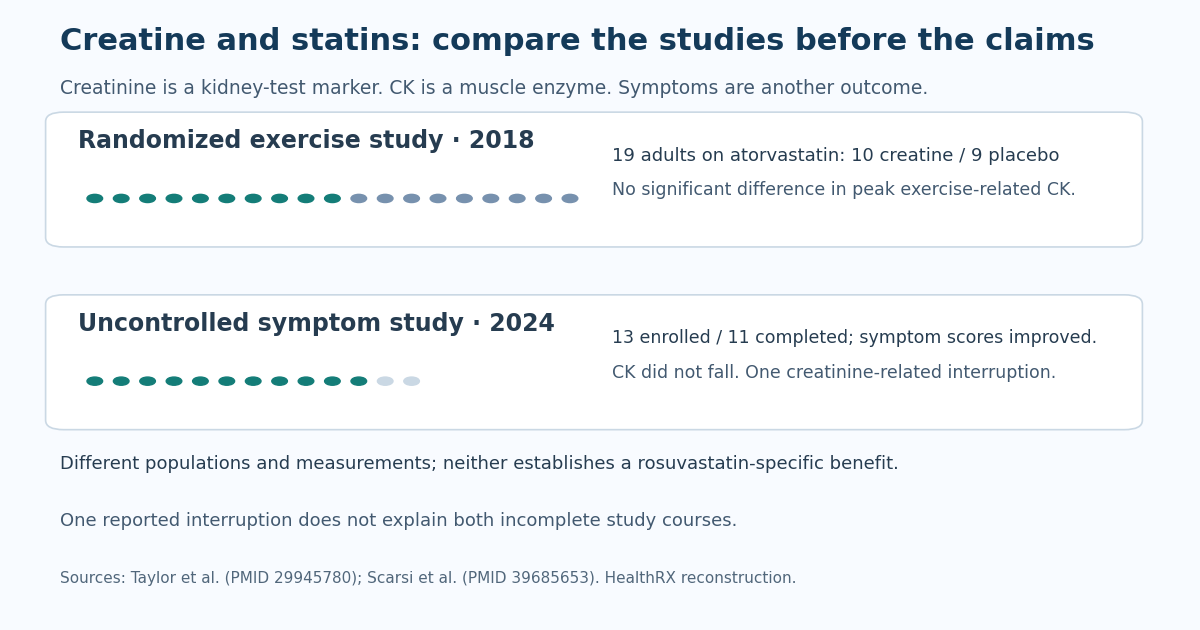
A 2018 pilot trial randomly assigned 19 healthy, nonsmoking adults to creatine plus atorvastatin or placebo plus atorvastatin. Ten received creatine and nine received placebo; both groups took atorvastatin 80 mg. After four weeks, participants completed 45 minutes of downhill walking, and researchers followed blood CK for four days afterward. [2]
CK increased in both groups. The researchers found no statistically significant difference in peak CK between groups, whether assessed as relative or absolute change. Soreness and pain also did not differ significantly. This provides limited information about the response to a particular exercise challenge during atorvastatin treatment.
The trial was small, with wide confidence intervals. It did not prove that the treatments were equivalent or that creatine could never affect muscle outcomes. It also did not test rosuvastatin or demonstrate prevention of statin myopathy. Its exercise procedure is a research method, not a way to test your own tolerance to a statin.
Why the preliminary symptom study gives a different picture
A 2024 preliminary study enrolled 13 consecutive patients with statin myopathy; 11 completed it. Their myopathy symptom scores improved during low-dose creatine supplementation, while CK did not decrease. One participant interrupted treatment because serum creatinine increased. The published abstract identifies one interruption related to a creatinine result; it does not attribute both incomplete courses to the supplement. [3]
This study had no randomized placebo comparison. Improvement could reflect several influences, including symptom fluctuation, expectations, or other changes over time. It offers a reason for further research, rather than a dependable treatment recommendation for an individual taking rosuvastatin.
The findings do not directly contradict the earlier trial. One study examined exercise-related CK and soreness in healthy adults on atorvastatin. The other followed symptoms in people already experiencing statin myopathy. Symptoms and CK can move differently, and neither study establishes a rosuvastatin-specific benefit.
What the kidney trial actually measured
A 2013 randomized, double-blind, placebo-controlled trial followed healthy resistance-trained people eating a high-protein diet for 12 weeks. Importantly, investigators measured GFR directly using chromium-51 EDTA, rather than relying only on a creatinine-based estimate. Measured GFR showed no significant treatment-related change, and other kidney parameters did not change significantly. [4]
That finding is reassuring within the population and duration studied. It does not settle the question for people with chronic kidney disease, for rosuvastatin–creatine combination treatment, or for every supplement formulation. A healthy-exerciser trial cannot establish that a new abnormal kidney result is harmless.
KDIGO identifies creatine supplements and high-protein diets as factors that can affect serum creatinine independently of GFR. When creatinine-based eGFR may be inaccurate, cystatin C or a combined creatinine–cystatin C estimate may help. These approaches also have limitations and require clinical interpretation. [6]
Bring a usable record to the medication review
Bring the actual supplement container or a clear ingredient list. Record the amount you take, the dates you started or changed it, and any recent increase in training intensity. Include prescription medicines, over-the-counter products, and other supplements. For blood tests, bring the units, laboratory reference ranges, and previous results. Describe when pain or weakness began and whether it affects ordinary activities.
The April 2026 Crestor label warns about myopathy and rhabdomyolysis. Severe weakness or dark urine warrants prompt medical assessment. Renal impairment and concurrent medicines matter; severe renal impairment carries a lower dose cap. Exact drugs such as cyclosporine and gemfibrozil require particular attention. The label does not establish a validated creatine washout interval. [1]
Avoid dismissing symptoms as exercise soreness or a supplement effect. A clinician can decide which measurements need repeating or supplementing and whether treatment needs adjustment. Separating the measurements makes that assessment clearer without assuming that every abnormal result represents injury or that every change is harmless.
Frequently asked questions
Can I take creatine while on Crestor?
That needs an individual review of your kidney function, muscle symptoms, medicines, and exact supplement. The available studies do not establish the safety of this combination for everyone or show a rosuvastatin-specific muscle benefit. Bring the product label and your recent laboratory results to your prescriber or pharmacist.[2]
Does creatine interact with Crestor?
The cited studies do not establish a clinically defined rosuvastatin–creatine interaction, but they also cannot rule out every concern. Creatine can affect interpretation of creatinine results, while rosuvastatin has important muscle warnings and interactions with specific medicines. Absence from a label's interaction list does not prove a supplement is safe.[1]
Will creatine make statin muscle side effects worse or harder to interpret?
The small atorvastatin trial found no significant difference in exercise-related peak CK or soreness. The uncontrolled statin-myopathy study reported improved symptom scores without lower CK. Neither establishes what will happen with rosuvastatin. Recent exercise, symptoms, and CK trends all matter; severe weakness or dark urine needs prompt medical assessment.[2]
Should I stop creatine before a blood test while taking rosuvastatin?
Tell the clinician ordering the test that you use creatine and provide the amount and start date. These sources do not establish a universal washout period. The clinician may recommend a pause, repeat testing, or another assessment depending on the reason for testing and your results. An elevated creatinine should not automatically be dismissed as a supplement effect.[6]
What is cystatin C and why is it relevant here?
Cystatin C is another blood marker used to estimate kidney filtration. It may help when creatinine-based eGFR is difficult to interpret, sometimes through a combined equation. Steroid use, thyroid disease, and cancer can affect cystatin C. A normal result alone does not exclude kidney injury. [6]
Does creatine cause kidney damage on its own?
The 12-week healthy-exerciser trial found no significant adverse change in directly measured GFR. That does not establish universal safety, especially in chronic kidney disease. KDIGO also cites reports of creatine-associated interstitial nephritis; those reports do not establish a frequency or a rosuvastatin-combination risk. [4] [6]
Can I take rosuvastatin and creatine at the same time of day?
These studies do not establish required spacing or provide personal clearance to take them together. Separating the doses by a few hours has not been shown here to resolve the relevant concerns. Ask a pharmacist to review the exact supplement and your medication list rather than assuming that timing makes the combination safe.[2]
References
Sources checked October 14, 2026.
-
U.S. Food and Drug Administration. CRESTOR (rosuvastatin) prescribing information. Revised April 2026. FDA label
-
Taylor BA, Panza G, Ballard KD, et al. Creatine supplementation does not alter the creatine kinase response to eccentric exercise in healthy adults on atorvastatin. 2018. PubMed
-
Scarsi E, Dorighi U, Adriano E, et al. Low-Dose Creatine Supplementation May Be Effective in Early-Stage Statin Myopathy: A Preliminary Study. 2024. PubMed
-
Lugaresi R, Leme M, de Salles Painelli V, et al. Does long-term creatine supplementation impair kidney function in resistance-trained individuals consuming a high-protein diet? 2013. PubMed
-
Wyss M, Kaddurah-Daouk R. Creatine and creatinine metabolism. 2000. PubMed
-
Kidney Disease: Improving Global Outcomes (KDIGO). KDIGO 2024 Clinical Practice Guideline for the Evaluation and Management of Chronic Kidney Disease. Guideline PDF