Rosuvastatin With Magnesium: Identify the Product Before Changing Timing
At a glance
- Aluminum + magnesium hydroxide antacid / Take Crestor at least 2 hours before it
- Magnesium-only supplement / No form-wide interaction rule has been proven; check the exact ingredient and purpose
- Magnesium oxide / A small 12-week trial found no LDL difference between simultaneous and separated dosing
- Citrate or glycinate / Not tested in the study that created the Crestor timing instruction
- Elemental magnesium / This is the number to read on the Supplement Facts panel
- Kidney impairment / Ask the prescribing clinician before adding magnesium; accumulation risk is higher
Start with the product, not the word “magnesium”
“Magnesium” can mean a constipation product, a heartburn antacid, or a dietary supplement. Those are not interchangeable exposures.
| What you have | What the evidence actually says | Practical move |
|---|---|---|
| Aluminum hydroxide plus magnesium hydroxide antacid | Directly studied and covered by the FDA label | Take Crestor at least 2 hours before the antacid |
| Magnesium oxide used for constipation or supplementation | Tested in one small 2025 clinical trial | No statistically significant difference was detected in the 12-week LDL change; that does not establish equivalence for every product |
| Magnesium citrate, glycinate, chloride, lactate, or another magnesium-only product | Not tested in the study behind the Crestor label instruction | Do not call it “proven safe” or “proven interacting” by analogy alone; check other ingredients and the reason for use |
| Multi-ingredient heartburn or mineral product | The front-label name may hide aluminum, calcium, or other active ingredients | Read the Active Ingredients or Supplement Facts panel before deciding |
The important word in the FDA interaction is combination. The label does not say that every product containing magnesium cuts rosuvastatin absorption in half.
The experiment behind the 2-hour instruction
The current FDA label gives the sequence plainly:
“When taking CRESTOR with an aluminum and magnesium hydroxide combination antacid, administer CRESTOR at least 2 hours before the antacid” [1]
That sentence is narrower than the shorthand “separate magnesium from Crestor.” It names a combination antacid, specifies which product comes first, and does not silently extend the rule to every magnesium salt sold as a supplement.
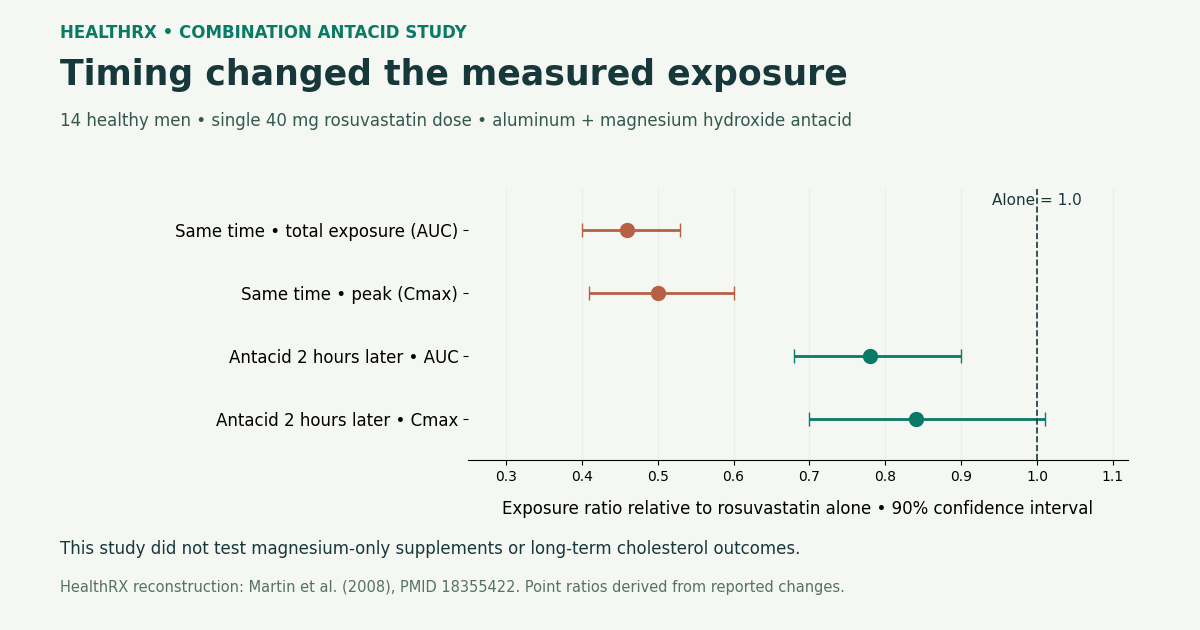
The dosing rule traces to a three-way crossover study in just 14 healthy men. Each participant received a single 40 mg rosuvastatin dose in three conditions: rosuvastatin alone; rosuvastatin at the same time as 20 mL of an aluminum hydroxide–magnesium hydroxide antacid; and the same antacid 2 hours after rosuvastatin [2].
What happened to rosuvastatin exposure
| Study condition | Change in total exposure (AUC) | Change in peak concentration (Cmax) |
|---|---|---|
| Rosuvastatin alone | Reference | Reference |
| Combination antacid at the same time | 54% lower | 50% lower |
| Combination antacid 2 hours later | 22% lower | 16% lower |
That is a substantial same-time effect. It also corrects a common online reversal: the current U.S. label says to take Crestor first, then wait at least 2 hours before taking the aluminum/magnesium antacid. It does not say “2 hours before or after” as though direction were irrelevant.
The study measured drug concentrations after a single high dose. It did not measure heart attacks, long-term LDL control, or every magnesium salt sold in a supplement aisle. Repeated antacid use was not tested.
What the original study did not test
It did not test magnesium glycinate, citrate, taurate, threonate, chloride, or lactate. It therefore cannot prove that glycinate has “low chelation risk,” that taurate is the “best cardiovascular form,” or that threonate is the best choice for someone taking Crestor. Those familiar comparison tables look helpful, but the rosuvastatin-specific evidence is not there.
The NIH does note that citrate, aspartate, lactate, and chloride tend to be absorbed more completely than oxide and sulfate in small magnesium studies [4]. That tells us about magnesium absorption; it does not automatically tell us how each form changes rosuvastatin absorption.
A newer magnesium oxide trial complicates the story
In 2025, researchers published a randomized, multicenter trial in which 45 Japanese outpatients prescribed both rosuvastatin and magnesium oxide completed follow-up. Twenty-five took the drugs together. Twenty took magnesium oxide at least 2 hours after rosuvastatin. After 12 weeks, the change in LDL cholesterol was not significantly different between the groups (P = 0.9091) [3].
This is useful because it looked at the outcome patients actually care about—whether LDL control changed—not only a one-dose concentration curve. It also studied magnesium oxide alone rather than the aluminum/magnesium antacid combination.
It is not a blank check for every magnesium product. The final analysis included participants reporting at least 80% adherence. The median ages in the two groups were 78 and 76. These results concern a small group, one magnesium product and a 12-week LDL outcome. A small negative study can miss a modest effect. The cleanest interpretation is:
The antacid interaction is real and remains in the FDA label. A separate small trial did not detect a difference in short-term LDL change with magnesium oxide, but it does not erase the label or establish a rule for every magnesium form.
A schedule that respects both the evidence and real life
If the product is an aluminum/magnesium antacid, follow the labeled direction:
- Take Crestor at the prescribed time.
- Wait at least 2 hours.
- Take the combination antacid.
The April 2026 Crestor label allows dosing at any time of day, with or without food. [1]
For a magnesium-only supplement, the combination-antacid label does not establish a rule for every form. A clinician or pharmacist can review the exact ingredients alongside the existing prescription schedule. Record missed doses or actual timing difficulties so that review addresses what is happening.
Read the label in the right place
For an antacid, look at Active Ingredients. “Magnesium hydroxide” beside “aluminum hydroxide” puts the product squarely inside the FDA instruction.
For a dietary supplement, look at Supplement Facts. The listed amount is elemental magnesium, not the full weight of magnesium glycinate, citrate, or oxide. This matters because two bottles can advertise similarly sized compound doses while providing very different amounts of magnesium.
The adult upper limit for magnesium from supplements and medications is 350 mg per day unless a clinician recommends otherwise. Magnesium naturally present in food does not count toward that limit. Higher supplemental amounts commonly cause diarrhea, nausea, and abdominal cramping; the limit is about adverse effects, not a claim that everyone needs 350 mg [4].
Three situations where the answer changes
Reduced kidney function
Healthy kidneys clear excess magnesium. With impaired renal function, magnesium can accumulate, so a clinician should review new supplementation rather than relying on a generic dose chart. Severe renal impairment also changes Crestor dosing: the current label says to start at 5 mg and not exceed 10 mg daily in patients with creatinine clearance below 30 mL/min/1.73 m² who are not on hemodialysis. See the fuller rosuvastatin renal-impairment guide.
New muscle pain or weakness
Magnesium deficiency can cause weakness or cramps, but that does not make magnesium a proven treatment for statin-associated muscle symptoms. New, unexplained, or persistent symptoms deserve a medication review—especially if they are severe or accompanied by fever, dark urine, or unusual fatigue. The Crestor muscle-pain guide separates common soreness from signs that need prompt attention.
A crowded medication list
Magnesium can reduce absorption of some oral bisphosphonates and certain tetracycline or quinolone antibiotics. Proton-pump inhibitors and some diuretics can also affect magnesium status. The practical question is not simply “magnesium plus Crestor?” but “what is the full schedule?” Bring the actual bottle or a photo of both labels to a pharmacist or prescribing clinician.
What this evidence does—and does not—support
| Claim | Verdict | Why |
|---|---|---|
| “All magnesium must be separated from Crestor” | Too broad | The labeled rule is for an aluminum/magnesium hydroxide combination antacid |
| “Magnesium glycinate has no interaction” | Unproven | Glycinate was not in the rosuvastatin interaction study |
| “Magnesium oxide definitely cuts LDL control” | Not shown clinically | The 2025 pilot found no significant LDL difference over 12 weeks |
| “Magnesium treats statin muscle pain” | Not established | Correcting a true deficiency and treating statin-associated symptoms are different questions |
| “Take the antacid first, then Crestor” | Opposite the U.S. label | Crestor should come first, at least 2 hours before the combination antacid |
Frequently asked questions
Can I take magnesium with Crestor?
What happens if I took Crestor and a magnesium antacid together once?
Is magnesium glycinate the best form with rosuvastatin?
Can magnesium help Crestor muscle pain?
How much magnesium can I take?
References
- U.S. Food and Drug Administration. Crestor (rosuvastatin calcium) prescribing information, revised 2026. Current FDA label
- Martin PD, Schneck DW, Dane AL, Warwick MJ. The effect of a combination antacid preparation containing aluminium hydroxide and magnesium hydroxide on rosuvastatin pharmacokinetics. Current medical research and opinion. 2008;24(4):1231-5. doi:10.1185/030079908x280662. PMID:18355422. PubMed record
- Nakashima A, Tokura K, Misaki M, et al. Clinical Effects of the Concurrent Ingestion of Rosuvastatin and Magnesium Oxide: A Multicenter, Randomized, Parallel-Group Trial. Journal of clinical medicine research. 2025;17(10):550-555. doi:10.14740/jocmr6363. PMID:41209578. PMCID:PMC12591265. Full text in PubMed Central
- National Institutes of Health Office of Dietary Supplements. Magnesium: Fact Sheet for Health Professionals. Updated January 6, 2026. NIH fact sheet