Vyvanse Food and Supplements: Match the Ingredient to the Evidence
At a glance
- Current U.S. label / revised April 2026
- With food / permitted with or without food
- Capsule mixing / the full contents may be mixed with yogurt, water, or orange juice and consumed immediately
- Orange juice study / active d-amphetamine exposure remained within the prespecified bioequivalence range
- High-fat meal / delayed time to peak by about one hour; active-drug AUC and Cmax were unchanged
- Acidifying agents / may lower amphetamine blood levels; the label names ascorbic acid but provides no supplement timing interval
- Alkalinizing agents / may increase amphetamine levels; coadministration should be avoided
- Omeprazole / a controlled crossover found no clear change in Vyvanse peak timing or total exposure
- Caffeine / the label defines no cup or milligram limit
- Nutrient studies in ADHD / do not automatically establish a Vyvanse interaction or dosing schedule
Identify Which Exposure Path the Evidence Addresses
| Question | Direct evidence | Result | Boundary that must stay attached |
|---|---|---|---|
| Can the capsule contents be mixed with orange juice? | Current label plus a three-period crossover in 30 healthy adults [1,2] | The label permits it; d-amphetamine Cmax and AUC met the study's bioequivalence criterion versus an intact capsule | Single-dose administration testing does not establish the effect of every vitamin C supplement or long-term urinary acidification pattern |
| Does yogurt change active-drug exposure? | Current label and the same 30-person crossover [1,2] | D-amphetamine exposure was similar to the intact capsule | The entire mixture must be consumed immediately; the dose should not be divided or stored |
| Does a high-fat meal block Vyvanse? | Label pharmacokinetics and a fed-versus-fasted crossover [1,3] | D-amphetamine AUC and Cmax were unchanged; time to peak moved about one hour later | A later peak can change perceived onset without proving reduced total exposure or reduced clinical benefit |
| Does omeprazole make Vyvanse release earlier? | Four-period crossover; 24 randomized and 21 completed [4] | Median d-amphetamine Tmax was 3 hours with and without omeprazole; no clear Vyvanse timing trend emerged | The same study found an earlier, variable peak for mixed amphetamine salts XR; that result must not be transferred to Vyvanse |
| Do acidifying agents matter? | Current label [1] | Urinary acidifying agents may lower amphetamine blood levels and efficacy; ascorbic acid is an example | The label gives no vitamin C milligram threshold, ordinary-food avoid-list, or validated spacing interval |
| Do alkalinizing agents matter? | Current label [1] | Urinary alkalinizing agents may increase blood levels and potentiate amphetamine; coadministration should be avoided | “Antacid” and “magnesium” are not single ingredients; identify the actual product before classifying it |
| Does Vyvanse change caffeine metabolism? | Crossover interaction study in 30 healthy adults [5] | Lisdexamfetamine did not meaningfully alter CYP1A2 activity measured with caffeine exposure | This reverse-direction PK result does not prove that any caffeine dose is symptom-free or cardiovascularly safe with Vyvanse |
The tested route and measured outcome determine which conclusion fits. A change in active-drug exposure, a meal-time observation and a reported symptom need separate interpretation.
Orange Juice and Vitamin C Are Not One Evidence Question
The label instructs patients who cannot swallow a capsule whole that they may empty the entire contents into orange juice, yogurt, or water, mix until dispersed, and consume the whole mixture immediately [1]. It also reports that neither orange juice nor yogurt changed the observed AUC or Cmax of d-amphetamine after a single 70 mg capsule in healthy adults.
The underlying 30-person crossover provides the numerical comparison [2]. For d-amphetamine after orange juice, the geometric-mean ratios versus an intact capsule were 0.971 for Cmax and 0.986 for AUC from zero to infinity; their 90% confidence intervals remained within the study's prespecified 0.80-to-1.25 bioequivalence range. The inactive lisdexamfetamine prodrug had lower measured exposure in orange juice, but the active d-amphetamine exposure remained within the study’s prespecified bounds.
That directly contradicts a blanket instruction to avoid orange juice around the dose. It does not prove that any amount or formulation of vitamin C has no downstream effect. The label separately names ascorbic acid as an example of a urinary acidifying agent that can lower amphetamine blood levels [1]. It does not state that 500 mg or 1,000 mg is the threshold, quantify a 30% to 50% AUC loss, or instruct patients to wait four, six, or any other number of hours.
The evidence-based distinction is therefore:
- Tested dose vehicle: orange juice used to take the capsule met the prespecified active-drug exposure bounds in the single-dose study.
- Labeled interaction class: urinary acidifying agents can lower amphetamine levels.
- Unproven consumer rule: a universal vitamin C dose cutoff or spacing interval that guarantees no interaction.
If a new supplement coincides with a repeatable change, record the exact ingredient, amount, formulation, timing, and observed effect. Do not compensate by changing the Vyvanse dose without the prescriber.
Food: Separate Peak Timing From Total Exposure
Vyvanse may be taken in the morning with or without food [1]. In the label's capsule data, food prolonged the average time to peak d-amphetamine concentration from 3.8 hours fasting to 4.7 hours after a high-fat meal and 4.2 hours with yogurt. It did not change observed d-amphetamine AUC or Cmax.
The earlier fed-versus-fasted crossover reached the same overall conclusion: active d-amphetamine AUC and peak concentration were similar, while peak timing was about one hour later with food [3]. That is evidence for a timing shift, not for “blocked absorption.” It also does not establish that a particular protein target improves Vyvanse duration.
Appetite, nausea, the practical ability to eat later, and an individual's prescribed plan may still affect whether taking it with breakfast works better. Those are treatment-context questions, not a reason to invent a 20-, 30-, or 40-gram protein requirement.
Urinary pH: The Label Does Not Publish a Home-Titration Method
After lisdexamfetamine is absorbed and converted, the active moiety is d-amphetamine. Urinary pH can affect amphetamine excretion, which is why the label handles acidifying and alkalinizing agents as interaction classes [1].
For urinary acidifying agents, the label says blood levels and efficacy may decrease and directs dose adjustment based on clinical response. That direction belongs to the prescriber; it is not permission to increase a dose after eating acidic food.
For urinary alkalinizing agents, the label says blood levels and amphetamine action may increase and that coadministration should be avoided. The label does not provide a supplement “dosing window” or classify products by marketing category. Sodium bicarbonate is the label's example. A pharmacist can determine whether a specific antacid, urinary product, or multi-ingredient supplement belongs to the interaction class.
Omeprazole: Vyvanse Is Not Adderall XR
A product-specific crossover compared lisdexamfetamine 50 mg and mixed amphetamine salts XR 20 mg with and without 14 days of omeprazole [4]. For Vyvanse, mean d-amphetamine Cmax was 45.0 ng/mL alone and 46.3 ng/mL with omeprazole; mean AUC was 713.0 and 761.6 ng·h/mL. Median Tmax was 3 hours in both conditions. Twenty-five percent had a peak at least one hour earlier, but the investigators found no clear trend.
For mixed amphetamine salts XR, median Tmax moved from 5 hours to 2.75 hours and roughly 57% to 62% had an earlier peak. Copying that formulation result onto Vyvanse would erase the study's most important finding: the two delivery systems responded differently.
This study does not establish that every acid-suppressing drug is irrelevant for every person. It does show that the common claim “PPIs make all extended-release stimulants peak early” is too broad.
Supplements: Sort Evidence Before Giving Advice
Studies of zinc, iron, omega-3 fatty acids, magnesium, melatonin, or dietary patterns in people with ADHD may answer whether an intervention affected a symptom scale or a deficiency. They do not establish that the supplement changes Vyvanse absorption, conversion, exposure, duration, or safety unless Vyvanse and the supplement were actually studied together with those endpoints.
The April 2026 label does not list zinc, iron, omega-3, magnesium glycinate, or melatonin as product-specific interactions [1]. Absence from the table is not proof of compatibility at every dose. Product formulation matters: a mineral supplement can contain antacid ingredients, an energy product can contain caffeine or other stimulants, and a sleep blend can contain serotonergic substances.
St. John's wort belongs in a different evidence category. The label names it among serotonergic substances that can increase serotonin-syndrome risk [1]. It does not describe St. John's wort as the same thing as a contraindicated monoamine oxidase inhibitor. Actual MAO inhibitors are contraindicated during Vyvanse treatment and for 14 days after the MAOI is stopped.
Prepare a Vitamin C or Antacid Question
Bring the ingredient panel from the actual product. A mineral supplement, an antacid and a multi-ingredient energy powder can share a word on the front of the container while containing different active ingredients.
Identify the amount per serving and the number of servings you used. Write down why you started it, when you started it, and whether the reported change followed that change. A sour taste does not measure urinary acidification, and this evidence does not supply a home urine-pH target.
For a possible interaction, distinguish the prescribed Vyvanse formulation from the added product. Ask the pharmacist which label interaction class, if any, fits that ingredient. If it is an acidifying or alkalinizing agent, the label instruction cannot be replaced with an invented spacing window. A symptom report also needs its context: sleep, missed meals, other medicines and late or missed doses may have changed at the same time. [1]
What the Caffeine Substrate Study Actually Compared
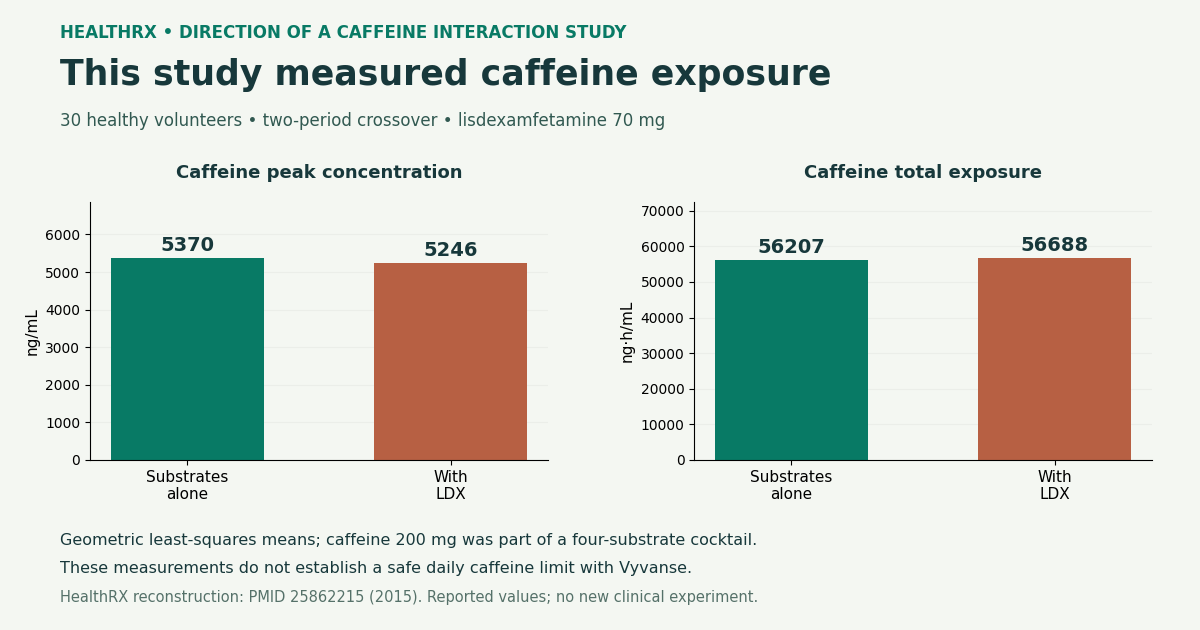
A separate open-label randomized crossover involved 30 healthy volunteers. They received a four-substrate cocktail alone or with a single 70 mg lisdexamfetamine dose. The cocktail included 200 mg caffeine as a CYP1A2 substrate; those amounts describe the research, not a recommended combination. [5]
| Caffeine outcome | Cocktail without lisdexamfetamine | Cocktail with lisdexamfetamine |
|---|---|---|
| Geometric least-squares mean peak concentration | 5,370 ng/mL | 5,246 ng/mL |
| Geometric least-squares mean total exposure | 56,207 ng·h/mL | 56,688 ng·h/mL |
The direction matters: the experiment tested lisdexamfetamine's effect on the substrate's pharmacokinetics. It does not establish a daily caffeine limit, a symptom-free coffee amount or cardiovascular safety during routine Vyvanse treatment. [5]
Evidence Boundaries
- Capsule and chewable-tablet instructions differ; the chewable must be chewed thoroughly, while the capsule may be swallowed or mixed as directed [1].
- The full daily dose should be taken; the label says not to divide a single capsule or chewable tablet [1].
- A direct orange-juice study is stronger evidence for that administration question than a general claim based on acidic taste.
- A supplement's effect on ADHD symptoms is not evidence that it improves Vyvanse pharmacokinetics.
- Adderall XR food and PPI findings do not transfer to Vyvanse because their delivery mechanisms differ [4].
- No label sentence establishes a universal caffeine, protein, zinc, iron, magnesium, melatonin, or vitamin C schedule.
Frequently asked questions
Can Vyvanse capsules be mixed with orange juice?
Does that mean high-dose vitamin C can never affect Vyvanse?
Should vitamin C be separated from Vyvanse by four to six hours?
Does a high-fat breakfast reduce Vyvanse absorption?
Does Vyvanse require a high-protein breakfast?
Does omeprazole make Vyvanse peak earlier?
Can sodium bicarbonate be used to make Vyvanse last longer?
Are magnesium, zinc, iron, fish oil, or melatonin proven safe with Vyvanse?
How much caffeine is safe with Vyvanse?
References
-
DailyMed. Vyvanse capsules and chewable tablets, current U.S. prescribing information, revised April 2026. Current Vyvanse label
-
Krishnan S, et al. Relative bioavailabilities of lisdexamfetamine dimesylate and d-amphetamine after mixing with food or drink. Therapeutic Drug Monitoring. 2016;38(6):769-776. PubMed 27661399
-
Krishnan S, Zhang Y. Relative bioavailability of lisdexamfetamine 70 mg in fasted and fed healthy adults and in solution. Journal of Clinical Pharmacology. 2008;48(3):293-302. PubMed 18285619
-
Haffey MB, et al. Effects of omeprazole on lisdexamfetamine and mixed amphetamine salts extended-release pharmacokinetics. Postgraduate Medicine. 2009;121(5):11-19. PubMed 19820270
-
Ermer J, Corcoran M, Martin P. Lisdexamfetamine effects on the pharmacokinetics of cytochrome P450 substrates in healthy adults. Drugs in R&D. 2015;15(2):175-185. PubMed 25862215