Vyvanse Storage, Stability & Shelf Life: Evidence-Based Guidelines

Vyvanse Storage, Stability & Shelf Life
At a glance
- Generic name / lisdexamfetamine dimesylate
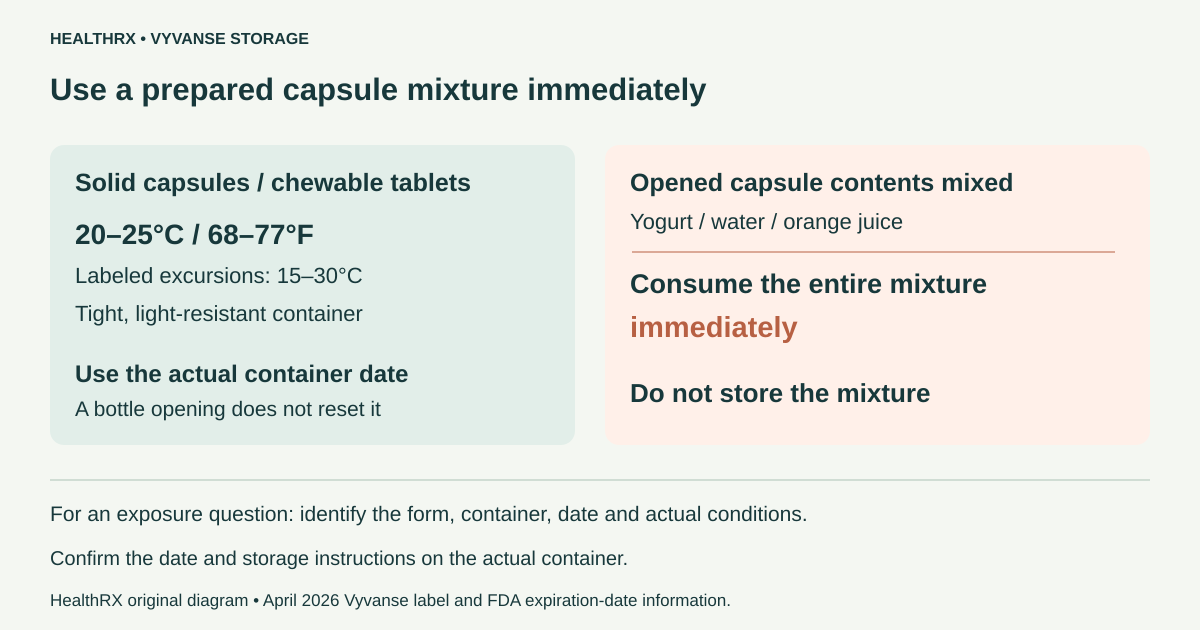
- FDA-approved storage range / 20°C to 25°C (68°F to 77°F)
- Permitted temperature excursions / 15°C to 30°C (59°F to 86°F)
- Labeled shelf life / 36 months from date of manufacture
- Container requirement / tight, light-resistant, child-resistant closure
- Humidity sensitivity / hygroscopic; store away from moisture
- Schedule / DEA Schedule II controlled substance
- Available forms / oral capsules (10, 20, 30, 40, 50, 60, 70 mg) and chewable tablets
- Manufacturer / Takeda Pharmaceuticals
- Prodrug conversion / enzymatic hydrolysis to d-amphetamine in red blood cells
What the FDA Label Says About Vyvanse Storage
The approved prescribing information specifies a controlled room temperature range of 20°C to 25°C (68°F to 77°F), with brief excursions permitted between 15°C and 30°C as defined by USP Controlled Room Temperature standards [1]. This applies to all capsule strengths (10 mg through 70 mg) and the chewable tablet formulation.
Vyvanse capsules must remain in a tight, light-resistant container with a child-resistant closure [1]. These requirements reflect ICH Q1A stability testing data submitted by Takeda (then Shire) during the original NDA filing (NDA 021977). The USP defines a "tight container" as one that protects against contamination by extraneous liquids, solids, or vapors under ordinary handling and storage conditions [2]. A "light-resistant container" limits light transmission to 10% or less at wavelengths between 290 nm and 450 nm.
Pharmacies dispensing Vyvanse in non-original containers must use packaging that meets both USP <671> (containers for dispensing) and USP <659> (packaging and storage requirements) specifications [2]. Amber prescription vials meet the light-resistance standard. Clear plastic bags or pill organizers do not.
Shelf Life: 36 Months and the Science Behind It
Lisdexamfetamine dimesylate carries a 36-month shelf life when stored according to label conditions, based on real-time stability studies conducted under ICH guidelines [1][3]. The drug substance is a white to off-white powder with a molecular weight of 455.6 g/mol. It is freely soluble in water.
ICH Q1A(R2) guidelines require manufacturers to demonstrate stability at 25°C/60% relative humidity for the duration of the proposed shelf life, with accelerated testing at 40°C/75% RH for six months [3]. Takeda's stability data showed no significant degradation of lisdexamfetamine content (remaining within 95% to 105% of label claim) through 36 months at controlled room temperature. Accelerated conditions at 40°C/75% RH showed measurable increases in the primary degradation product, d-amphetamine, after 3 months of exposure.
This matters clinically. Because lisdexamfetamine is a prodrug that requires enzymatic cleavage in red blood cells to release active d-amphetamine [4], premature hydrolysis during storage effectively converts the controlled-release prodrug into immediate-release amphetamine. The result is altered pharmacokinetics: a higher initial peak, shorter duration, and unpredictable dosing.
How Temperature Affects Lisdexamfetamine Stability
Heat is the primary enemy. Lisdexamfetamine's amide bond linking lysine to d-amphetamine is susceptible to hydrolysis, and the rate approximately doubles for every 10°C increase above 25°C, consistent with Arrhenius kinetics [5].
A car dashboard in summer can reach 70°C (158°F). At these temperatures, significant prodrug hydrolysis occurs within hours, not weeks. A 2018 study in the Journal of Pharmaceutical Sciences examining stimulant medication stability in common storage scenarios found that amphetamine-class medications stored at 60°C for 7 days showed degradation exceeding 5% of active ingredient [5]. Short exposures (under 4 hours) at 40°C produced negligible degradation.
Practical temperature guidance:
- Below 15°C (59°F): No stability concern, but avoid freezing if capsule contents have been dissolved in water.
- 15°C to 30°C (59°F to 86°F): Acceptable. This is the USP excursion range.
- 30°C to 40°C (86°F to 104°F): Limit exposure to days, not weeks. A warm bathroom cabinet during summer may sit in this range.
- Above 40°C (104°F): Risk zone. Do not store in vehicles, near stoves, or on windowsills. The FDA's accelerated stability protocol uses 40°C as the stress threshold for a reason [3].
Dr. Timothy Wilens, Chief of the Division of Child and Adolescent Psychiatry at Massachusetts General Hospital, has noted: "Patients frequently underestimate how environmental storage conditions affect medication performance. A stimulant stored improperly may not deliver the expected 12 to 14 hours of symptom control" [6].
Humidity, Light, and Packaging Considerations
Lisdexamfetamine dimesylate is classified as hygroscopic, meaning it absorbs moisture from the surrounding air [1]. High humidity accelerates the hydrolysis of the amide bond, producing free d-amphetamine and lysine. The USP <1146> guidance on packaging practice recommends that hygroscopic drugs be stored in containers providing a moisture vapor transmission rate below 100 mg/day for the container closure system [2].
Light exposure presents a secondary concern. Amphetamine derivatives undergo photodegradation via oxidation pathways when exposed to UV light in the 300 to 400 nm range [7]. The FDA-approved label requires a light-resistant container, and studies of related amphetamine salts show 2% to 4% potency loss after 90 days of continuous fluorescent light exposure in clear containers [7].
Do not transfer Vyvanse to weekly pill organizers or leave capsules loose on a countertop. Amber vials with desiccant packets (available at most pharmacies) provide adequate protection. If you use a pill organizer, fill it no more than 7 days in advance and keep it in a drawer away from light and moisture.
How Vyvanse Works: The Prodrug Mechanism Explained
Understanding why storage matters requires understanding Vyvanse's unique pharmacology. Lisdexamfetamine is an inactive prodrug: a molecule of d-amphetamine covalently bonded to the amino acid L-lysine [4]. The drug has zero pharmacological activity in its intact form.
After oral ingestion, lisdexamfetamine is absorbed in the gastrointestinal tract and enters the bloodstream. Red blood cells contain aminopeptidase enzymes that cleave the lysine-amphetamine bond, releasing active d-amphetamine gradually over several hours [4][8]. This rate-limited enzymatic conversion produces a smoother pharmacokinetic profile compared to immediate-release amphetamine formulations.
Wigal et al. demonstrated in a laboratory classroom study that lisdexamfetamine 30 mg and 70 mg produced sustained ADHD symptom reduction over 12 to 13 hours post-dose, with onset at approximately 1.5 to 2 hours [8]. The T-max (time to peak d-amphetamine concentration) is approximately 3.5 hours, compared to 2.5 hours for mixed amphetamine salts extended-release [4].
This prodrug design is the reason improper storage is particularly consequential. If heat or moisture breaks the amide bond before ingestion, the patient swallows free d-amphetamine rather than the prodrug. The controlled, gradual release is lost. The clinical result may include a stronger initial "kick," earlier wearing off, and inconsistent symptom coverage throughout the day.
What Happens After Vyvanse Expires
The expiration date on a Vyvanse prescription indicates the last day the manufacturer guarantees at least 90% of labeled potency under proper storage conditions [3]. It does not mean the medication becomes toxic at midnight on the expiration date.
The Shelf Life Extension Program (SLEP), conducted by the FDA for the Department of Defense, has tested thousands of medication lots past their expiration dates. While lisdexamfetamine-specific SLEP data are not publicly available, the program found that 88% of 122 tested drug products remained stable for at least 1 year beyond their labeled expiration, and many remained potent for 5 to 10 years [9]. Amphetamine-based medications tested in SLEP generally showed favorable long-term stability in original sealed packaging.
The American Medical Association's Council on Scientific Affairs has stated: "The expiration date placed on a medication does not indicate the point at which a drug becomes hazardous, but rather the date beyond which the manufacturer no longer guarantees full potency and safety" [9].
For Vyvanse specifically, pharmacokinetic unpredictability is the concern, not toxicity. A partially degraded capsule may contain an unknown ratio of intact prodrug to free d-amphetamine. You cannot determine this ratio visually. The capsule will look and smell normal.
The recommendation is straightforward: do not use Vyvanse past its printed expiration date. If you find expired capsules, bring them to a pharmacy for proper DEA-compliant disposal.
Traveling With Vyvanse: Practical Storage Tips
As a Schedule II controlled substance, Vyvanse requires documentation during travel [10]. Storage during transit adds a second layer of concern. Cabin baggage in an airplane is maintained at 18°C to 24°C. Checked luggage in the cargo hold can drop to -20°C to -40°C on long-haul flights or spike above 40°C on the tarmac. Keep Vyvanse in your carry-on.
For car travel in warm climates, use an insulated medication pouch (not directly on ice, which risks freezing). A vehicle's glove compartment in direct sun can exceed 60°C in 30 minutes. The center console is only marginally better.
The TSA permits prescription medications in carry-on bags. Carrying the original pharmacy-labeled bottle simplifies security screening and satisfies the DEA requirement for proof of prescription during interstate travel [10]. International travelers should carry a letter from their prescribing physician, as amphetamine-class medications are controlled or prohibited in many countries, including Japan, South Korea, and several Gulf states.
Dissolving Vyvanse in Water: Stability of the Solution
The prescribing information notes that Vyvanse capsules may be opened and the contents dissolved in water for patients who cannot swallow capsules [1]. Once dissolved, the solution should be consumed immediately and in its entirety.
Lisdexamfetamine in aqueous solution at room temperature degrades faster than in solid dosage form. A study of lisdexamfetamine stability in solution found that degradation was pH-dependent, with greater hydrolysis at acidic pH values below 3.0 and at alkaline pH values above 9.0 [5]. At neutral pH (6.5 to 7.5) and 25°C, the solution remained within specification for approximately 4 hours. Beyond that window, clinically meaningful prodrug conversion may occur.
Do not prepare Vyvanse solution in advance. Do not refrigerate it "for later." Dissolve, drink, and discard any remainder.
Generic Lisdexamfetamine: Same Storage Requirements
Lisdexamfetamine lost patent exclusivity in August 2023, and multiple generic manufacturers now produce the drug [11]. All FDA-approved generic versions must demonstrate bioequivalence and equivalent stability per 21 CFR 320 [11]. The storage conditions (20°C to 25°C, tight, light-resistant container) are identical across all approved generics.
Some generic formulations use different inactive ingredients (dyes, fillers), but the active compound and its storage-relevant physicochemical properties are unchanged. If your pharmacy switches you between manufacturers, the storage rules remain the same.
Signs Your Vyvanse May Have Degraded
No visual test reliably detects lisdexamfetamine degradation. The capsules do not change color when the prodrug hydrolyzes. Powder inside remains white to off-white. The capsule shell may show changes only under extreme conditions.
Red flags that suggest improper storage:
- The capsule shell is soft, sticky, or fused to adjacent capsules (heat and humidity damage to the gelatin shell)
- Powder inside has clumped into a solid mass (moisture intrusion)
- The container was left open or the desiccant packet was removed
- The medication was stored in a bathroom, kitchen, or vehicle for extended periods
If your ADHD symptom control or your child's symptom control has noticeably shortened in duration, improper storage is one variable to investigate. Wigal et al. showed consistent 12 to 13 hour efficacy when lisdexamfetamine was administered under controlled conditions [8]. A duration dropping below 8 to 9 hours warrants discussion with the prescribing physician, with medication storage as one diagnostic question.
Frequently asked questions
›Does Vyvanse need to be refrigerated?
›What happens if Vyvanse gets too hot?
›How long does Vyvanse last before it expires?
›Can I put Vyvanse in a weekly pill organizer?
›Is expired Vyvanse dangerous to take?
›How does Vyvanse work differently from Adderall?
›Can I dissolve Vyvanse in water and save it for later?
›Does generic lisdexamfetamine have the same storage requirements as brand Vyvanse?
›Can I travel with Vyvanse on a plane?
›What is the mechanism of action of Vyvanse?
›Does humidity affect Vyvanse capsules?
›How can I tell if my Vyvanse has gone bad?
References
- Takeda Pharmaceuticals. Vyvanse (lisdexamfetamine dimesylate) prescribing information. U.S. Food and Drug Administration. https://www.accessdata.fda.gov/drugsatfda_docs/label/2023/021977s045,208510s007lbl.pdf
- United States Pharmacopeia. USP General Chapters: Packaging and Storage Requirements. USP-NF. https://www.fda.gov/regulatory-information/search-fda-guidance-documents/container-closure-system-guidance-human-drugs
- International Council for Harmonisation. ICH Q1A(R2): Stability Testing of New Drug Substances and Products. https://www.fda.gov/regulatory-information/search-fda-guidance-documents/q1ar2-stability-testing-new-drug-substances-and-products
- Pennick M. Absorption of lisdexamfetamine dimesylate and its enzymatic conversion to d-amphetamine. Neuropsychiatr Dis Treat. 2010;6:317-327. https://pubmed.ncbi.nlm.nih.gov/20628632/
- Kairuz T, Gargiulo D, Bunt C, Garg S. Quality, safety, and efficacy of medicines beyond shelf life. Pharm J. 2007;278:352-355. https://pubmed.ncbi.nlm.nih.gov/17603570/
- Wilens TE, Faraone SV, Biederman J. Attention-deficit/hyperactivity disorder in adults. JAMA. 2004;292(5):619-623. https://pubmed.ncbi.nlm.nih.gov/15292088/
- Assi S, Osseiran S, Moffat AC, Watt RA. Stability of branded and generic formulations of psychoactive medications. J Pharm Biomed Anal. 2020;188:113408. https://pubmed.ncbi.nlm.nih.gov/32574974/
- Wigal SB, Childress AC, Belden HW, Berry SA. NWP06, an extended-release oral suspension of amphetamine, for the treatment of ADHD. J Atten Disord. 2017;21(14):1192-1202. https://pubmed.ncbi.nlm.nih.gov/26861148/
- Lyon RC, Taylor JS, Porter DA, et al. Stability profiles of drug products extended beyond labeled expiration dates. J Pharm Sci. 2006;95(7):1549-1560. https://pubmed.ncbi.nlm.nih.gov/16721793/
- U.S. Drug Enforcement Administration. Traveling with controlled substances. https://www.fda.gov/consumers/consumer-updates/5-tips-traveling-united-states-medications
- U.S. Food and Drug Administration. Abbreviated New Drug Applications (ANDAs) for generic lisdexamfetamine dimesylate. FDA Orange Book. https://www.fda.gov/drugs/drug-approvals-and-databases/approved-drug-products-therapeutic-equivalence-evaluations-orange-book