Wegovy Missed Dose: The Current FDA Instructions for Weekly Injections
At a glance
- Scope / once-weekly Wegovy injection; the daily Wegovy tablet has different missed-dose instructions
- One missed injection, next dose more than 48 hours away / inject as soon as possible
- One missed injection, next dose less than 48 hours away / skip it and resume on the regular day
- Exactly 48 hours / the label does not state which side of the boundary applies; confirm with a pharmacist or prescriber
- Two or more consecutive missed injections / resume as scheduled or, if needed, reinitiate and follow the escalation schedule
- Published universal restart table / none in the current FDA label
- Do not improvise / do not double a dose or substitute pen strengths to "catch up"
- Source checked / FDA Wegovy prescribing information, reference ID 5749750, accessed August 29, 2026
- Medical review / pending
Medical review status: This page was editorially checked against the current FDA prescribing information on August 29, 2026. Independent clinician sign-off is pending. It explains the label boundary and does not replace instructions from your prescriber or pharmacist.
First, Confirm Which Wegovy Form You Use
This page is about the single-dose pen used once each week. The current U.S. prescribing information also includes a once-daily Wegovy tablet for adults. Its missed-dose direction is different: skip a missed tablet and take the next dose the following day [1]. Do not apply the injection rule to tablets or the tablet rule to injections.
Questions about routine pen preparation, injection sites, and device use belong in the Wegovy self-injection guide, not in a catch-up schedule.
For the weekly injection, the current label frames the decision by the amount of time remaining before the next scheduled dose. That is more precise than the older shorthand "take it within five days," and it avoids ambiguity when a person has changed injection days.
One Missed Weekly Injection: Use the 48-Hour Decision Point
The FDA instructions in section 2.4 create two stated branches [1]:
- The next scheduled injection is more than 48 hours away: administer the missed injection as soon as possible.
- The next scheduled injection is less than 48 hours away: do not administer the missed injection. Resume on the regularly scheduled day.
The label uses "more than" and "less than." It does not say what to do at exactly 48 hours. That narrow boundary is a reason to ask a pharmacist or prescriber rather than silently converting the wording to "48 hours or more" or "48 hours or less."
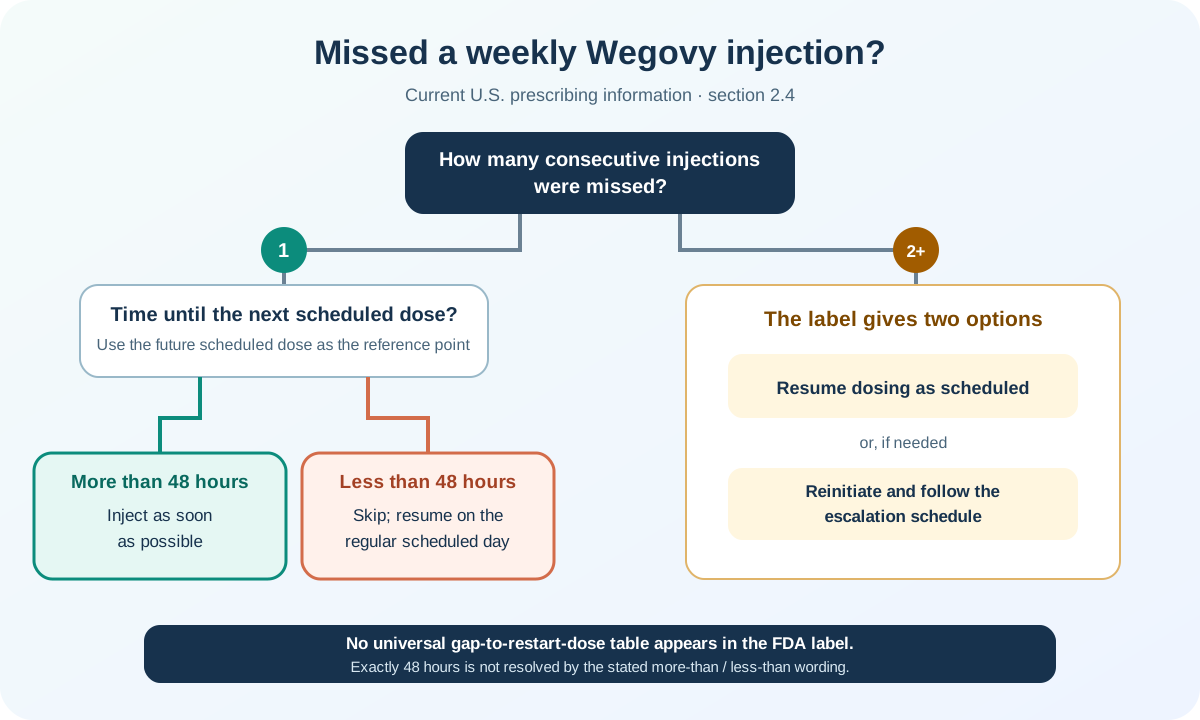
This map reproduces the choices stated in section 2.4 of the current U.S. prescribing information. It intentionally does not invent a dose for restarting after a longer gap.
Worked examples
- Usual day Monday; remembered on Wednesday: the next Monday dose is more than 48 hours away, so the labeled branch is to take the missed injection as soon as possible.
- Usual day Monday; remembered on Sunday: the next Monday dose is less than 48 hours away, so the labeled branch is to skip the missed injection and resume Monday.
- Usual day Monday; remembered on Saturday at the exact time that is 48 hours before the next dose: the label does not resolve the equality case. Confirm the plan rather than guessing.
These examples assume only one injection was missed and the regular schedule is known. They are not restart instructions for a multi-week interruption.
Two or More Consecutive Missed Injections: What the Label Actually Says
For two or more consecutive missed injections, the FDA label gives two possibilities [1]:
- resume dosing as scheduled; or
- if needed, reinitiate Wegovy injection and follow the dosage-escalation schedule, which may reduce gastrointestinal adverse reactions associated with reinitiation.
The regulator's exact wording is: "resume dosing as scheduled or, if needed, reinitiate WEGOVY injection and follow the dosage escalation schedule" [1]. This is a pair of labeled options, not an endorsement of either choice for every patient or of HealthRX.com.
That is the full labeled boundary. The label does not assign a restart dose based only on a two-, four-, six-, or eight-week gap. It does not say that everyone who misses a particular number of weeks should restart at 0.25 mg, 1 mg, or 1.7 mg. A fixed gap-to-dose table presented as an FDA protocol would therefore overstate the evidence.
The Medication Guide gives patient-facing language for a gap of two or more weeks: take the next dose on the regularly scheduled day or call the healthcare provider to discuss how to restart treatment [1]. Because the professional label offers a reinitiation option specifically to reduce gastrointestinal adverse reactions, contacting the prescriber is especially useful when the right option is unclear.
What Can Affect the Restart Decision
The label does not publish a complete decision algorithm, but a prescriber can evaluate facts that a generic web page cannot:
- the last dose strength you tolerated;
- whether you were still escalating or had reached maintenance;
- how many consecutive doses were missed;
- why treatment stopped, including vomiting, dehydration, surgery, or another illness;
- whether earlier dose increases caused substantial nausea, vomiting, diarrhea, or abdominal pain;
- use of insulin or an insulin secretagogue, which changes the hypoglycemia context;
- pregnancy plans or a newly recognized pregnancy; and
- whether the product and pen strength on hand match the active prescription.
These inputs explain why two people with the same calendar gap may receive different instructions. They do not establish an unofficial dosing protocol.
The Labeled Escalation Schedule Is a Reinitiation Option, Not a Gap Calculator
When reinitiation is needed, the label points back to the injection escalation schedule in section 2.2 [1]:
| Stage | Weekly injection dose |
|---|---|
| Weeks 1-4 | 0.25 mg |
| Weeks 5-8 | 0.5 mg |
| Weeks 9-12 | 1 mg |
| Weeks 13-16 | 1.7 mg |
| Week 17 onward for weight reduction | 2.4 mg recommended or 1.7 mg, selected by response and tolerability |
The table describes the labeled escalation sequence. It does not mean that a person who missed a certain number of weeks can choose a row independently. Section 2.4 leaves the choice between resuming and reinitiating patient-specific.
If a dose is not tolerated during escalation, the current label says clinicians may consider delaying escalation for four weeks [1]. That instruction addresses tolerability during escalation; it is not permission to design a new restart schedule without the prescriber.
Do Not Use Half-Life Math to Choose a Restart Dose
Semaglutide has an elimination half-life of about one week, and the label notes that it can remain in circulation for weeks after the last dose [1]. That pharmacokinetic fact helps explain why Wegovy is dosed weekly and why effects after excess dosing may require prolonged observation. The Wegovy pharmacokinetics page owns the deeper absorption and exposure evidence.
It does not validate a consumer formula such as "a certain percentage remains, therefore restart at a certain dose." Drug concentration, gastrointestinal tolerance, dose strength, and clinical circumstances are not interchangeable. The FDA could have supplied a gap-to-dose formula in section 2.4; it did not.
What Trials Can and Cannot Tell Us About a Missed Dose
The STEP trials established semaglutide's effects during structured treatment and showed what can happen after sustained withdrawal. They were not randomized comparisons of competing missed-dose strategies.
STEP 4 compared continued semaglutide with a switch to placebo after a 20-week run-in [2]. The STEP 1 extension followed participants after treatment and lifestyle intervention ended [3]. Those studies support the broader conclusion that continued treatment and discontinuation are different clinical states. They do not tell a person whether to inject on Saturday, skip until Monday, or restart at a particular dose after a three-week gap.
For the immediate missed-dose decision, the current prescribing information is the direct authority. Withdrawal studies are contextual evidence only.
Changing the Weekly Injection Day
The label permits changing the weekly administration day as long as the last dose was given two or more days before the new day [1]. That rule is separate from the missed-dose branches. Keep a written record of the actual injection date before changing days so you do not accidentally compress the interval.
If you took a late injection under the "more than 48 hours away" branch and want that day to become the new weekly day, confirm the next date from the actual last injection. When dates are uncertain, a pharmacist can help reconstruct the schedule from the pen, prescription record, and calendar.
If You Accidentally Took an Extra Dose
An extra injection is an overdose question, not a missed-dose question. Do not wait for an arbitrary symptom threshold or try to offset the dose with food. The current Wegovy label says overdose effects reported with other GLP-1 receptor agonists include severe nausea, severe vomiting, and severe hypoglycemia; it advises supportive treatment based on clinical signs and symptoms and says to consider contacting Poison Help at 1-800-222-1222 or a medical toxicologist [1]. Poison Control also directs people who took too much semaglutide to its online tool or the same phone number, available 24 hours a day [4].
Call emergency services for collapse, seizure, trouble breathing, inability to awaken, or another immediate emergency.
A Safer Call to the Prescriber or Pharmacist
Have these details ready:
- injection form and exact pen strength;
- usual injection day and time;
- date and time of the last injection actually taken;
- number of scheduled injections missed;
- current symptoms and the reason for the interruption;
- other glucose-lowering medicines; and
- the date and time of the next scheduled injection.
A precise timeline is more useful than saying "I missed a few weeks." Do not take a catch-up dose while waiting if doing so could place the next scheduled injection within the label's less-than-48-hour branch.
Evidence Ledger
| Page statement | Direct source and locator | What the source supports | What it does not support |
|---|---|---|---|
| One missed weekly injection uses the more-than/less-than-48-hour branch | FDA Wegovy label, section 2.4, page 4; Medication Guide, page 46 | The two stated injection choices | A consumer-created rule for exactly 48 hours |
| Two or more consecutive missed injections may be resumed as scheduled or reinitiated with escalation if needed | FDA Wegovy label, section 2.4, page 4 | Both labeled options and the GI-tolerability rationale | A universal restart strength for each gap length |
| Injection escalation runs 0.25, 0.5, 1, and 1.7 mg before maintenance | FDA Wegovy label, section 2.2, pages 3-4 | The labeled escalation sequence and maintenance choices | Self-selection of a restart row after an interruption |
| Wegovy has an approximately one-week half-life | FDA Wegovy label, sections 10 and 12.3 | Pharmacokinetic context and potential need for prolonged overdose observation | Dose selection from percentage-remaining calculations |
| Sustained withdrawal evidence is not missed-dose evidence | STEP 4 and STEP 1 extension study designs | Outcomes after continued treatment versus withdrawal or after treatment ended | Management of one missed injection or a validated restart dose |
| Poison Help is an appropriate resource after excess dosing | FDA Wegovy label, section 10; Poison Control semaglutide guidance | Poison Help number and toxicology guidance | A fixed home-observation or restart schedule |
Questions People Ask
Frequently asked questions
What should I do if I miss one Wegovy injection?
Is the Wegovy missed-dose rule five days or 48 hours?
What should I do at exactly 48 hours before the next injection?
Can I take two Wegovy injections close together to catch up?
Do two missed Wegovy doses mean I must restart at 0.25 mg?
What dose should I restart after three or four weeks off Wegovy?
Can I change my Wegovy injection day?
Does the same missed-dose rule apply to Wegovy tablets?
Will one missed injection undo my weight loss?
Should I use semaglutide half-life calculations to pick a restart dose?
References
- U.S. Food and Drug Administration. Wegovy (semaglutide) injection and tablets prescribing information. 2026 revision, Reference ID 5749750. See sections 2.2, 2.4, 10, 12.3, and the Medication Guide. Current FDA prescribing information
- Rubino D, Abrahamsson N, Davies M, et al. Effect of continued weekly subcutaneous semaglutide vs placebo on weight loss maintenance in adults with overweight or obesity: the STEP 4 randomized clinical trial. JAMA. 2021;325(14):1414-1425. doi:10.1001/jama.2021.3224. PMID:33755728; PMCID:PMC7988425; NCT03548987. PubMed record
- Wilding JPH, Batterham RL, Davies M, et al. Weight regain and cardiometabolic effects after withdrawal of semaglutide: the STEP 1 trial extension. Diabetes, Obesity and Metabolism. 2022;24(8):1553-1564. doi:10.1111/dom.14725. PMID:35441470; PMCID:PMC9542252; NCT03548935. PubMed record
- National Capital Poison Center. Is Ozempic safe? See "What do I do if I have a bad reaction to or take too much semaglutide?" Poison Control guidance