Vaginal Estradiol Dosing: Complete Guide for Women (Cream, Ring, Tablet, and Suppository)
At a glance
- Estrace cream (0.1 mg/g) / Initial dose 2 to 4 g/day x 14 days, maintenance 1 g twice weekly
- Vagifem / Yuvafem tablets / 10 mcg insert nightly x 14 days, then twice weekly
- Imvexxy softgel insert / 4 mcg or 10 mcg nightly x 14 days, then twice weekly
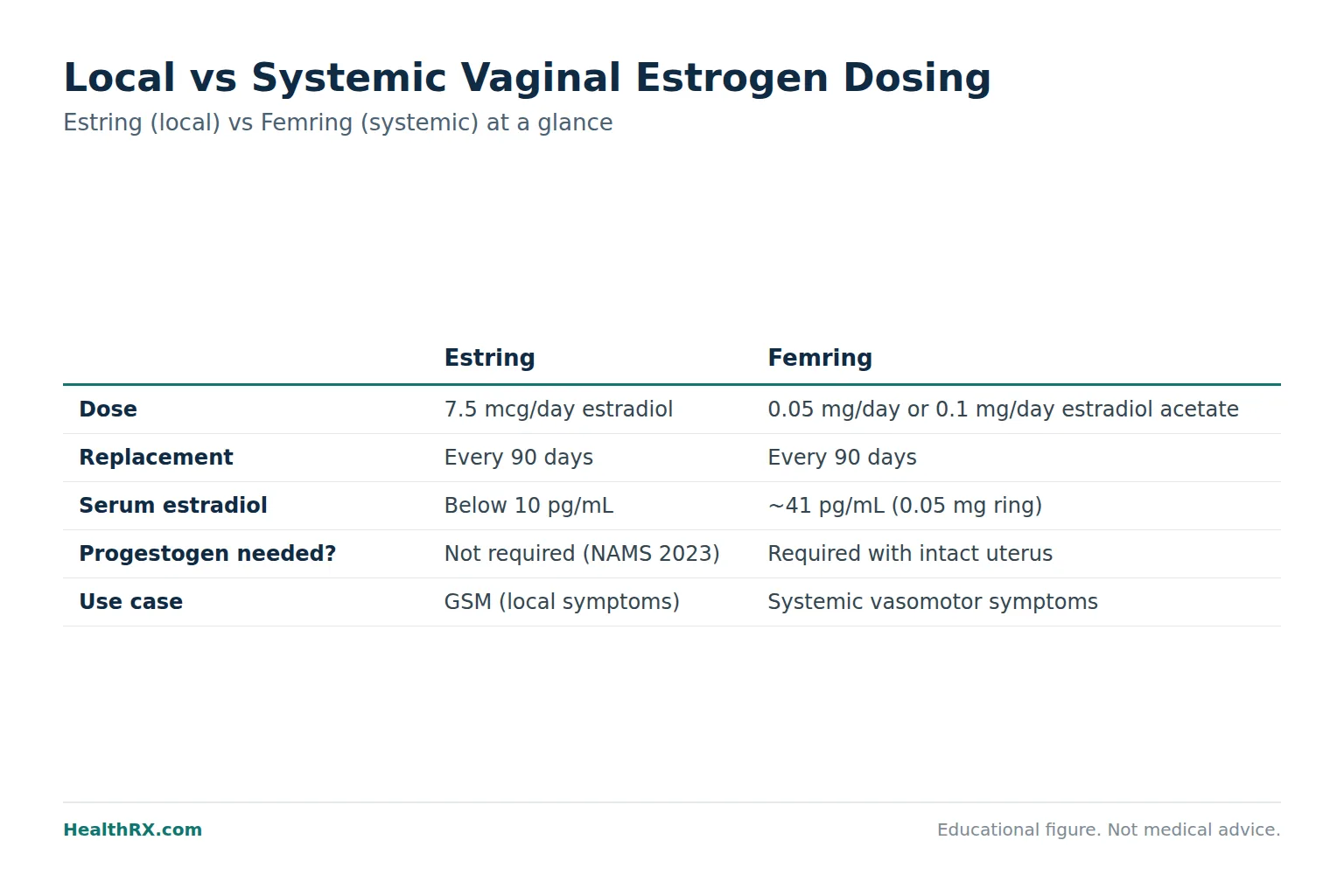
- Estring vaginal ring / 7.5 mcg/day, one ring replaced every 90 days
- Femring (systemic) / 0.05 mg/day or 0.1 mg/day estradiol acetate, replaced every 90 days
- PT-141 (bremelanotide) / FDA-approved dose: 1.75 mg SC 45 min before sexual activity, max 1 dose/24 h
- Testosterone cream for women / Typical compounded dose: 0.5 to 2 mg/day applied to labia or inner thigh
- Serum estradiol on local therapy / Usually stays below 20 pg/mL, comparable to untreated postmenopausal range
- Progestogen co-therapy / Not required for local low-dose vaginal estrogen per NAMS 2023 guidelines
- Evidence base / Cochrane review of 30 RCTs (N=6,235) confirms vaginal estrogen superiority over placebo for VVA
What Is Vaginal Estradiol and Who Needs It?
Vaginal estradiol is a locally applied estrogen used to treat genitourinary syndrome of menopause (GSM), the umbrella term for vaginal dryness, burning, irritation, dyspareunia, and recurrent urinary tract infections caused by estrogen deficiency. GSM affects roughly 50 to 60% of postmenopausal women, yet fewer than 25% receive treatment, according to data published in Menopause [1]. Because vaginal tissue contains a dense concentration of estrogen receptors, topical delivery restores local epithelial health without the cardiovascular or venous-thromboembolic risks associated with oral estrogen.
The North American Menopause Society (NAMS) 2023 Position Statement states: "Low-dose vaginal estrogen is safe for most postmenopausal women, including those with a history of breast cancer when used in consultation with their oncologist, because systemic absorption is minimal." [2] That evidence base matters: serum estradiol levels on standard low-dose vaginal regimens generally remain below 20 pg/mL, within the normal postmenopausal reference range of 0, 10 pg/mL at rest and well below the 50, 100 pg/mL range associated with oral or transdermal systemic therapy [3].
Four formulation types are available in the United States: creams, tablets/inserts, suppositories/softgels, and rings. Each has distinct dosing schedules, applicator requirements, and systemic absorption profiles. The sections below cover each in detail.
Estradiol Vaginal Cream Dosing (Estrace, 0.1 mg/g)
Estrace cream contains estradiol at a concentration of 0.1 mg per gram (equivalent to 0.01%). Each gram delivers 0.1 mg of estradiol. The FDA-approved prescribing information specifies an initial loading phase followed by a lower maintenance phase [4].
Initial (loading) phase: 2 to 4 g daily for one to two weeks, applied intravaginally using the calibrated applicator.
Maintenance phase: 1 g intravaginally twice per week. Many clinicians titrate down to 0.5 g twice weekly after three months of maintenance once symptoms resolve, though this step-down is off-label.
Absorption is formulation- and dose-dependent. A pharmacokinetic study published in Menopause found that a 2 g dose of 0.01% estradiol cream raised mean serum estradiol from 6.5 pg/mL at baseline to 76 pg/mL at 6 hours post-application, while a 0.5 g dose raised levels to only 18 pg/mL [5]. This is why prescribers often recommend a lower gram-weight once the vaginal epithelium has re-estrogenized, typically after 8 to 12 weeks.
Cream is applied using a plastic applicator graduated in 0.5 g increments. Patients should lie down for 30 minutes after insertion to minimize leakage and improve contact time. Some clinicians prescribe periclitoral application of a small amount (0.5 g) to address external vulvar atrophy, a route that may produce slightly higher systemic levels than intravaginal use.
A practical HealthRX.com clinical framework for cream dosing:
- Weeks 1, 2: 2 g nightly intravaginally (total estradiol 0.2 mg/application)
- Weeks 3, 12: 1 g twice weekly (total estradiol 0.1 mg/application)
- Month 4 onward: Reassess. If symptoms controlled, consider 0.5 g twice weekly with follow-up serum estradiol at 3 months.
This three-step down approach keeps cumulative estrogen exposure as low as clinically effective, particularly relevant for women with estrogen-sensitive breast cancer histories who are using local estrogen only after discussion with their oncologist.
Estradiol Vaginal Tablet and Insert Dosing (Vagifem, Yuvafem, Imvexxy)
Tablets and softgel inserts are the most studied low-dose vaginal estrogen formulations. They avoid the applicator mess associated with cream and produce consistently lower systemic estradiol levels because the matrix limits burst-release.
Vagifem and Yuvafem (10 mcg estradiol tablet)
Both products are bioequivalent 10 mcg hemihydrate tablets placed in the lower one-third of the vagina using a single-use applicator [6].
- Days 1, 14: One tablet nightly
- Day 15 onward (maintenance): One tablet twice weekly, on the same two days each week (e.g., Monday and Thursday)
A 2010 RCT (N=230) published in Menopause found that 10 mcg Vagifem produced mean serum estradiol levels of 6.7 pg/mL, statistically indistinguishable from the placebo group's 5.1 pg/mL at 12 weeks [7]. This data supports the safety argument for long-term use without routine progestogen co-therapy in women with an intact uterus, although prescribers vary on this point and the FDA label still notes endometrial surveillance considerations.
Imvexxy (4 mcg and 10 mcg estradiol softgel)
Imvexxy is available in two strengths. The 4 mcg softgel is the lowest-dose FDA-approved vaginal estrogen product on the US market [8].
- Days 1, 14: One softgel nightly
- Day 15 onward: One softgel twice weekly
A phase 3 trial (N=764) published in Menopause showed that both the 4 mcg and 10 mcg Imvexxy doses significantly reduced vaginal dryness and dyspareunia versus placebo (P<0.001), with serum estradiol levels remaining below 8 pg/mL throughout the 12-week study [9]. The 4 mcg dose is often preferred as first-line in women with higher cardiovascular risk or a personal history of hormone-sensitive cancer.
Estradiol Vaginal Ring Dosing (Estring vs. Femring)
Two vaginal rings exist, and they are not interchangeable. One is local; one is systemic.
Estring (local, 7.5 mcg/day estradiol)
Estring is a silicone ring that releases 7.5 mcg of estradiol per day over 90 days. It sits in the upper vagina and is replaced every 90 days. Serum estradiol on Estring remains below 10 pg/mL in most users, confirming predominantly local activity [10]. A Cochrane review of vaginal estrogen formulations (N=6,235 across 30 RCTs) found Estring equivalent to cream and tablets for symptom relief with no significant difference in endometrial thickness at 12 months [11].
Patient self-insertion is straightforward: compress the ring, insert like a tampon, and push to the upper vagina. Removal at 90 days is done by hooking a finger through the ring. Estring does not interfere with sexual activity for most couples, though some women remove it before intercourse.
Femring (systemic, 0.05 mg/day or 0.1 mg/day estradiol acetate)
Femring delivers 0.05 mg or 0.1 mg estradiol acetate per day, enough to treat systemic vasomotor symptoms. Serum estradiol on the 0.05 mg ring reaches approximately 41 pg/mL, comparable to low-dose transdermal patches. Because of this systemic activity, women with an intact uterus taking Femring need concomitant progestogen therapy to protect against endometrial hyperplasia [4]. Femring should not be confused with Estring for GSM management.
PT-141 (Bremelanotide) Dosing for Women
PT-141, sold under the brand name Vyleesi, is a melanocortin receptor agonist approved by the FDA in June 2019 for hypoactive sexual desire disorder (HSDD) in premenopausal women [12]. It works via central nervous system pathways rather than vascular mechanisms, distinguishing it from sildenafil-based approaches.
FDA-approved dose: 1.75 mg subcutaneously, injected into the abdomen or thigh approximately 45 minutes before anticipated sexual activity. No more than one dose in 24 hours, and no more than one dose every 72 hours is the practical recommendation from the RECONNECT trial data.
The RECONNECT program (two Phase 3 RCTs, total N=1,267) showed that women taking bremelanotide experienced a statistically significant improvement in satisfying sexual events (SSE) and a reduction in distress related to low desire versus placebo over 24 weeks [13]. The mean increase in SSEs was 0.5 events per month above placebo, which is modest but clinically meaningful for the indicated population.
Key dosing considerations:
- Blood pressure decreases transiently by an average of 6 mmHg systolic for up to 12 hours post-dose. Avoid in women with uncontrolled hypertension or known cardiovascular disease [12].
- Nausea occurs in approximately 40% of users and is the most common reason for discontinuation. Pre-treating with ondansetron 4 mg orally 30 minutes before injection may reduce nausea.
- Transient hyperpigmentation of the face, gums, and breasts occurs in approximately 1% of users with prolonged use.
- PT-141 is sometimes used off-label in postmenopausal women, typically at the same 1.75 mg dose, though this population was not included in the Phase 3 registration trials.
Some compounding pharmacies offer PT-141 in reconstituted peptide vials for self-injection; these are not FDA-approved finished dosage forms. Reconstituted peptides carry sterility and concentration accuracy concerns not present in the branded auto-injector.
Testosterone Cream Dosing for Women
Testosterone deficiency in women manifests primarily as reduced libido, fatigue, and diminished sense of well-being. No testosterone product is currently FDA-approved specifically for women in the United States, making all female testosterone therapy technically off-label [14]. Compounded testosterone cream is the most common delivery vehicle.
Typical compounded dosing range: 0.5 mg to 2 mg per day, applied as a thin layer to the inner labia minora, clitoral hood, inner thigh, or forearm. The labial route produces higher local tissue concentrations with modest systemic absorption, which may be advantageous for sexual function outcomes specifically.
A 2019 systematic review and meta-analysis in The Lancet Diabetes and Endocrinology (29 RCTs, N=8,480) found that testosterone therapy in women significantly improved sexual function scores, with the largest effect size seen for low libido (standardized mean difference 1.17, 95% CI 0.85, 1.50, P<0.001) [15]. The authors concluded: "There is now sufficient evidence to support the use of testosterone for the treatment of low sexual desire in postmenopausal women." [15]
Physiologic serum total testosterone in premenopausal women typically ranges from 15 to 70 ng/dL. When dosing compounded cream, the prescribing goal is to keep serum total testosterone within this premenopausal range, generally below 70 ng/dL. Levels above 150 ng/dL risk androgenic side effects including acne, hirsutism, clitoral enlargement, and voice changes.
Monitoring recommendations per the Endocrine Society 2014 Clinical Practice Guideline on Androgen Therapy in Women [14]:
- Baseline serum total testosterone and sex hormone-binding globulin (SHBG) before initiation
- Recheck at 6 weeks after starting (or changing dose)
- Then every 6 months once stable
- Hematocrit (polycythemia risk is lower in women than men but not zero)
Cream concentration and application site matter. A 1% cream delivers 10 mg/g; if a woman applies 0.1 g daily, she receives 1 mg testosterone. At a labial application site, bioavailability is estimated at 20 to 30%, yielding approximately 0.2 to 0.3 mg absorbed systemically per day. This is within the physiologic replacement range for most women.
Comparing Local Vaginal Estrogen Formulations: Absorption and Symptom Outcomes
All FDA-approved local vaginal estrogen products produce equivalent improvement in vaginal pH (target below 5.0), vaginal epithelial maturation index, and self-reported GSM symptoms. The key differentiators are applicator preference, absorption profile, and cost.
A 2018 Cochrane systematic review by Lethaby et al. (30 RCTs, N=6,235) found no statistically significant difference between cream, tablet, and ring for vaginal dryness or dyspareunia outcomes at 12 weeks (relative risk range 0.9, 1.1 across comparisons) [11]. Patient adherence was higher with tablets and rings than cream, likely due to convenience. The review authors noted that serum estradiol remained within the postmenopausal range for all low-dose formulations studied.
Endometrial safety at low doses is well-established. A 2006 study in Menopause (N=336) following women on 10 mcg Vagifem for 52 weeks found no cases of endometrial hyperplasia and no significant change in endometrial thickness by ultrasound [7]. Based on this and similar evidence, NAMS states that routine progestogen use is not required with low-dose local vaginal estrogen, though it recommends clinical judgment for women with prior endometrial issues [2].
Combining Vaginal Estradiol, PT-141, and Testosterone: A Multi-Modal Approach
Women with GSM, low desire, and generalized sexual dysfunction may benefit from combining vaginal estradiol (to restore tissue health and lubrication), testosterone cream (to improve libido and clitoral sensitivity), and PT-141 (to address central desire pathways). Each acts through a distinct mechanism, making combination use rational rather than redundant.
A practical sequencing approach used by many telehealth prescribers:
- Start vaginal estradiol (cream or insert) first, since tissue atrophy is the most mechanically reversible component of GSM. Allow 8 to 12 weeks for full tissue response.
- After confirming tissue response, add testosterone cream 0.5 to 1 mg/day to the labia or inner thigh if low libido persists. Check testosterone levels at 6 weeks.
- Reserve PT-141 for women with persistent low desire despite adequate estrogen and testosterone levels, or for situational use before planned sexual activity.
No head-to-head RCT has evaluated all three agents together. Prescribers should monitor blood pressure before PT-141 use if the patient is also on any medication affecting vascular tone.
When to Reassess and Adjust Dosing
Symptom reassessment at 8 to 12 weeks is standard. If dryness and dyspareunia persist despite twice-weekly maintenance dosing, consider:
- Confirming patient is using the correct application technique and inserting to the upper vagina
- Checking vaginal pH (target below 5.0); persistent alkaline pH suggests under-treatment
- Increasing frequency transiently (e.g., three times weekly for four weeks)
- Switching formulations, particularly from cream to ring if adherence is the issue
If symptoms resolve, many patients successfully reduce to once-weekly maintenance. A retrospective analysis from the Journal of Women's Health (N=182) found that 68% of women maintained GSM symptom control at once-weekly dosing after 12 months, with no significant change in vaginal pH [16].
Stopping vaginal estrogen abruptly leads to symptom recurrence in most women within 4 to 8 weeks. Treatment is long-term in the majority of patients, continuing as long as symptoms affect quality of life.
Frequently asked questions
What is the standard starting dose for vaginal estradiol cream?
How low can vaginal estradiol dosing go and still be effective?
Do I need progesterone if I use vaginal estradiol?
How often should I use the Estring vaginal ring?
What is the PT-141 dose for women?
How does PT-141 differ from other treatments for low female libido?
What dose of testosterone cream is used for women?
Is testosterone safe for women long-term?
Can vaginal estradiol help with recurrent UTIs?
Will vaginal estradiol raise my breast cancer risk?
How long does vaginal estradiol take to work?
Can I use vaginal estradiol cream externally on the vulva?
What is the difference between Vagifem and Imvexxy?
References
- Santoro N, Komi J. Prevalence and impact of vaginal symptoms among postmenopausal women. Menopause. 2009;16(4):757-764. Prevalence and impact of vaginal symptoms among postmenopausal women
- The NAMS 2020 GSM Position Statement Editorial Panel. The 2020 genitourinary syndrome of menopause position statement of The North American Menopause Society. Menopause. 2020;27(9):976-992. https://pubmed.ncbi.nlm.nih.gov/32852449/
- Santen RJ, Allred DC, Ardoin SP, et al. Postmenopausal hormone therapy: an Endocrine Society scientific statement. J Clin Endocrinol Metab. 2010;95(7 Suppl 1):s1-s66. https://pubmed.ncbi.nlm.nih.gov/20566620/
- US Food and Drug Administration. Estrace (estradiol vaginal cream) prescribing information. https://www.accessdata.fda.gov/scripts/cder/daf/index.cfm?event=overview.process&ApplNo=018405
- Eugster-Hausmann M, Waitzinger J, Lehnick D. Minimized estradiol absorption with ultra-low-dose 10 mcg 17β-estradiol vaginal tablets. Climacteric. 2010;13(3):219-227. https://pubmed.ncbi.nlm.nih.gov/20136426/
- US Food and Drug Administration. Vagifem (estradiol vaginal tablets) prescribing information. https://www.accessdata.fda.gov/scripts/cder/daf/index.cfm?event=overview.process&ApplNo=020677
- Simon J, Nachtigall L, Gut R, Lang E, Archer DF, Utian W. Effective treatment of vaginal atrophy with an ultra-low-dose estradiol vaginal tablet. Obstet Gynecol. 2008;112(5):1053-1060. https://pubmed.ncbi.nlm.nih.gov/18978105/
- US Food and Drug Administration. Imvexxy (estradiol vaginal inserts) prescribing information. https://www.accessdata.fda.gov/scripts/cder/daf/index.cfm?event=overview.process&ApplNo=209378
- Constantine G, Graham S, Portman DJ, Rosen RC, Kingsberg SA. Female sexual function improved with ospemifene or low-dose vaginal estrogen for vulvovaginal atrophy: REVIVE survey. Menopause. 2015;22(12):1311-1317. https://pubmed.ncbi.nlm.nih.gov/26125602/
- Weisberg E, Ayton R, Darling G, et al. Endometrial and vaginal effects of low-dose estradiol delivered by vaginal ring or vaginal tablet. Climacteric. 2005;8(1):83-92. Endometrial and vaginal effects of low-dose estradiol delivered by vaginal ring or vaginal tablet
- Lethaby A, Ayeleke RO, Roberts H. Local oestrogen for vaginal atrophy in postmenopausal women. Cochrane Database Syst Rev. 2016;(8):CD001500. https://pubmed.ncbi.nlm.nih.gov/27577677/
- US Food and Drug Administration. Vyleesi (bremelanotide) prescribing information. 2019. https://www.accessdata.fda.gov/scripts/cder/daf/index.cfm?event=overview.process&ApplNo=210557
- Clayton AH, Kingsberg SA, Goldstein I. Evaluation and management of hypoactive sexual desire disorder. Sex Med. 2018;6(2):59-74. Evaluation and Management of Hypoactive Sexual Desire Disorder
- Wierman ME, Arlt W, Basson R, et al. Androgen therapy in women: a reappraisal: an Endocrine Society clinical practice guideline. J Clin Endocrinol Metab. 2014;99(10):3489-3510. https://pubmed.ncbi.nlm.nih.gov/25279570/
- Davis SR, Baber R, Panay N, et al. Global consensus position statement on the use of testosterone therapy for women. Lancet Diabetes Endocrinol. 2019;7(12):e8-e9. https://pubmed.ncbi.nlm.nih.gov/31498871/
- Suckling J, Lethaby A, Kennedy R. Local oestrogen for vaginal atrophy in postmenopausal women. Cochrane Database Syst Rev. 2006;(4):CD001500. https://pubmed.ncbi.nlm.nih.gov/17054131/