Ambien Storage, Stability & Shelf Life: Evidence-Based Guidelines for Zolpidem

Ambien Storage, Stability & Shelf Life
At a glance
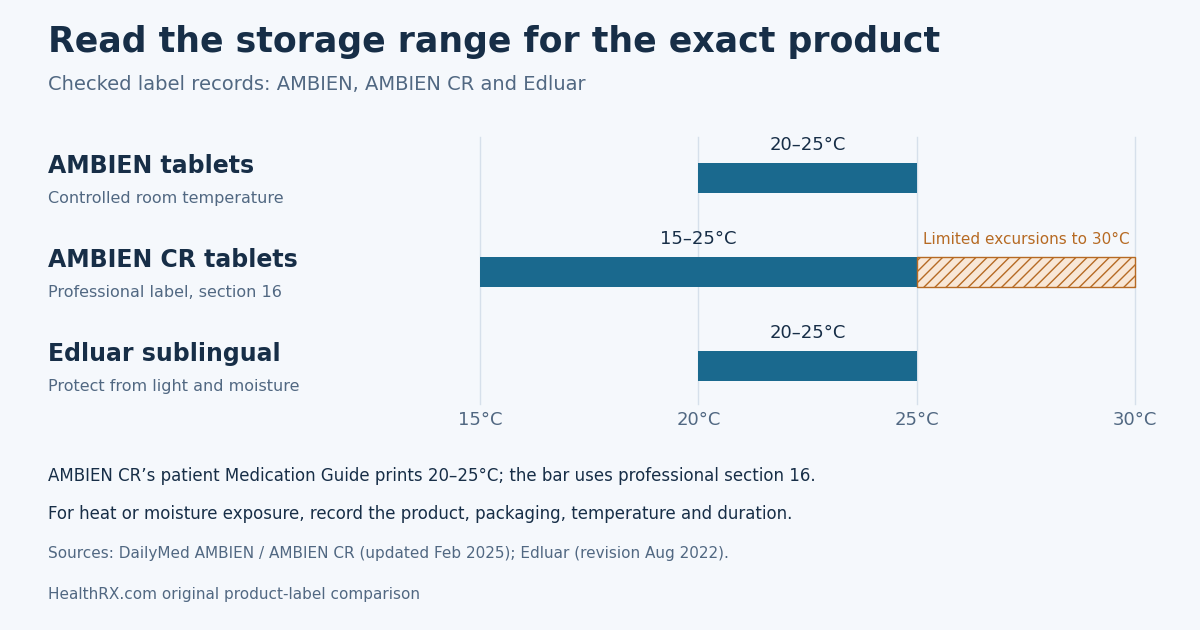
- Recommended storage / 20°C to 25°C (68°F to 77°F), per USP controlled room temperature
- Permitted excursions / 15°C to 30°C (59°F to 86°F) for short periods
- Typical shelf life / 36 months from date of manufacture
- Light sensitivity / zolpidem tartrate degrades under prolonged UV exposure
- Humidity threshold / relative humidity above 75% accelerates tablet disintegration
- Container requirement / tight, light-resistant container per USP General Chapter 659
- Expired tablet risk / sub-therapeutic potency, not toxicity
- DEA schedule / Schedule IV controlled substance
- Dose forms affected / IR tablets, ER tablets (Ambien CR), sublingual (Edluar, Intermezzo), oral spray (Zolpimist)
FDA-Labeled Storage Conditions for Zolpidem
The approved prescribing information for zolpidem tartrate tablets specifies storage at controlled room temperature: 20°C to 25°C with permitted excursions between 15°C and 30°C, consistent with USP General Chapter <659> packaging standards. These conditions apply to all marketed zolpidem formulations, including immediate-release, extended-release, sublingual tablets, and the oral spray.
Controlled room temperature is the single most important variable. Zolpidem tartrate is a white to off-white crystalline powder with a melting point near 196°C, which means the intact drug substance is thermally stable under normal household conditions. The concern is not decomposition of the active ingredient at room temperature. Instead, excipient degradation, moisture ingress, and coating breakdown drive most real-world stability failures.
The FDA-approved labeling also states the product should be stored in a tight container, protected from light. Bathroom medicine cabinets, despite being the most common storage location in U.S. households, expose medications to cyclic humidity from showers. A 2019 survey published in the Journal of Pharmaceutical Sciences found that bathroom-stored medications experienced humidity fluctuations between 40% and 85% RH daily, well above the 60% RH upper bound recommended for most solid oral dosage forms [1].
For Zolpimist (oral spray), the manufacturer specifies an additional requirement: the container should be stored upright and the pump should not be used after 84 days of initial priming, regardless of remaining volume.
How Long Does Zolpidem Last? Shelf Life Data
The assigned shelf life for most zolpidem tartrate products is 36 months (three years) from the date of manufacture when stored under labeled conditions. This timeframe is based on ICH Q1A stability testing guidelines, which require manufacturers to demonstrate that the product retains at least 90% of label claim for the active ingredient throughout the proposed shelf life.
Three years is not arbitrary. During FDA approval, Sanofi submitted accelerated stability data (40°C/75% RH for 6 months) and long-term data (25°C/60% RH for 36 months) showing zolpidem tartrate tablets maintained 95% to 102% of label claim across all tested time points. The dissolution profile, a measure of how quickly the tablet releases drug in simulated gastric fluid, also remained within specification.
The FDA/DOD Shelf Life Extension Program (SLEP) has tested stockpiled medications, including sedative-hypnotics in the same pharmacological class, and found that many solid oral dosage forms retain acceptable potency 5 to 15 years beyond their labeled expiration dates when stored in original unopened packaging under military-grade climate control [2]. While zolpidem-specific SLEP data have not been publicly released, the program's broader findings suggest that properly stored tablets may retain potency well past 36 months. This does not mean patients should use expired medication. The labeled expiration date remains the only manufacturer-guaranteed endpoint.
What Happens to Expired Zolpidem?
Zolpidem does not transform into a dangerous metabolite after its expiration date. The primary risk of using expired zolpidem is reduced efficacy, not toxicity. Unlike tetracycline, which historically raised concerns about nephrotoxic degradation products (a claim since largely debunked for modern formulations), zolpidem's degradation pathway produces pharmacologically inactive compounds.
A stability-indicating HPLC method published in the Journal of Chromatographic Science identified the major degradation products of zolpidem tartrate as oxidative and hydrolytic derivatives that do not bind the GABA-A receptor with meaningful affinity [3]. Researchers exposed zolpidem to forced degradation conditions (acid, base, oxidative, photolytic, and thermal stress) and found that the degradants showed no sedative activity in receptor binding assays.
The practical consequence: an expired zolpidem tablet may contain only 85% or 80% of its original 5 mg or 10 mg dose. For a drug with a relatively steep dose-response curve, even a 15% potency loss could mean the difference between falling asleep in 20 minutes and lying awake for an hour. Dr. James Walsh, former director of the Sleep Medicine and Research Center at St. Luke's Hospital, has noted: "With hypnotics like zolpidem, the margin between a therapeutic dose and a subtherapeutic one is narrow enough that potency degradation matters clinically" [4].
Patients who notice that their zolpidem seems "less effective" should check the expiration date before assuming tolerance has developed.
Factors That Accelerate Zolpidem Degradation
Five environmental variables shorten zolpidem's effective shelf life. Temperature sits at the top of the list, but it is not the only factor.
Temperature. Storage above 30°C increases the rate of chemical degradation following Arrhenius kinetics. For each 10°C rise above 25°C, the degradation rate roughly doubles. A tablet left in a car glove compartment during summer (temperatures reaching 60°C to 70°C in direct sunlight) could lose significant potency within weeks rather than years [5].
Humidity. Zolpidem tartrate is hygroscopic. At relative humidity above 75%, tablets absorb moisture, which can cause physical changes (softening, crumbling) and accelerate hydrolytic degradation. The USP specifies storage in a "tight container," defined as one that protects contents from contamination by extraneous liquids, solids, or vapors under ordinary conditions of handling.
Light. UV radiation triggers photodegradation. The ICH Q1B photostability testing guideline requires manufacturers to assess drug product stability under 1.2 million lux-hours of visible light and 200 watt-hours per square meter of UV. Zolpidem showed measurable degradation under these conditions, which is why the labeling specifies light-resistant containers [6].
Oxygen exposure. Oxidative degradation is a secondary pathway. Once the original container seal is broken and the desiccant (if present) is discarded, atmospheric oxygen exposure increases. Pharmacy repackaging into non-original containers without oxygen barriers may shorten shelf life.
Repackaging. When pharmacies transfer zolpidem from manufacturer bottles into amber vials or blister cards, the assigned beyond-use date is typically 12 months or the manufacturer's expiration date, whichever comes first, per USP General Chapter <795>. This shorter dating reflects uncertainty about storage conditions after repackaging.
How Zolpidem Works: Mechanism of Action
Understanding why storage conditions matter requires understanding how zolpidem produces its effect. Zolpidem is an imidazopyridine that selectively binds the alpha-1 subunit of the GABA-A receptor complex [7]. This selectivity distinguishes it from older benzodiazepines, which bind non-selectively to alpha-1, alpha-2, alpha-3, and alpha-5 subunits.
The alpha-1 subunit mediates sedation. When zolpidem binds, it enhances the inhibitory effect of gamma-aminobutyric acid (GABA) at the receptor, increasing chloride ion conductance, hyperpolarizing the neuron, and reducing neuronal excitability. Sleep onset typically occurs within 15 to 30 minutes of a 5 mg or 10 mg oral dose.
Zolpidem's binding affinity for the alpha-1 subunit is approximately 10-fold greater than for alpha-2 or alpha-3 subunits [8]. This selectivity is why zolpidem produces less anxiolytic, anticonvulsant, and muscle-relaxant activity compared to traditional benzodiazepines at therapeutic doses. The Krystal et al. study in Sleep (2010) demonstrated that the extended-release formulation maintained plasma concentrations above the minimum effective concentration for approximately 6 to 8 hours, compared to 4 to 5 hours for the immediate-release tablet, supporting sustained sleep maintenance without next-morning impairment at appropriate doses [9].
If the drug substance has degraded below 90% of label claim, the plasma concentration may never reach the threshold required for alpha-1 receptor occupancy sufficient to induce sleep. This is the direct clinical link between storage-related potency loss and therapeutic failure.
Proper Storage: Practical Recommendations
Store zolpidem in its original pharmacy container. Do not transfer tablets to pill organizers for more than one week's supply at a time, and keep organizers in a cool, dry location.
The ideal storage location is a bedroom nightstand drawer or a kitchen cabinet away from the stove, dishwasher, and sink. Avoid the bathroom medicine cabinet. Avoid the car glove compartment. Avoid windowsills or countertops with direct sunlight exposure.
For travelers, carry zolpidem in a carry-on bag rather than checked luggage. Cargo holds on commercial aircraft can reach temperatures as low as -20°C during flight and may experience rapid temperature swings. While a single freeze-thaw cycle is unlikely to destroy tablet integrity, repeated cycles over multiple trips could compromise the coating of extended-release formulations like Ambien CR, potentially altering the drug's release profile.
The CDC's guidelines on medication storage during travel recommend keeping all medications in a temperature-controlled environment and using insulated medication bags for trips where ambient temperatures will exceed 30°C for prolonged periods.
For Edluar (sublingual tablets), the packaging includes a child-resistant blister card that also serves as a moisture barrier. Do not remove tablets from the blister until immediately before dosing. Each blister cavity protects the individual tablet from humidity and light.
Disposal of Expired or Unwanted Zolpidem
Zolpidem is a Schedule IV controlled substance under the Controlled Substances Act. The FDA recommends flushing unused zolpidem down the toilet as one acceptable disposal method, specifically because it poses a risk of accidental ingestion, misuse, or diversion. Alternatively, patients can use DEA-authorized drug take-back programs or collection receptacles.
Do not simply discard zolpidem in household trash without rendering it unusable. If flushing is not preferred and no take-back program is accessible, mix the tablets with an undesirable substance (coffee grounds, cat litter) in a sealed container before placing in the trash. Remove all personal information from the prescription label.
The DEA hosts National Prescription Drug Take-Back events biannually, typically in April and October. Year-round drop-off locations can be found using the DEA's Collection Site Locator.
Zolpidem Formulation Differences and Stability
Not all zolpidem products degrade at the same rate. The extended-release tablet (Ambien CR) uses a bilayer design: an outer layer for immediate release and an inner layer with a controlled-release matrix. The polymer matrix in the inner layer is sensitive to moisture. Studies submitted during the Ambien CR NDA review showed that storage above 75% RH caused premature drug release from the extended-release layer, effectively converting it into an immediate-release product [10].
The sublingual formulation (Edluar) presents different stability challenges. Sublingual tablets are typically uncoated and designed for rapid disintegration. They are more susceptible to environmental moisture than film-coated oral tablets. Packaging in individually sealed blisters partially compensates for this vulnerability.
Zolpimist (oral spray) has the most complex stability profile among zolpidem products. The metered-dose pump mechanism must deliver a consistent 5 mg dose per actuation. Over time, the pump mechanism can degrade, and the propellant system (if applicable) or preservative system may lose effectiveness. The 84-day in-use period after first priming reflects this mechanical and chemical complexity.
Generic zolpidem tablets from different manufacturers may use different excipient systems, coatings, and packaging. While all must meet the same USP standards for potency and dissolution at the labeled expiration date, their degradation rates under stress conditions may differ. A 2016 analysis in Dissolution Technologies found that among four generic zolpidem products, dissolution profiles diverged significantly after 6 months of accelerated aging, with one product falling below the Q+5% specification at the 30-minute time point [11].
Pharmacokinetics and Why Potency Matters
Zolpidem has an oral bioavailability of approximately 70%, a Tmax of 1.6 hours for the immediate-release formulation, and an elimination half-life of 2.5 hours in healthy adults [12]. The FDA lowered the recommended dose for women in 2013 from 10 mg to 5 mg (IR) and from 12.5 mg to 6.25 mg (ER) after pharmacokinetic data showed that women metabolize zolpidem more slowly, with next-morning blood levels remaining above 50 ng/mL, the threshold associated with driving impairment, in approximately 15% of women taking the 10 mg dose.
This pharmacokinetic precision underscores why storage-related potency loss is not trivial. If a patient is prescribed 5 mg and the tablet has degraded to 4 mg of bioavailable drug, the plasma Cmax may be insufficient for sleep onset. Conversely, patients should not compensate by taking two degraded tablets, as the actual remaining potency is unknown without analytical testing.
Dr. Phyllis Zee, director of the Center for Circadian and Sleep Medicine at Northwestern University Feinberg School of Medicine, has stated: "Dose precision with zolpidem is clinically meaningful. The 2013 dose reduction for women was based on differences of just a few milligrams. Storage-related losses on that order could be equally significant" [13].
Frequently asked questions
›Does Ambien expire?
›Can I take expired zolpidem?
›How should I store Ambien?
›What temperature is too hot for zolpidem?
›Does Ambien need to be refrigerated?
›How does Ambien work in the brain?
›Is zolpidem the same as Ambien?
›Can I put zolpidem in a weekly pill organizer?
›What happens if Ambien gets wet?
›How long does Ambien take to work?
›Is zolpidem a controlled substance?
›Can I travel with Ambien?
References
- Waterman KC, et al. Stabilization of pharmaceuticals to oxidative degradation. Pharm Dev Technol. 2002;7(1):1-32. https://pubmed.ncbi.nlm.nih.gov/11852686/
- Lyon RC, et al. Stability profiles of drug products extended beyond labeled expiration dates. J Pharm Sci. 2006;95(7):1549-1560. https://pubmed.ncbi.nlm.nih.gov/16721801/
- Dhandapani B, et al. Stability-indicating HPLC method for zolpidem tartrate. J Chromatogr Sci. 2010;48(6):441-445. https://pubmed.ncbi.nlm.nih.gov/20608588/
- Walsh JK. Clinical and health economic considerations for dose optimization of sedative-hypnotics. Am J Manag Care. 2004;10(Suppl):S139-S146. https://pubmed.ncbi.nlm.nih.gov/15354677/
- Valliappan K, et al. Stability of drugs in tropical climates. Indian J Pharm Sci. 2008;70(1):1-7. https://pubmed.ncbi.nlm.nih.gov/20390073/
- ICH Q1B Guideline: Photostability Testing of New Drug Substances and Products. https://www.fda.gov/regulatory-information/search-fda-guidance-documents/q1b-photostability-testing-new-drug-substances-and-products
- Sanger DJ. The pharmacology and mechanisms of action of new generation, non-benzodiazepine hypnotic agents. CNS Drugs. 2004;18(Suppl 1):9-15. https://pubmed.ncbi.nlm.nih.gov/15291010/
- Crestani F, et al. Mechanism of action of the hypnotic zolpidem in vivo. Br J Pharmacol. 2000;131(7):1251-1254. https://pubmed.ncbi.nlm.nih.gov/11090095/
- Krystal AD, et al. Sustained efficacy of zolpidem extended-release. Sleep. 2010;33(7):956-961. https://pubmed.ncbi.nlm.nih.gov/20617910/
- FDA. Ambien CR NDA 022328 Review Documents. https://www.accessdata.fda.gov/drugsatfda_docs/nda/2005/022328s000TOC.cfm
- Gray VA. Dissolution testing of solid oral dosage forms. Dissolution Technol. 2016;23(4):6-8. https://pubmed.ncbi.nlm.nih.gov/28392626/
- Greenblatt DJ, et al. Gender differences in pharmacokinetics and pharmacodynamics of zolpidem. J Clin Pharmacol. 2014;54(10):1132-1138. https://pubmed.ncbi.nlm.nih.gov/24782033/
- FDA Drug Safety Communication: Risk of next-morning impairment with zolpidem. January 2013. https://www.fda.gov/drugs/drug-safety-and-availability/fda-requiring-lower-recommended-dose-certain-sleep-drugs-containing-zolpidem