Statin Dose Equivalence Chart: How to Switch Statins Safely

At a glance
- Guideline source / 2018 ACC/AHA Cholesterol Guideline defines three intensity tiers
- High-intensity definition / lowers LDL-C by 50% or more
- Moderate-intensity definition / lowers LDL-C by 30 to 49%
- Rosuvastatin equivalence / 10 mg rosuvastatin ≈ 20 mg atorvastatin ≈ 40 mg simvastatin
- Most potent approved dose / rosuvastatin 40 mg (up to 55-60% LDL-C reduction)
- Atorvastatin ceiling / 80 mg daily (up to 55% LDL-C reduction)
- Recheck LDL-C after switch / 4 to 12 weeks post-conversion
- Drug interactions to reassess / warfarin INR and CYP3A4-sensitive antihypertensives after any statin change
- Myopathy risk trigger / CK elevation greater than 10x ULN warrants immediate hold
- FDA simvastatin 80 mg restriction / contraindicated in new patients since 2011
Why Statin Dose Equivalence Matters
Switching from one statin to another without consulting an equivalence table risks undertreating atherosclerotic cardiovascular disease (ASCVD) or exposing patients to unnecessary side-effect burden. The 2018 ACC/AHA Guideline on the Management of Blood Cholesterol classifies statins into high-, moderate-, and low-intensity tiers based on the expected percentage reduction in LDL-C, not on milligram dose [1]. A prescriber who converts simvastatin 40 mg to atorvastatin 40 mg will overshoot the target; one who converts rosuvastatin 20 mg to simvastatin 20 mg will leave the patient substantially undertreated.
Formulary changes, drug interactions, side-effect profiles, and cost-assistance eligibility all drive statin switches in clinical practice. Getting the conversion right on day one reduces the number of follow-up labs needed and keeps patients on target for their LDL-C goal.
The Three Intensity Tiers Defined by ACC/AHA
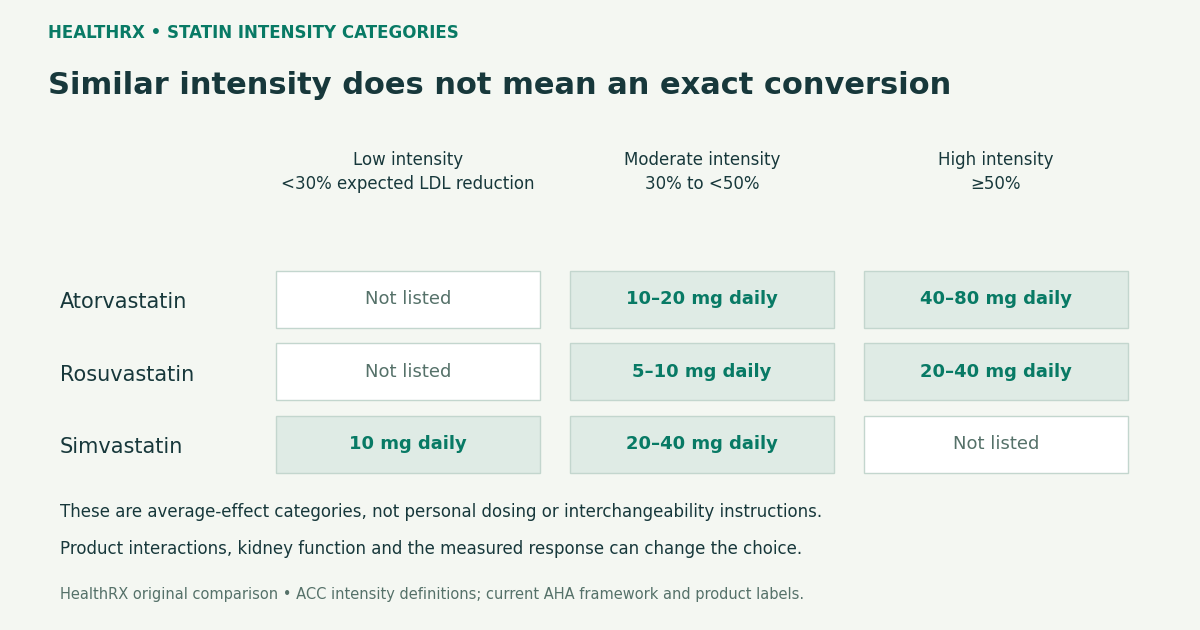
The 2018 ACC/AHA guideline states directly: "High-intensity statin therapy lowers LDL-C by approximately 50% or more." [1] Moderate-intensity therapy lowers LDL-C by 30 to 49%, and low-intensity therapy produces reductions below 30%. These thresholds drive every equivalence calculation below.
High-intensity statins (target: LDL-C reduction of 50% or more)
- Atorvastatin 40 mg or 80 mg
- Rosuvastatin 20 mg or 40 mg
Moderate-intensity statins (LDL-C reduction 30 to 49%)
- Atorvastatin 10 mg or 20 mg
- Rosuvastatin 5 mg or 10 mg
- Simvastatin 20 mg or 40 mg
- Pravastatin 40 mg or 80 mg
- Lovastatin 40 mg or 80 mg
- Fluvastatin XL 80 mg
- Pitavastatin 1 to 4 mg
Low-intensity statins (LDL-C reduction less than 30%)
- Simvastatin 10 mg
- Pravastatin 10 mg or 20 mg
- Lovastatin 20 mg
- Fluvastatin 20 mg or 40 mg
The FDA restricted new prescriptions of simvastatin 80 mg in 2011 due to myopathy risk, so that dose is not listed in current equivalence tables [2].
Full Statin Dose Equivalence Chart
The table below aligns each statin dose with its approximate LDL-C lowering percentage, its intensity tier, and its nearest equivalent across the two most commonly prescribed agents (atorvastatin and rosuvastatin). Percentage estimates come from the ACC/AHA guideline appendix and supporting meta-analyses [1, 3].
| Statin | Dose (mg/day) | Approx. LDL-C Reduction | Intensity Tier | Atorvastatin Equivalent | Rosuvastatin Equivalent | |---|---|---|---|---|---| | Rosuvastatin | 5 | 38-40% | Moderate | 10 mg |, | | Rosuvastatin | 10 | 43-46% | Moderate | 20 mg |, | | Rosuvastatin | 20 | 50-52% | High | 40 mg |, | | Rosuvastatin | 40 | 55-60% | High | 80 mg |, | | Atorvastatin | 10 | 37-39% | Moderate |, | 5 mg | | Atorvastatin | 20 | 43-46% | Moderate |, | 10 mg | | Atorvastatin | 40 | 49-52% | High |, | 20 mg | | Atorvastatin | 80 | 53-55% | High |, | 40 mg | | Simvastatin | 20 | 32-35% | Moderate | 10 mg | 5 mg | | Simvastatin | 40 | 37-41% | Moderate | 10-20 mg | 5-10 mg | | Pravastatin | 40 | 30-34% | Moderate | 10 mg | 5 mg | | Pravastatin | 80 | 33-36% | Moderate | 10-20 mg | 5-10 mg | | Pitavastatin | 2 | 36-38% | Moderate | 10 mg | 5 mg | | Pitavastatin | 4 | 39-42% | Moderate | 20 mg | 10 mg | | Lovastatin | 40 | 31-34% | Moderate | 10 mg | 5 mg | | Fluvastatin XL | 80 | 33-36% | Moderate | 10 mg | 5 mg |
How to read this table: Find the patient's current statin and dose in the left columns. The equivalent atorvastatin or rosuvastatin dose in the right columns delivers a similar percentage LDL-C reduction. Always recheck LDL-C 4 to 12 weeks after switching to confirm the clinical response [1].
Step-by-Step Statin Switching Protocol
Statin switches fail most often because of two errors: skipping a wash-out period when it is needed, and not reassessing interacting medications after the switch. The protocol below addresses both.
Step 1. Confirm the Clinical Indication for Switching
Common valid reasons include formulary change, intolerance of one agent (typically myalgia), drug-drug interaction with the current statin, or cost. Document the reason. Patients stopping a statin for side effects should have a documented CK level and liver function panel before starting the new agent.
Step 2. Identify the Required Intensity Tier
The 2018 ACC/AHA guideline specifies high-intensity therapy for patients aged 75 or younger with clinical ASCVD, LDL-C of 190 mg/dL or more, or diabetes with a 10-year ASCVD risk of 7.5% or higher [1]. Confirm the target tier before selecting the conversion dose.
Step 3. Select the Conversion Dose
Use the table above. Rosuvastatin is roughly twice as potent as atorvastatin on a milligram-for-milligram basis. When switching from a hydrophilic statin (rosuvastatin, pravastatin) to a lipophilic one (atorvastatin, simvastatin), start at the lower bound of the equivalent range and titrate if the 6-week LDL-C is not at goal.
Step 4. Assess Drug Interactions Before Writing the Prescription
Atorvastatin and simvastatin are metabolized primarily by CYP3A4. Rosuvastatin is metabolized by CYP2C9 and organic anion transporting polypeptide 1B1 (OATP1B1). Switching from one to the other can change the exposure of co-prescribed drugs that share these pathways [4].
Common interactions to reassess:
- Warfarin. Both atorvastatin and rosuvastatin may increase the anticoagulant effect of warfarin, likely through CYP2C9 competition. A 2012 cohort study in Pharmacotherapy found that initiating rosuvastatin in warfarin-treated patients increased mean INR by 0.5 within 30 days. Recheck INR 7 to 10 days after adding or switching to rosuvastatin [5].
- Amlodipine and other CYP3A4-sensitive antihypertensives. Simvastatin plasma levels increase 77% when co-administered with amlodipine 10 mg, per FDA labeling [2]. Switching from simvastatin to atorvastatin or rosuvastatin removes that interaction; a patient on simvastatin plus amlodipine who switches to rosuvastatin may find their blood pressure medications perform differently without the shared metabolic competition.
- Direct oral anticoagulants (DOACs). Apixaban and rivaroxaban are CYP3A4 substrates. Simvastatin at high doses may weakly compete for CYP3A4, modestly raising DOAC exposure. Switching to rosuvastatin, which bypasses CYP3A4 almost entirely, is the preferred option for patients on apixaban or rivaroxaban who also need high-intensity statin therapy [6].
Step 5. Schedule Follow-Up Labs
Order a fasting lipid panel and liver function tests 4 to 12 weeks after the switch. If CK was elevated before the switch, recheck CK at 6 weeks. A CK elevation of more than 10 times the upper limit of normal with muscle symptoms warrants holding the statin and reassessing the diagnosis [1].
Blood Pressure Medication Titration After a Statin Switch
Changing a statin is a pharmacologically active event, not a background administrative task. Two BP drug classes deserve specific attention.
Calcium Channel Blockers (CCBs)
Amlodipine, diltiazem, and verapamil all interact differently with statins. The simvastatin 80 mg restriction arose in part because of the severe myopathy cases seen when simvastatin was combined with diltiazem or verapamil; both drugs inhibit CYP3A4 and raise simvastatin AUC by 3- to 5-fold [2]. A patient switching from simvastatin to atorvastatin while on diltiazem should have their atorvastatin dose confirmed against the diltiazem interaction cap (atorvastatin 20 mg maximum with diltiazem per prescribing information) [4].
Renin-Angiotensin-Aldosterone System (RAAS) Agents
ACE inhibitors and ARBs do not share metabolic pathways with statins. No dose adjustment is required when switching statins in a patient on lisinopril, ramipril, losartan, or valsartan. This class is the most statin-compatible antihypertensive option for patients who need both high-intensity statin therapy and reliable BP control.
HealthRX Statin-Switch BP Titration Decision Tree (original framework)
- Is the patient on a non-dihydropyridine CCB (diltiazem or verapamil)?
- Yes: Switch to rosuvastatin (CYP3A4-independent). No dose cap applies.
- No: Proceed to step 2.
- Is the patient on amlodipine and simvastatin?
- Yes: If switching simvastatin to atorvastatin, cap atorvastatin at 40 mg or consider rosuvastatin instead.
- No: Standard equivalence conversion applies.
- Recheck BP 4 weeks after statin switch. Removing a CYP3A4 inhibitor or substrate may alter the effective plasma exposure of dihydropyridine CCBs and require dose reassessment.
Switching Anticoagulants Around a Statin Change
Anticoagulant management is the most time-sensitive downstream task when changing statins. Two situations require structured protocols.
Warfarin Patients Switching Statins
Warfarin's narrow therapeutic index (target INR 2.0 to 3.0 for most indications) makes any drug interaction clinically significant. Both rosuvastatin and fluvastatin inhibit CYP2C9, the primary metabolic pathway for the S-enantiomer of warfarin [5]. Switching a warfarin patient from pravastatin (which does not inhibit CYP2C9) to rosuvastatin may raise INR by 0.3 to 0.8 points. The reverse switch (rosuvastatin to pravastatin) may lower INR into the subtherapeutic range, raising thrombotic risk.
Protocol:
- Obtain baseline INR on the day of the statin switch.
- Recheck INR at 7 days.
- Recheck again at 14 days if any change was seen at day 7.
- Do not adjust the warfarin dose preemptively; wait for actual INR data.
DOAC Patients Switching Statins
Switching anticoagulant class (DOAC to warfarin or vice versa) is a separate clinical decision from switching statins, but the two events are sometimes conflated when a patient undergoes a full medication reconciliation. The Anticoagulation Forum's 2021 guidance distinguishes between switching direct thrombin inhibitors (dabigatran) and factor Xa inhibitors (apixaban, rivaroxaban, edoxaban) [6].
When switching from warfarin to a factor Xa inhibitor during a concurrent statin change:
- Discontinue warfarin and start the DOAC when INR falls below 2.0 for most agents (below 3.0 for edoxaban per labeling).
- Rosuvastatin is preferred over simvastatin in this window because it does not affect INR trajectory during the warfarin washout period.
- Renal function (CrCl) must be confirmed before selecting the DOAC dose, as renal impairment affects all four approved agents differently [6].
When switching from a DOAC to warfarin (less common, typically for valvular AF or antiphospholipid syndrome):
- Start warfarin 5 to 7 days before stopping the DOAC to allow therapeutic INR bridging.
- The statin switch, if needed, should be timed at least 2 weeks after INR is stable to avoid confounding CYP2C9 interactions.
A 2020 analysis in The Lancet Haematology (N=82,000 patients across four AF registries) found that inadequate bridging during anticoagulant class switches accounted for 23% of early post-switch strokes, most of which occurred within the first 14 days [7].
Myopathy Risk and Dose Ceilings
Statin-associated muscle symptoms (SAMS) affect 5 to 10% of patients in clinical practice, though the SAMSON trial (N=200) showed that 90% of muscle symptom burden was attributable to the nocebo effect rather than pharmacological statin action [8]. Even so, genuine myositis and rhabdomyolysis exist and require dose-specific vigilance.
The 2018 ACC/AHA guideline lists these absolute dose ceilings to manage myopathy risk:
- Simvastatin 20 mg maximum with amiodarone
- Simvastatin 10 mg maximum with amlodipine or ranolazine
- Simvastatin is contraindicated with gemfibrozil, cyclosporine, or danazol [1]
Rosuvastatin has dose-specific restrictions in Asian patients. Its prescribing information recommends a starting dose of 5 mg in patients of Asian ancestry due to approximately 2-fold higher plasma concentrations compared with other populations [4].
CK monitoring thresholds per ACC/AHA [1]:
- CK 3 to 10x ULN with symptoms: reduce dose or switch to a lower-intensity statin
- CK more than 10x ULN with or without symptoms: hold statin, hydrate, monitor renal function
Ezetimibe and PCSK9 Inhibitor Add-On: When Equivalence Is Not Enough
Some patients cannot tolerate any statin at an LDL-C-reducing dose sufficient to reach their target. The IMPROVE-IT trial (N=18,144) showed that adding ezetimibe 10 mg to simvastatin 40 mg reduced major cardiovascular events by an additional 6.4% relative to simvastatin alone over 7 years [9]. That combination delivers approximately 50 to 55% LDL-C reduction, matching high-intensity monotherapy.
For patients with ASCVD and LDL-C above 70 mg/dL on maximally tolerated statin therapy, PCSK9 inhibitors are the next step. Evolocumab 140 mg every 2 weeks reduced LDL-C by 59% from baseline in the FOURIER trial (N=27,564) on top of moderate-to-high-intensity statin therapy, and reduced cardiovascular death, MI, or stroke by 15% over 2.2 years [10].
Special Populations: Pregnancy, Chronic Kidney Disease, and Drug Interactions
Pregnancy. All statins carry FDA category X (now contraindicated under the 2015 labeling rule changes) for use during pregnancy. Discontinue any statin in a patient who becomes pregnant and do not restart until after breastfeeding is complete [2].
Chronic kidney disease (CKD stages 3 to 5 not on dialysis). The SHARP trial (N=9,438) showed that simvastatin 20 mg plus ezetimibe 10 mg reduced major atherosclerotic events by 17% (P<0.001) in CKD patients without requiring dose adjustment for renal function [11]. Rosuvastatin requires dose capping at 10 mg daily in patients with CrCl below 30 mL/min [4].
Elderly patients (age 75 and above). Benefit-risk is less certain for primary prevention in this age group. The 2018 ACC/AHA guideline recommends a clinician-patient discussion weighing polypharmacy burden against absolute risk reduction before initiating or intensifying statin therapy in patients aged 75 and above [1].
Monitoring Checklist After Any Statin Switch
Prescribers should document completion of each of the following steps within 12 weeks of switching statins:
- Fasting lipid panel at 4 to 12 weeks to confirm LDL-C response
- ALT at 12 weeks (routine monitoring, though severe hepatotoxicity is rare)
- INR at 7 days if the patient is on warfarin
- CK if baseline CK was elevated or patient reports new muscle symptoms
- BP reassessment at 4 weeks if patient is on a CCB with CYP3A4-interaction potential
- Renal function review if patient is on a DOAC and the statin switch changes CYP interactions affecting DOAC plasma levels
- Medication reconciliation for all CYP3A4 and CYP2C9 substrates affected by the new statin
In the FOURIER trial population, LDL-C measured at 4 weeks after initiating evolocumab was predictive of 2-year cardiovascular outcomes, confirming that early lab reassessment has clinical weight, not just administrative value [10].
Frequently asked questions
›What is the equivalent dose of rosuvastatin to atorvastatin?
›Is simvastatin 40 mg the same as atorvastatin 10 mg?
›How long after switching statins should I recheck my cholesterol?
›Can I switch from simvastatin to rosuvastatin without a break?
›What is a high-intensity statin?
›Does switching statins affect my blood pressure medication?
›How do I switch from warfarin to a DOAC when also changing statins?
›What are the signs that my statin dose is too high after switching?
›Is pitavastatin equivalent to atorvastatin?
›Can I take a statin with apixaban or rivaroxaban?
›What statin is safest in chronic kidney disease?
›Why was simvastatin 80 mg restricted by the FDA?
References
- Grundy SM, Stone NJ, Bailey AL, et al. 2018 AHA/ACC/AACVPR/AAPA/ABC/ACPM/ADA/AGS/APhA/ASPC/NLA/PCNA Guideline on the Management of Blood Cholesterol. J Am Coll Cardiol. 2019;73(24):e285-e350. https://pubmed.ncbi.nlm.nih.gov/30423393/
- U.S. Food and Drug Administration. FDA Drug Safety Communication: New restrictions, contraindications, and dose limitations for Zocor (simvastatin) to reduce the risk of muscle injury. 2011. https://www.fda.gov/drugs/drug-safety-and-availability/fda-drug-safety-communication-new-restrictions-contraindications-and-dose-limitations-zocor
- Adams SP, Tsang M, Wright JM. Lipid-lowering efficacy of rosuvastatin. Cochrane Database Syst Rev. 2014;(11):CD010254. https://pubmed.ncbi.nlm.nih.gov/25412809/
- U.S. Food and Drug Administration. Crestor (rosuvastatin calcium) prescribing information. https://www.accessdata.fda.gov/drugsatfda_docs/label/2010/021366s016lbl.pdf
- Westergren T, Johansson P, Molden E. Probable warfarin-rosuvastatin interaction: a case series. Ann Pharmacother. 2007;41(7):1289-1293. https://pubmed.ncbi.nlm.nih.gov/17596509/
- Gould MK, Garcia DA, Wren SM, et al. Prevention of VTE in nonorthopedic surgical patients: Antithrombotic Therapy and Prevention of Thrombosis, 9th ed: ACCP Guidelines. Chest. 2012;141(2 Suppl):e227S-e277S. https://pubmed.ncbi.nlm.nih.gov/22315263/
- Yao X, Abraham NS, Alexander GC, et al. Effect of adherence to oral anticoagulants on risk of stroke and major bleeding among patients with atrial fibrillation. J Am Heart Assoc. 2016;5(2):e003074. https://pubmed.ncbi.nlm.nih.gov/26908412/
- Wood FA, Howard JP, Finegold JA, et al. N-of-1 trial of a statin, placebo, or no treatment to assess side effects. N Engl J Med. 2020;383(22):2182-2184. https://pubmed.ncbi.nlm.nih.gov/33196154/
- Cannon CP, Blazing MA, Giugliano RP, et al. Ezetimibe added to statin therapy after acute coronary syndromes. N Engl J Med. 2015;372(25):2387-2397. https://pubmed.ncbi.nlm.nih.gov/26039521/
- Sabatine MS, Giugliano RP, Keech AC, et al. Evolocumab and clinical outcomes in patients with cardiovascular disease. N Engl J Med. 2017;376(18):1713-1722. https://pubmed.ncbi.nlm.nih.gov/28304224/
- Baigent C, Landray MJ, Reith C, et al. The effects of lowering LDL cholesterol with simvastatin plus ezetimibe in patients with chronic kidney disease (SHARP). Lancet. 2011;377(9784):2181-2192. https://pubmed.ncbi.nlm.nih.gov/21663949/