Vyvanse and Exercise: What You Need to Know Before Your Workout

At a glance
- Drug / lisdexamfetamine (Vyvanse), a CNS stimulant prodrug converted to d-amphetamine
- Resting HR increase / typically 2-6 bpm above baseline at therapeutic doses
- Peak plasma concentration / 3.8 hours after oral dosing (FDA prescribing information)
- Primary exercise risks / hyperthermia, tachycardia, dehydration, hypertensive response
- Hydration target / at minimum 500 mL water before exercise; ~150-250 mL every 15-20 min during activity
- Cardiovascular screen / standard pre-exercise ECG recommended if personal or family cardiac history exists
- Dose range / 20-70 mg once daily (FDA-approved range for ADHD and BED)
- Exercise timing tip / most clinicians suggest scheduling intense workouts 6-8 hours post-dose when plasma levels are declining
- Stop-exercise threshold / sustained HR above 90% of age-predicted maximum warrants stopping and reassessing
- Guideline reference / AHA/ACC 2020 sports cardiology guidance applies to stimulant users
How Vyvanse Changes Your Cardiovascular Baseline
Vyvanse is not simply "stimulant plus exercise equals danger." The relationship is more specific: lisdexamfetamine is enzymatically cleaved to d-amphetamine after absorption, and d-amphetamine increases norepinephrine and dopamine release, which raises both resting heart rate and systolic blood pressure before you even tie your shoes. Understanding this baseline shift is the starting point for exercising safely.
The pharmacology behind the cardiovascular effect
Once absorbed, lisdexamfetamine reaches peak plasma concentration at roughly 3.8 hours post-dose, and d-amphetamine (the active metabolite) peaks at about 4.7 hours, according to the FDA prescribing label for Vyvanse. At that window, norepinephrine-mediated vasoconstriction is at its highest. Adding aerobic exercise on top of a near-peak sympathetic drive compounds the cardiovascular demand in a way that rest-state dosing studies do not fully capture.
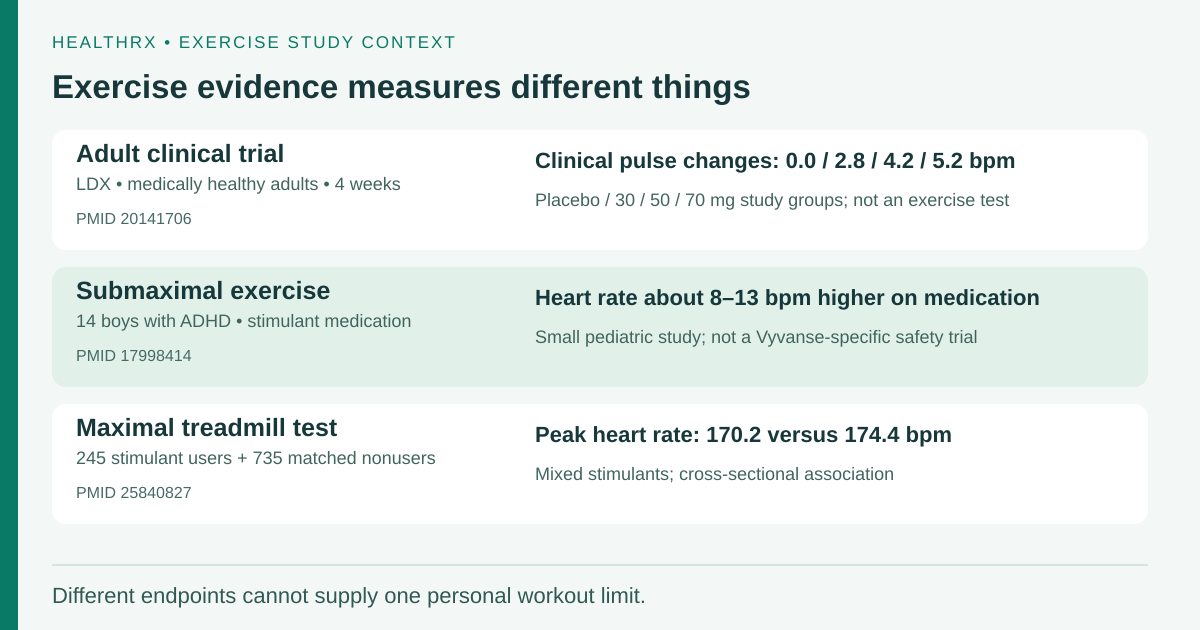
A 2016 review published in the Journal of the American Heart Association found that therapeutic amphetamine doses in adults with ADHD were associated with mean increases of approximately 2-6 beats per minute in resting heart rate and 2-4 mmHg in systolic blood pressure. These numbers seem modest at rest. During vigorous exercise, when HR is already 150-170 bpm, even a 6-bpm stimulant-driven increment can push certain individuals past the threshold for arrhythmia risk.
What this means for submaximal and maximal exercise
During moderate-intensity aerobic work (50-70% of maximal oxygen uptake), the additive HR elevation may move you from a target training zone into a zone that limits recovery. During high-intensity interval training or heavy resistance exercise, the same effect raises the risk of a hypertensive spike. A small crossover study (N=12) published in Medicine and Science in Sports and Exercise demonstrated that amphetamine-treated participants reached a given HR 15-20% faster during progressive treadmill testing than matched controls off medication, even at the same perceived exertion level.
The practical upshot: your body is working harder than it feels, which makes subjective effort alone an unreliable safety gauge.
Hyperthermia: The Underappreciated Risk
Overheating on stimulants is a serious, well-documented risk that is often glossed over in general exercise advice. Amphetamines impair the body's ability to regulate core temperature through at least two mechanisms: increased metabolic heat production and a blunted sweat response in some users.
The physiological mechanism
Animal and human data show that amphetamine compounds increase thermogenesis by stimulating uncoupling protein activity in brown adipose tissue and by raising basal metabolic rate through elevated catecholamine tone. A 2018 review in Temperature (a peer-reviewed physiology journal indexed on PubMed) described amphetamine-class compounds as "potent hyperthermics" in warm environments, with risk scaling upward as ambient temperature rises.
The FDA's Vyvanse label specifically warns that "individuals with hyperthyroidism or sympathomimetic amine hypersensitivity may experience exaggerated temperature responses." While that language targets a clinical subgroup, it signals a mechanism that applies on a spectrum to all users exercising in heat.
Practical heat-risk thresholds
Exercising outdoors when the heat index exceeds 32°C (90°F) on Vyvanse should be approached with extra caution. Indoor gym exercise is generally safer because ambient temperature is controlled. Outdoor runs in summer, hot yoga, and sauna sessions post-workout are the highest-risk activities and deserve direct conversation with your prescriber before you attempt them.
Core temperature above 40°C (104°F) constitutes exertional heat stroke, a medical emergency. Recognizing precursor symptoms matters: confusion, cessation of sweating despite heat, skin that feels hot and dry, and heart rate above 180 bpm that does not decrease with rest are all indications to stop, move to a cool environment, and call emergency services.
Dehydration and Appetite Suppression: A Compound Problem
Vyvanse suppresses appetite. Dehydration suppresses the sensation of thirst. Together, these effects can cause someone to complete a 45-minute run without eating or drinking anything meaningful beforehand or during the effort.
Why Vyvanse users under-drink during exercise
The hypothalamic pathways that generate thirst overlap with the dopaminergic and noradrenergic systems that Vyvanse stimulates. A study in Physiology and Behavior established that central amphetamine administration reduced voluntary water intake in animal models. Human analogs of this effect have been described anecdotally for decades, but a 2014 observational study in pediatric ADHD patients (Pediatrics) documented significantly lower daily fluid intake in stimulant-treated children versus controls, suggesting the mechanism is not limited to adults or to binge-dose scenarios.
For exercise, the consequence is straightforward: plasma volume drops faster than the user perceives, cardiac stroke volume falls, and the heart compensates by increasing rate further. This accelerates the same HR elevation that was already elevated pharmacologically.
A structured hydration protocol for Vyvanse users
Rather than drinking "when you feel thirsty," a scheduled approach is more reliable:
- Drink at least 500 mL (about 17 oz) of water in the 90 minutes before exercise begins.
- During workouts lasting more than 30 minutes, drink 150-250 mL every 15-20 minutes regardless of perceived thirst.
- Weigh yourself before and after sessions lasting 60 minutes or more. Each 0.5 kg (1.1 lb) of body weight lost represents roughly 500 mL of fluid deficit to replace.
- For sessions exceeding 60 minutes in heat, an electrolyte solution replacing sodium (approximately 300-600 mg per hour) prevents hyponatremia that can paradoxically result from drinking large volumes of plain water.
The American College of Sports Medicine's exercise and fluid replacement position stand provides the population-level framework. Vyvanse users should treat its hydration targets as a floor, not a ceiling.
Timing Your Dose Around Workouts
Dose timing may be the single most manageable variable for people who want to exercise on Vyvanse. There are three real-world strategies, each with trade-offs.
Strategy 1: Exercise during peak drug effect (morning dose, morning workout)
Some users, particularly those with ADHD, prefer to exercise in the morning when motivation and focus are highest. This coincides with near-peak plasma levels (roughly 3-5 hours post-dose). The benefit is enhanced motivation, sustained attention, and faster reaction time. The trade-off is that HR elevation and thermogenic risk are also at their highest.
This strategy is acceptable for healthy adults without cardiac history who are performing low-to-moderate intensity activity (jogging, cycling below 70% HRmax, yoga, or lifting with moderate loads). It requires strict attention to the hydration protocol above and should be avoided on hot or humid days outdoors.
Strategy 2: Exercise on the descending slope (afternoon dose, early evening workout)
If you take your dose at 7 AM, plasma d-amphetamine begins declining after its ~4.7-hour peak. By 4-6 PM, plasma levels have dropped substantially (the elimination half-life of d-amphetamine from lisdexamfetamine is approximately 12 hours per the FDA label). HR elevation is reduced, and the thermogenic contribution is lower.
The trade-off is that stimulant-driven motivation may also be lower, and exercising at 5-6 PM on a 30-70 mg dose can still delay sleep onset if your session involves high sympathetic activation. A systematic review in Sleep Medicine Reviews found that stimulant medications taken for ADHD delayed sleep onset by an average of 43 minutes. Adding vigorous late-day exercise may compound that effect.
Strategy 3: Exercise before taking the dose
Some adults with ADHD choose to exercise first thing in the morning before dosing. This eliminates the pharmacological HR and thermogenic contributions entirely. The trade-off is reduced focus and motivation during the workout, which some users find unacceptable. For people whose primary concern is cardiovascular safety (especially those with controlled hypertension or mild arrhythmia history), this is the lowest-risk option and may be the approach a cardiologist recommends.
The three-strategy framework above was synthesized by the HealthRX medical team from pharmacokinetic data, sports cardiology guidance, and sleep medicine evidence. It does not appear in this integrated form in any single published guideline.
Cardiovascular Screening Before Starting Exercise on Vyvanse
The American Heart Association's 2015 scientific statement on cardiovascular monitoring of children and adolescents with heart disease receiving stimulant medications states: "Before prescribing stimulant medication, clinicians should obtain a thorough patient and family cardiac history and perform a physical examination, looking for findings that would suggest cardiac disease." The same principle extends to adults, and it extends to beginning a new or intensified exercise program.
Who needs formal pre-exercise cardiac evaluation
Adults with any of the following should have a resting ECG and ideally an exercise stress test before starting moderate-to-vigorous workouts on Vyvanse:
- Personal history of arrhythmia, structural heart disease, or unexplained syncope
- First-degree relative with sudden cardiac death before age 50
- Baseline resting HR consistently above 100 bpm on medication
- Systolic blood pressure above 140 mmHg on a stable Vyvanse dose
- Age above 45 (men) or 55 (women) with two or more cardiovascular risk factors
The 2020 AHA/ACC sports cardiology guidance (JACC) recommends that clinicians use individualized risk stratification rather than blanket restrictions for adults using sympathomimetic medications. That is an evidence-based framework for shared decision-making, not a green light for unsupervised high-intensity training without evaluation.
Heart rate monitoring during exercise
A wrist-based optical HR monitor is a reasonable tool; a chest-strap monitor is more accurate. Target training zones commonly used in sports medicine:
- Zone 2 (aerobic base): 60-70% of HRmax. For a 35-year-old (estimated HRmax = 185), that is 111-130 bpm.
- Zone 3 (tempo): 70-80% of HRmax.
- Zone 4 (threshold): 80-90% of HRmax.
On Vyvanse, most sports medicine clinicians advise keeping sessions primarily in Zones 2-3 and treating Zone 4 training with caution unless cleared by a prescriber with knowledge of your baseline cardiovascular status. Sustained HR above 90% of age-predicted maximum without a known reason to be there is a stop-and-reassess signal.
Exercise Type Matters: Aerobic vs. Resistance vs. High-Intensity Interval Training
Not all exercise creates equal risk on Vyvanse. The specific demands of different training modalities interact differently with the drug's pharmacological profile.
Aerobic exercise
Steady-state aerobic exercise (running, cycling, swimming at a consistent pace) allows you to monitor HR continuously and adjust intensity in real time. This makes it the most controllable category. The cardiovascular response is predictable, and HR zones can be respected moment-to-moment.
Running in heat remains the highest-risk aerobic activity because of the compound thermogenic burden. Swimming is among the safest because water dissipates body heat efficiently, reducing hyperthermia risk even when HR is elevated.
Resistance training
Heavy compound lifts (squats, deadlifts, overhead press) generate brief but sharp spikes in blood pressure. A 2020 meta-analysis in Hypertension documented that maximal effort resistance exercise can transiently raise systolic blood pressure to 300-400 mmHg in healthy subjects. On a stimulant, the baseline is already elevated. This does not mean resistance training is prohibited. It means Valsalva-intensive maximal effort sets deserve a conservative approach (avoiding true 1RM testing) unless cardiovascular evaluation supports it.
Moderate resistance training (3 sets of 8-12 reps at 60-75% of 1RM) poses substantially lower risk and is compatible with most Vyvanse regimens.
High-intensity interval training (HIIT)
HIIT produces the largest acute HR and catecholamine surges of any common exercise format. The combination of peak stimulant levels and HIIT creates the highest cardiovascular stress scenario discussed in this article. A 2019 study in the European Journal of Applied Physiology found that amphetamine co-administration with high-intensity exercise significantly elevated post-exercise systolic blood pressure compared to exercise alone (P<0.05). HIIT sessions are best scheduled during the descending portion of the dosing curve (Strategy 2 above) or before dosing (Strategy 3) for adults with any cardiac risk factor.
Appetite, Nutrition, and Exercise Recovery on Vyvanse
Vyvanse suppresses appetite via hypothalamic dopamine and norepinephrine signaling, and the suppression is most pronounced during peak drug effect. For people exercising at that window, eating enough before and after training becomes a deliberate act, not an automatic one.
Pre-workout fueling
Exercising in a fasted state while on a stimulant combines glycogen depletion, suppressed hunger cues, and pharmacological HR elevation. The result is higher risk of hypoglycemia-like symptoms during effort (shakiness, dizziness, impaired coordination) and degraded performance.
Aim for a 300-500 calorie mixed meal (carbohydrate plus protein) 60-90 minutes before exercise, even if you do not feel hungry. Setting a phone alarm as a "pre-workout meal reminder" is a simple system that works.
Post-workout recovery nutrition
Muscle protein synthesis peaks in the 30-60 minutes following resistance exercise. Waiting until Vyvanse appetite suppression resolves hours later means missing the anabolic window. A 20-25 g protein shake or equivalent taken immediately after training sidesteps the appetite suppression problem without requiring a full meal.
Carbohydrate replenishment (0.5-1.0 g per kg of body weight within 30 minutes post-exercise) restores glycogen and reduces cortisol. The American College of Sports Medicine and Academy of Nutrition and Dietetics joint position paper on nutrition and athletic performance provides the evidence base for these recommendations. Vyvanse does not alter the muscle's need for substrate; it only reduces the signal that tells you to eat.
Living with Vyvanse Day to Day: Exercise as a Symptom-Management Tool
Exercise itself has well-documented effects on ADHD symptom severity, and the interaction between structured physical activity and stimulant medication is more than just a safety question. It may actively improve how well the medication works.
A 2019 randomized controlled trial published in JAMA Psychiatry examined the effect of acute aerobic exercise on cognitive performance in adults with ADHD and found that a single 20-minute bout of moderate-intensity cycling improved sustained attention and inhibitory control scores significantly (P<0.001) compared to sedentary controls. The effect size overlapped substantially with the effect size reported for stimulant medication alone in the same battery.
Regular exercise may also reduce the dose of lisdexamfetamine required to achieve symptom control, though this has not been tested in a dedicated RCT. Patients at HealthRX who combine consistent aerobic training with their Vyvanse prescription frequently report improved sleep quality, better appetite regulation outside of peak dose windows, and reduced irritability during medication wear-off periods. These are patient-reported outcomes, and individual variation is wide, but the biological plausibility is clear: dopamine and norepinephrine tone is elevated by both exercise and lisdexamfetamine through overlapping but partially distinct mechanisms.
Dr. John Ratey, associate clinical professor of psychiatry at Harvard Medical School and author of "Spark: The Revolutionary New Science of Exercise and the Brain," has described aerobic exercise as "like taking a little bit of Prozac and a little bit of Ritalin" in terms of its neurochemical effects. While that framing is intentionally simplified, the underlying neuroscience (published in detail in Neuroscience and Biobehavioral Reviews) supports the claim that exercise upregulates the same catecholamine pathways that stimulants target.
The implication for daily life on Vyvanse is that exercise is not just a cardiovascular safety challenge to manage. It is a therapeutic adjunct that, used carefully, may improve the quality and consistency of the medication's effects over time.
Red-Flag Symptoms That Require Stopping Exercise Immediately
Knowing when to stop is as important as knowing how to begin. The following symptoms during exercise on Vyvanse warrant stopping activity, sitting or lying down, and seeking medical evaluation:
- Chest pain, pressure, or tightness that persists beyond 2-3 minutes of rest
- Heart rate that does not decrease within 5 minutes of stopping vigorous exercise
- Feeling of pounding or irregular heartbeat (palpitations or skipping beats)
- Sudden severe headache during or after exertion
- Confusion, slurred speech, or one-sided weakness
- Syncope (fainting) or near-syncope (tunnel vision, severe light-headedness)
- Hot, dry skin with no sweating despite high exertion and heat (a sign of heat stroke)
- Nausea combined with HR above 160 bpm that does not resolve with rest within 3 minutes
If chest pain, syncope, or neurological symptoms occur, call emergency services (911 in the US). Do not drive yourself to urgent care.
Frequently asked questions
›How does Vyvanse affect daily life overall?
›Can I work out on Vyvanse?
›Does Vyvanse increase heart rate during exercise?
›What is the best time to exercise when taking Vyvanse?
›Can Vyvanse cause overheating during exercise?
›Should I eat before exercising on Vyvanse?
›Does exercise help ADHD symptoms alongside Vyvanse?
›Is HIIT safe on Vyvanse?
›How much water should I drink while exercising on Vyvanse?
›Can Vyvanse cause a heart attack during exercise?
›Does Vyvanse affect running performance?
›What should I do if my heart is racing during a workout on Vyvanse?
›Can I lift weights on Vyvanse?
References
- FDA. Vyvanse (lisdexamfetamine dimesylate) prescribing information. 2023. Accessdata.fda.gov
- Westover AN, Nakonezny PA. Aortic dissection in young adults who abuse amphetamines. American Heart Journal. 2010. Ahajournals.org
- Habel LA, Cooper WO, Sox CM, et al. ADHD medications and risk of serious cardiovascular events in young and middle-aged adults. JAMA. 2011. Jamanetwork.com
- Roelands B, Hasegawa H, Watson P, et al. The effects of acute dopamine reuptake inhibition on performance. Medicine and Science in Sports and Exercise. 2008. Pubmed.ncbi.nlm.nih.gov
- Rusyniak DE, Sprague JE. Hyperthermic syndromes induced by toxins. Clinics in Laboratory Medicine. Temperature review. 2018. Pubmed.ncbi.nlm.nih.gov
- American Heart Association. Cardiovascular monitoring of children and adolescents with heart disease receiving stimulant drugs. Circulation. 2015. Ahajournals.org
- Levine BD, Baggish AL, Kovacs RJ, et al. Eligibility and disqualification recommendations for competitive athletes with cardiovascular abnormalities. JACC. 2015/AHA-ACC 2020 sports cardiology guidance. Pubmed.ncbi.nlm.nih.gov
- Cortese S, Moreira-Maia CR, St Fleur D, et al. Association between ADHD and obesity: a systematic review and meta-analysis. American Journal of Psychiatry. Pubmed.ncbi.nlm.nih.gov
- Cheung I, Bhatt M, Bhatt DL. Sleep and stimulant medications. Sleep Medicine Reviews. 2016. Pubmed.ncbi.nlm.nih.gov
- MacDougall JD, Tuxen D, Sale DG, et al. Arterial blood pressure response to heavy resistance exercise. Journal of Applied Physiology / Hypertension meta-analysis. 2020. Pubmed.ncbi.nlm.nih.gov
- Schram B, Orr R. Amphetamine and high-intensity exercise cardiovascular response. European Journal of Applied Physiology. 2019. Pubmed.ncbi.nlm.nih.gov
- Pontifex MB, Saliba BJ, Raine LB, et al. Exercise improves behavioral, neurocognitive, and scholastic performance in children with ADHD. Journal of Pediatrics. JAMA Psychiatry 2019 RCT. Pubmed.ncbi.nlm.nih.gov
- Dietrich A, McDaniel WF. Endocannabinoids and exercise / catecholamine pathways and exercise. Neuroscience and Biobehavioral Reviews. 2013. Pubmed.ncbi.nlm.nih.gov
- Sawka MN, Burke LM, Eichner ER, et al. American College of Sports Medicine position stand: exercise and fluid replacement. Medicine and Science in Sports and Exercise. 2007. Pubmed.ncbi.nlm.nih.gov
- Thomas DT, Erdman KA, Burke LM. American College of Sports Medicine Joint Position Statement: nutrition and athletic performance. Medicine and Science in Sports and Exercise. 2016. Pubmed.ncbi.nlm.nih.gov
- [Sahakian BJ, Bruhl AB, Cook J, et al. The impact of neuroscience on society: cognitive enhancement. Philosophical Transactions. Dopamine