Traveling With Vyvanse: Check the Route, Supply and Dose Time
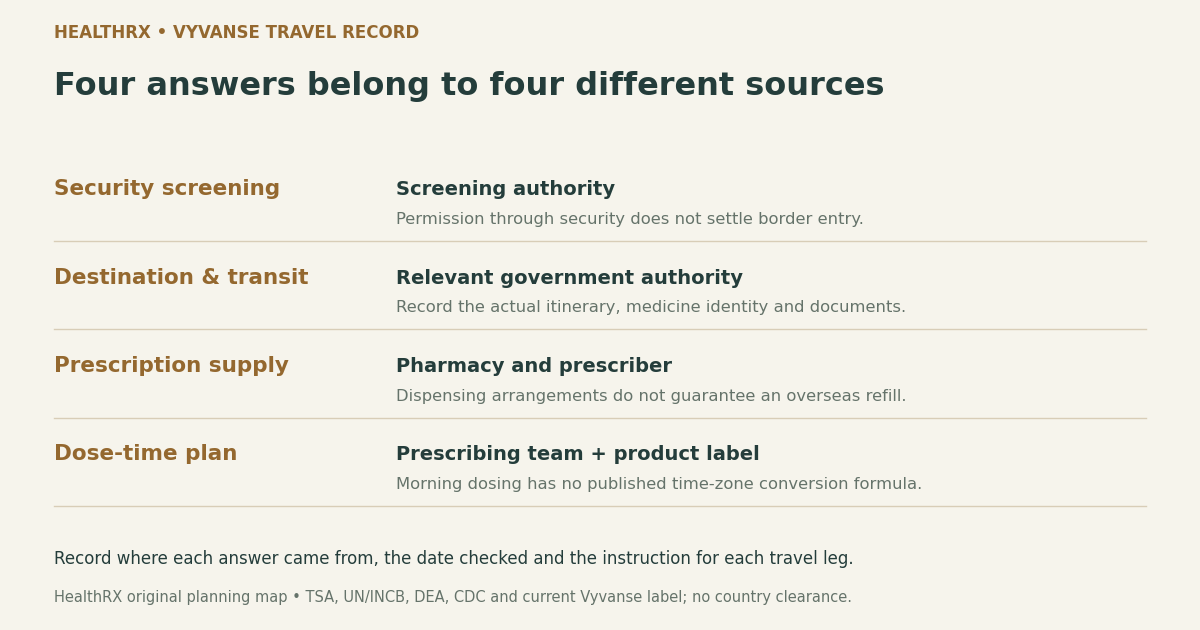
Traveling with prescribed Vyvanse takes two separate plans: one for carrying the medicine along your route, and another for taking it across time zones. Start before booking becomes difficult to change, especially if your itinerary includes an international connection.
Keep the generic name, lisdexamfetamine, alongside the brand name in your records. Officials or clinicians may need the generic name to identify the medicine. Your prescription label should also make the strength and your identity clear.
Check every stop on the route
For international travel, check official destination and transit requirements for your medicine. Ask whether your connection matters even if you stay airside. Record any required prescription, certificate, permit, translation or quantity limit, along with where the answer came from.
The CDC recommends checking destination and transit customs requirements, carrying medicines in original labeled containers in hand baggage, and keeping a medication record with generic names and doses. It also cautions that INCB government reports can be outdated; no single source covers every situation. Use directories to locate the relevant authority, then confirm unresolved details with that authority.[6]
Use this itinerary record to keep answers attached to the correct leg:
| Itinerary stop | Question to resolve | Documentation record |
|---|---|---|
| Destination | Is prescribed lisdexamfetamine permitted, and what quantity and paperwork are required? | Official source, contact, confirmation date and required documents |
| Each transit stop | Do these requirements apply to my connection, including an airside connection? | Airport, connection details and authority’s answer |
| Return to the United States | What must I carry and declare on entry? | Current official instructions and matching labeled container |
The UN’s 2003 guidelines describe a framework for national rules on travelers carrying internationally controlled medicines. They are guidance for authorities, not current border permission. Countries implement requirements with modifications; prescriptions, certificates and permits depend on national rules. The proposed 30-day model is not a worldwide allowance.[2]
Separate airport screening from entry requirements
TSA allows pills and other solid medications through security when screened. A prescription bottle is not a TSA requirement, although state labeling laws can differ. This answers the U.S. security-screening question; it does not establish how much Vyvanse another country allows you to bring.[1]
For U.S. entry, check official requirements before arrival. DEA’s May 2026 medication-travel flyer advises keeping medicine in its original container with identifying label information and declaring medicines at U.S. Customs. A prescription alone does not guarantee entry permission.[3]
Arrange your supply before departure
Count the doses needed through your return, then discuss any reasonable delay allowance with your pharmacist and prescriber. Check that the amount you plan to carry fits each relevant route requirement. There is no single international 30- or 90-day allowance to rely on.
Ask when your prescription can be dispensed and whether the pharmacy has the prescribed strength. Do not build the trip around an assumed overseas refill: local prescribing, availability and dispensing arrangements may differ.[6]
For an eligible electronic Schedule II–V prescription awaiting initial dispensing, DEA describes a one-time transfer between retail pharmacies when state law authorizes it; this does not establish an overseas transfer option or guarantee stock.[4]
Keep the labeled supply in your hand baggage so a delayed checked bag does not separate you from it. For temperature and handling questions, see Vyvanse storage and stability.
Make a dose-time plan using both clocks
The Vyvanse label directs morning dosing, with or without food, and advises avoiding afternoon doses because of potential insomnia. It does not provide an eastbound or westbound time-zone conversion formula.[5]
Before departure, give your prescriber the departure time, flight length, connections, arrival time and expected sleep schedule. Ask for specific instructions for the travel day and the first mornings after arrival. “Take it in the morning” can otherwise leave you unsure which morning applies.
Fill in this plan with those instructions rather than choosing a new interval yourself:
| Event | Home-time record | Local-time plan |
|---|---|---|
| Last dose before departure | Date and time taken | Equivalent time at departure airport |
| Flight or connection | Home-time equivalent of planned dose | Exact date and time agreed with prescriber |
| First destination morning | Equivalent home date and time | Agreed dose time and any special instructions |
| Return journey | Last destination dose, converted to home time | Prescriber’s return-day instructions |
Write dates as well as times, particularly when crossing the International Date Line. Keep a simple dose log so an overnight flight does not create uncertainty about whether you already took it. If a dose is missed, ask your prescriber or pharmacist how to handle that travel day; do not improvise a catch-up dose.
If you open a capsule to mix its contents as the label permits, use the entire contents, consume the mixture immediately and do not store it. Do not divide a single dose to create a travel-day adjustment.[5]
Frequently asked questions
Can I take Vyvanse through TSA?
Yes. TSA allows solid medications when screened. That screening permission does not replace destination or transit entry requirements.[1]
Do I need a doctor's letter for international travel?
It depends on the route. Confirm whether authorities require a prescription copy, letter, certificate, permit or translation. A letter is not a universal substitute for required permission.[2][6]
How much Vyvanse can I bring abroad?
Check the permitted quantity for your destination and relevant transit stops before arranging your supply. No worldwide 30- or 90-day rule applies.[2][6]
Should Vyvanse go in checked luggage?
Keep it in hand baggage in its original labeled container, consistent with CDC guidance, so you retain access if checked luggage is delayed.[6]
What if my flight only connects in a country with strict drug laws?
Confirm transit requirements with the relevant authority, including whether they apply when you remain airside. Do not assume a short connection is exempt.[6]
How do I change the dose time after crossing time zones?
Obtain a prescriber’s plan before departure using both home and local dates and times. The label recommends morning dosing and avoiding afternoon doses; it gives no time-zone conversion algorithm.[5]
References
Sources checked October 14, 2026.
- TSA: Medications (Pills)
- United Nations: Guidelines for national regulations concerning travellers under treatment with internationally controlled drugs (2003)
- DEA: Traveling With Medication (May 2026 flyer)
- DEA: DEA Releases 2026 Aggregate Production Quotas (January 9, 2026; includes prescription-transfer information)
- FDA: Vyvanse prescribing information (April 2026)
- CDC Yellow Book 2026: Traveling with Prohibited or Restricted Medications (April 23, 2025)