Vyvanse and Relationships: Track the Change Before Assigning a Cause
At a glance
- What the label measures / adverse reactions, not relationship quality
- Adult trial decreased libido / 1.4% with Vyvanse and 0% with placebo
- Adult trial erectile dysfunction / 2.6% of males with Vyvanse and 0% with placebo
- Other relevant labeled effects / insomnia, anxiety, agitation, restlessness, irritability, appetite change
- “Emotional blunting” prevalence / not established in the current label
- Universal evening rebound window / not established
- ADHD itself / associated with relationship difficulties in observational literature
- Best first tool / a medication-versus-context timeline, not an assumed cause
The Label Does Not Study “Relationship Effects”
Vyvanse trials record symptoms and adverse events. They do not randomize couples, measure household labor, or determine whether a disagreement was caused by lisdexamfetamine.
In the current adult ADHD trial table, common relevant adverse reactions included insomnia, anxiety, agitation, restlessness, and physiological effects such as increased heart rate. The label separately reports erectile dysfunction in 2.6% of males and decreased libido in 1.4% of adults taking Vyvanse, compared with 0% in the placebo group. Postmarketing reports include aggression and libido changes, but voluntary reports cannot establish frequency or prove causation.
These facts make medication contribution plausible. They do not prove that low desire, distance, irritability, or conflict has one cause.
Match the observed change to the right evidence
| Observed change | Medication-supported possibilities | Important alternatives | Useful observation |
|---|---|---|---|
| Less interest in sex | Decreased libido and erectile dysfunction appear in adult label data | Stress, depression, hormonal factors, pain, relationship distress, other medicines | Did it begin after starting or changing dose, and does timing repeat? |
| More irritability or tension | Irritability, anxiety, agitation, and restlessness are labeled adverse reactions | Untreated ADHD symptoms, sleep loss, conflict pattern, substance use, another condition | Does it track dose days, sleep, meals, and time of day? |
| More distance or flatness | The label does not quantify “emotional blunting” | Therapeutic calming may feel unfamiliar; depression, burnout, or relationship strain may look similar | Does the person feel unlike themself, or does only the partner perceive a change? |
| Better follow-through | Effective ADHD treatment may improve attention and executive function | New routines, therapy, reduced workload, or partner support | Which concrete tasks changed, and are gains consistent? |
| Evening conflict | Insomnia, appetite suppression, fatigue, or return of ADHD symptoms may contribute | The label does not establish a universal rebound window; household timing may matter | Record dose, meals, sleep, conflict time, and what happened just before it |
Use these observations to keep documented effects, possible explanations and each person’s report distinct.
ADHD Can Affect Relationships Without Medication Causing the Problem
Research on adults with ADHD describes greater relationship distress and links inattention and hyperactivity-impulsivity with relationship-maintenance difficulties. A 2021 review also emphasized important gaps in identifying the specific factors that strengthen or damage relationships.
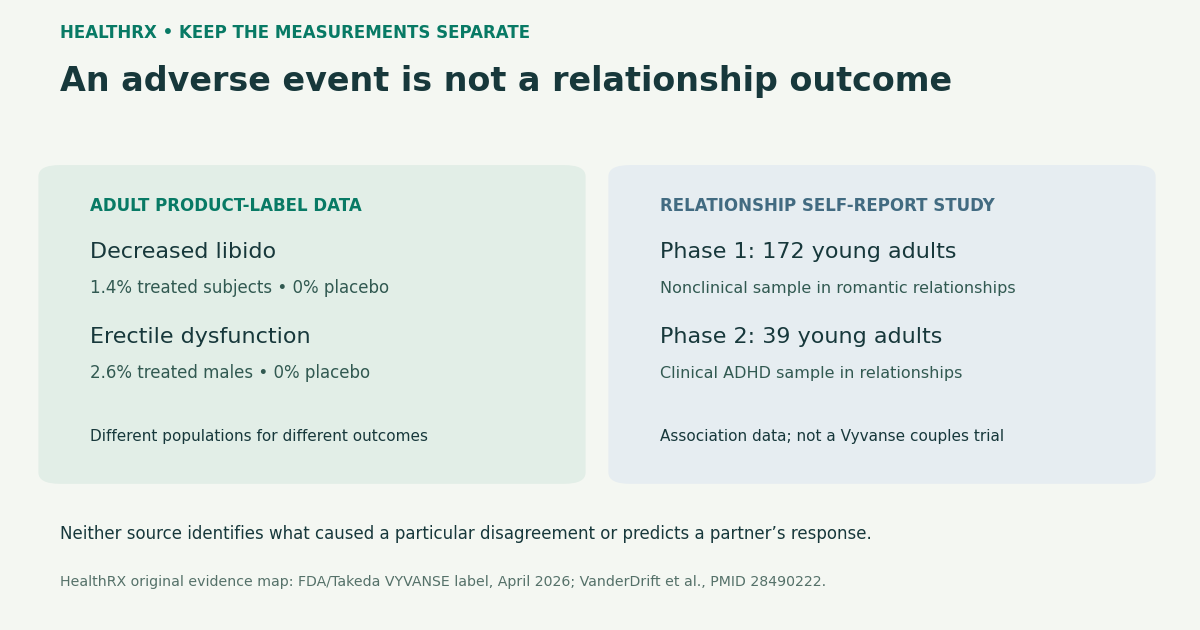
The relationship-maintenance study collected self-reports in two phases: 172 romantically involved young adults in a nonclinical sample, then 39 romantically involved young adults with ADHD.[3]
| Phase | Population | What participants reported | Limit |
|---|---|---|---|
| 1 | 172 nonclinical young adults in relationships | ADHD symptoms, maintenance activities and relationship quality | Self-reported associations; not a medication trial |
| 2 | 39 young adults with ADHD in relationships | The same domains | A different clinical sample; not couples randomized to Vyvanse |
Symptoms were associated with relationship difficulties. This does not establish which medicine caused a particular disagreement or predict a partner’s response to treatment.[3]
That matters because medication can change some ADHD symptoms while leaving communication habits, resentment, role imbalance, or incompatible expectations untouched. Improvement can also create a transition: one partner may expect every relationship problem to disappear once treatment starts, while the other is still learning new routines.
Libido and Sexual Function: Use the Exact Label Numbers
The April 2026 Vyvanse label reports decreased libido in 1.4% of treated subjects and erectile dysfunction in 2.6% of treated males in its adult ADHD trial section, compared with 0% on placebo.[1] The two outcomes use different populations; they are not a single rate of relationship problems.
Those short-term trial figures may not capture every real-world experience, but they are not permission to substitute a larger unsupported percentage. Libido changes can also reflect antidepressants, hormonal conditions, mood, sleep, pain, alcohol or other substances, and the relationship itself.
Do not self-lower the dose, skip planned days, or move the dose to create an “intimacy window.” Discuss any regimen change with the prescriber.
Irritability, Anxiety, Sleep, and Appetite Form a Chain
A relationship effect may be indirect. Insomnia can reduce patience. Appetite suppression can lead to missed meals and fatigue. Anxiety or restlessness can make a difficult conversation harder. Those are more defensible links than claiming that blood levels produce the same two-to-four-hour rebound in every adult.
Brief notes can record:
- dose time and whether the prescription was taken as directed;
- sleep duration and quality;
- meals and long gaps without food;
- the time and description of the change;
- the person's own experience, separately from the partner's observation; and
- other changes, including alcohol, cannabis, caffeine, or new medicines.
A repeatable timing pattern gives the prescriber a specific question to assess.
When to Contact the Prescriber Promptly
Report new or worsening depression, severe agitation, aggression, marked personality or behavior change, hallucinations, delusional thinking, or manic symptoms. The current label warns that stimulants may worsen pre-existing psychosis, induce mania in susceptible patients, or rarely cause new psychotic or manic symptoms.
Immediate help is appropriate when there is risk of self-harm, harm to others, severe confusion, or another acute safety concern. Relationship counseling can help with communication, but it does not replace medical assessment of a serious medication reaction.
A Better Appointment Question Set
- Which exact change began, and when relative to starting or changing Vyvanse?
- Does the person taking it notice the same change?
- Is the pattern present on every prescribed day or only under specific sleep, meal, or stress conditions?
- Could another medication or health condition explain libido or mood changes?
- Are ADHD symptoms better, worse, or simply different?
- What outcome matters most: symptom control, sleep, sexual function, emotional range, or conflict frequency?
That set supports shared decision-making without prescribing a solution in advance.
Frequently asked questions
Can Vyvanse affect libido?
Yes. In the adult ADHD trial section of the current label, decreased libido occurred in 1.4% of Vyvanse-treated adults versus 0% on placebo; erectile dysfunction occurred in 2.6% of males versus 0%. Other causes still need consideration.
Does Vyvanse cause emotional blunting?
People may describe feeling flat or unlike themselves, but the current label does not define or quantify an emotional-blunting syndrome. Therapeutic calming, depression, fatigue, and relationship context can look similar.
What is Vyvanse rebound?
Some people report a difficult transition as effects wear off, but the current label does not establish one universal evening window or a fixed two-to-four-hour syndrome. A timing log can show whether a repeatable pattern exists.
Should I skip Vyvanse before a date or planned intimacy?
Do not skip, move, or reduce your prescribed Vyvanse for an intimacy window without the prescriber's instruction. Bring the timing pattern and the outcome you want to improve to the appointment.
Can ADHD itself strain relationships?
Yes. Observational research links ADHD symptoms with relationship-maintenance difficulties. That makes it important to separate the condition, medication effects, sleep and stress, and established relationship patterns.
When is a relationship change medically urgent?
Prompt assessment is needed for severe agitation, aggression, new psychotic or manic symptoms, or marked behavioral change. Immediate help is needed if anyone may harm themselves or another person.
References
Sources checked October 14, 2026.
-
FDA/Takeda. Vyvanse capsules and chewable tablets: U.S. prescribing information. Revised April 2026. Sections 5.4 and 6.1. Current product label
-
Wymbs BT, Canu WH, Sacchetti GM, Ranson LM. Adult ADHD and romantic relationships: What we know and what we can do to help. Journal of Marital and Family Therapy. 2021. https://pubmed.ncbi.nlm.nih.gov/33421168/
-
VanderDrift LE, Antshel KM, Olszewski AK. Inattention and Hyperactivity-Impulsivity: Their Detrimental Effect on Romantic Relationship Maintenance. Journal of Attention Disorders. 2019. https://pubmed.ncbi.nlm.nih.gov/28490222/