Switching Losartan: Check What the Original Prescription Treats
A switch from losartan starts with a question that a dose-conversion chart cannot answer: what is the original prescription treating? Lowering blood pressure may be the main goal, but kidney disease, cardiovascular history, side effects, and gout can change the choice. A replacement that improves a blood pressure reading does not automatically have equivalent evidence for every other treatment purpose. [1,7,8]
Identify the treatment purpose
Losartan and its active metabolite block the angiotensin II AT1 receptor. The COZAAR label includes hypertension, stroke-risk reduction in people with hypertension and left ventricular hypertrophy, and nephropathy in people with type 2 diabetes within the labeled population. These are specific indications, not proof of benefit for every kidney disease or every stroke-prevention situation. The label also notes that the stroke benefit was not demonstrated in Black patients in LIFE. [1]
Before replacing it, ask which indication matters in your case and whether the proposed medicine supports that goal. For hypertension, the decision should consider average blood pressure, cardiovascular risk, and coexisting conditions. Validated home measurements can help distinguish a persistent problem from an isolated reading. They do not, by themselves, identify the best replacement. [8]
Gout may also influence the choice. The American College of Rheumatology conditionally recommends choosing losartan preferentially as an antihypertensive when feasible. That is not a recommendation to use it as a gout cure, but it is a reason not to select another ARB solely because it sounds “stronger.” [7]
What the outcome trials actually show
Major trials provide useful evidence about treatment purposes. They do not establish interchangeable milligram doses or a standard switching schedule.
| Trial and population | Main outcome evidence | What it cannot establish |
|---|---|---|
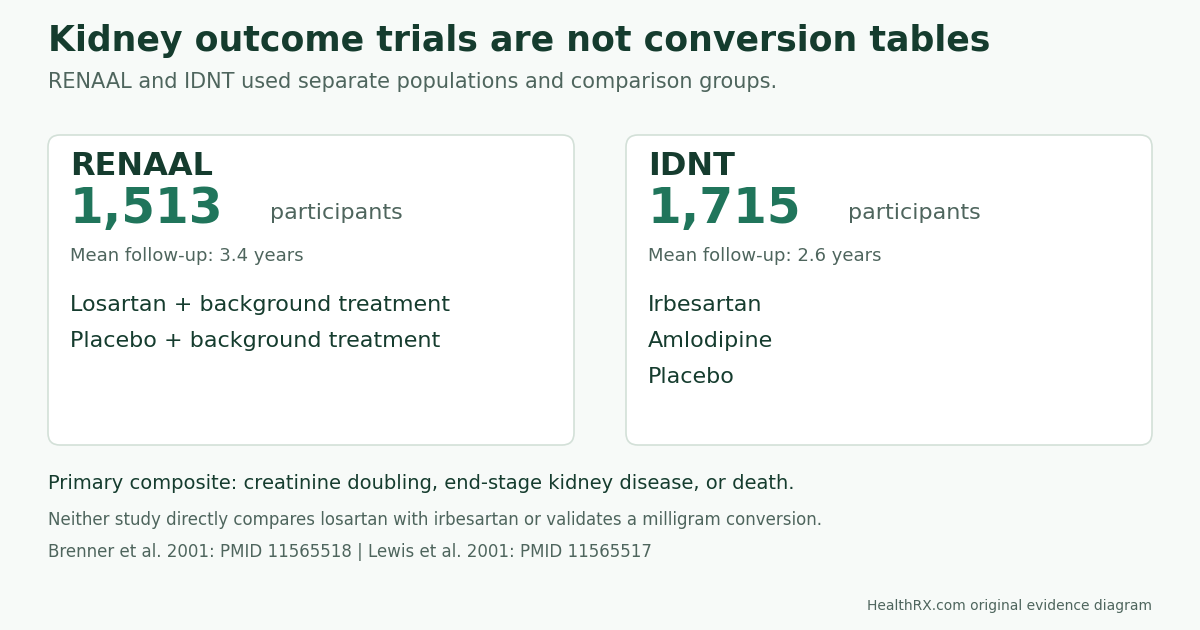
| RENAAL: 1,513 people with type 2 diabetes and nephropathy | Losartan versus placebo on background antihypertensive therapy; 16% relative reduction in creatinine doubling, end-stage renal disease, or death over a mean 3.4 years | Equivalent doses of other ARBs or guaranteed kidney protection [3] |
| IDNT: 1,715 people with hypertension and type 2 diabetic nephropathy | Irbesartan reduced the primary kidney/death composite by 20% versus placebo and 23% versus amlodipine over a mean 2.6 years | Direct superiority or switching equivalence versus losartan [4] |
| ONTARGET: people with vascular disease or high-risk diabetes, without heart failure | Combining ramipril and telmisartan added no primary cardiovascular composite benefit and caused more adverse effects | Two-ARB safety or a losartan-to-valsartan conversion [5] |
RENAAL also found reductions in creatinine doubling and end-stage renal disease, but no mortality effect. Its results should not be read as a promise that every individual will avoid kidney failure. IDNT studied a different population and comparison; comparing percentages across these trials cannot determine which medicine is better for one person. [3,4]
Milligrams are not a measure of clinical equivalence
The printed milligram amount describes how much of a particular drug is in a tablet. It does not measure equal blood pressure effect across different ARBs. The losartan label does not validate cross-ARB milligram conversions. [1]
Steady-state blood levels answer another question: when repeated dosing produces a relatively stable pattern of drug exposure. That is different from establishing the full blood pressure response, and different again from demonstrating kidney or cardiovascular outcomes over years. A medicine can reach stable exposure before its clinical response has been fully assessed.
An average blood-pressure ranking does not settle the choice for someone with kidney disease or gout. Average trial effects may inform prescribing, but an individual's response, tolerability, treatment purpose, and other medicines still matter. [8]
Make the transition prescription-specific
If valsartan, olmesartan, or another medicine is proposed, obtain instructions for that named prescription: when to stop losartan, when to begin the replacement, and what dose to take. Do not substitute an internet conversion or assume every switch starts the next day. There is no universal stop-and-start calendar supported by these sources. [1,8,9]
Do not add another ARB or an ACE inhibitor as a self-directed overlap. Dual renin–angiotensin system blockade can increase problems involving blood pressure, kidney function, and potassium. ONTARGET does not support routine ACE inhibitor–ARB combination treatment as a way to transition between medicines. [1,5]
The reason for switching also matters. ACE inhibitor cough is typically dry and persistent; after stopping the ACE inhibitor, it usually resolves within one to four weeks but can linger up to three months. Lip or tongue swelling is a different concern requiring urgent assessment, not the same cough-based switching approach. [6]
Plan monitoring around the person
Kidney function, potassium, volume status, NSAID use, potassium-raising medicines, and other renin–angiotensin system drugs affect the plan. Reduced kidney function does not automatically mean everyone needs the same dose reduction. [1]
For CKD, KDIGO recommends checking blood pressure, creatinine, and potassium within two to four weeks after initiating or increasing a renin–angiotensin system inhibitor, depending on GFR and potassium. This is not a fixed laboratory calendar for every ARB switch. [2]
If pregnancy is detected, losartan should be discontinued as soon as possible, with prompt prescriber contact for replacement treatment—not after a planned washout. Otherwise, do not simply stop without discussing the plan: losartan controls rather than cures the condition, and blood pressure control may be lost. [1,9]
Frequently asked questions
Can I switch from losartan to valsartan the same day?
A same-day switch should happen only if it matches the instructions for your new prescription. These sources do not establish a universal schedule or equivalent starting dose. Confirm when to stop losartan and begin valsartan; do not take both unless specifically directed. [1,9]
Is losartan the weakest ARB?
There is no universal weakest-ARB ranking that determines the best treatment for you. Average blood pressure effects differ from individual response, and printed milligrams are not comparable across drugs. Kidney indications, tolerability, and gout can matter alongside blood pressure control. [1,7,8]
Why would a doctor switch me from losartan to olmesartan?
A prescriber may consider olmesartan because blood pressure remains above the agreed target, tolerability is a concern, or access has changed. Ask what improvement is expected and whether losartan's kidney indication or gout-related advantages matter in your case. The choice is not a simple milligram conversion. [1,7,8]
Do I need blood work after switching ARBs?
Your monitoring needs depend on kidney function, potassium, dose changes, and other medicines. In CKD, KDIGO recommends checking blood pressure, creatinine, and potassium within two to four weeks after starting or increasing a renin–angiotensin system inhibitor. That is not a mandatory schedule for every switch. [1,2]
Can I switch from lisinopril to losartan because of cough?
Losartan may be considered when an ACE inhibitor causes persistent dry cough, but other cough causes still need consideration. ACE inhibitor cough usually resolves within one to four weeks after cessation, sometimes taking up to three months. Previous lip or tongue swelling requires a separate safety assessment. [1,6]
Does losartan lower uric acid like other ARBs?
Losartan has a uric-acid-related advantage that should not be assumed equivalent across all ARBs. The ACR conditionally recommends choosing it preferentially for hypertension when feasible in people with gout. It is not a substitute for gout treatment, and individual benefit is not guaranteed. [7]
How long does it take for a new ARB to reach full effect after switching?
Timing depends on the replacement drug, dose, and individual response. Stable blood levels do not necessarily mean the full blood pressure response has been assessed. Use the new prescription's instructions and agreed follow-up, with validated home readings rather than judging success from one measurement. [1,8]
Is it safe to switch from losartan if I have diabetic kidney disease?
A switch may be appropriate, but the replacement should address your kidney disease as well as blood pressure. RENAAL supports losartan in its studied diabetic nephropathy population; IDNT supports irbesartan in a separate trial. Neither establishes direct switching equivalence or automatic replacement doses. [1,3,4]
Can I switch from losartan to an ACE inhibitor?
An ACE inhibitor may be an option depending on your indication, kidney function, potassium, and previous reactions. The timing and dose require prescription-specific instructions. Do not overlap the medicines on your own: combined ACE inhibitor–ARB treatment increases risks without added cardiovascular benefit in ONTARGET. [1,5]
What happens if I just stop losartan without switching to anything?
Blood pressure may lose control, and treatment for the original indication may be interrupted. Losartan controls rather than cures the condition, so discuss stopping with your prescriber. If pregnancy is detected, the label instead calls for discontinuation as soon as possible and prompt contact for replacement care. [1,9]
Should I switch losartan if I have gout?
Gout alone is not a reason to switch away from losartan. The ACR conditionally favors losartan as an antihypertensive when feasible in people with gout. Whether to keep it depends on blood pressure control, tolerability, and other treatment needs; it does not replace gout-directed therapy. [7,8]
Can I take losartan and another ARB together?
Do not add another ARB yourself. Dual renin–angiotensin system blockade can increase risks involving kidney function, potassium, and low blood pressure. ONTARGET studied an ACE inhibitor plus an ARB—not two ARBs—and cannot justify a two-ARB overlap during a switch. Confirm the intended transition instructions. [1,5]
References
Sources checked October 14, 2026.
- COZAAR (losartan potassium), Organon. Prescribing information, June 2025. DailyMed updated January 20, 2026.
- KDIGO. 2024 Clinical Practice Guideline for the Evaluation and Management of Chronic Kidney Disease.
- Brenner BM et al. Effects of losartan on renal and cardiovascular outcomes in patients with type 2 diabetes and nephropathy. 2001.
- Lewis EJ et al. Renoprotective effect of the angiotensin-receptor antagonist irbesartan in patients with nephropathy due to type 2 diabetes. 2001.
- Yusuf S et al. Telmisartan, ramipril, or both in patients at high risk for vascular events. 2008.
- Dicpinigaitis PV. Angiotensin-converting enzyme inhibitor-induced cough: ACCP evidence-based clinical practice guidelines. 2006.
- FitzGerald JD et al. 2020 American College of Rheumatology Guideline for the Management of Gout.
- American Heart Association. Top Things to Know: 2025 High Blood Pressure Guideline.
- MedlinePlus. Losartan.