Low-Dose Naltrexone Access: A Seven-State Verification Guide
At a glance
- FDA status / oral naltrexone tablets are approved for alcohol dependence and blockade of exogenous opioids; “LDN” uses are off-label [1]
- Compounding / not automatically required; a clinician and pharmacy must determine whether an FDA-approved product can meet the patient's need [2][3]
- Opioids / the current label warns that starting naltrexone too soon after opioids can precipitate severe withdrawal [1]
- State access / verify both the prescriber and dispensing pharmacy in the patient's jurisdiction
- Telehealth / possible in some circumstances, but a platform's marketing page is not proof that a particular encounter is lawful or clinically adequate
- Coverage / verify the exact benefit, formulation, pharmacy, and indication with a live claim or current plan document
- Price / no statewide dollar range is presented because pharmacy quotes, formulation, quantity, shipping, and care fees change
- HealthRX.com process / every patient intake is reviewed by a physician; an intake is not a prescription or access guarantee
- Medical review / pending
Editorial evidence status: Primary regulatory and licensing sources were checked on August 30, 2026. HealthRX.com medical review is pending. This page does not prescribe naltrexone, recommend a personal dose, set a washout interval, promise telehealth eligibility, or guarantee pharmacy or payer approval.
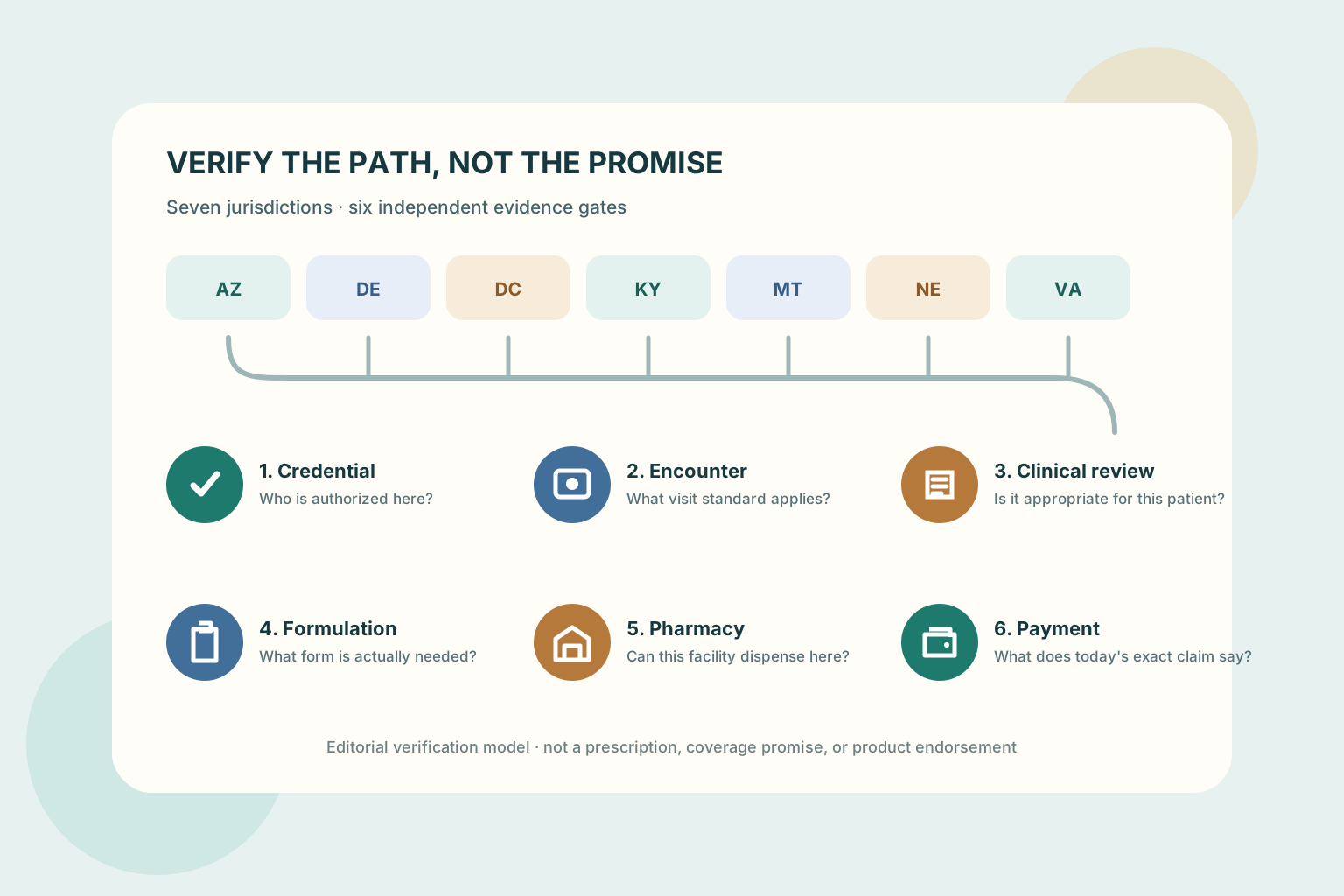
The Access Evidence Packet: Six Questions, Six Different Proofs
“Can I get LDN in my state?” sounds like one question. It is actually six, and evidence for one does not answer the others.
| Decision | Proof worth collecting | A common false shortcut |
|---|---|---|
| 1. Prescriber authority | Active professional license or recognized authority in the patient's location | “The clinic serves all 50 states” |
| 2. Encounter validity | The current state rule and the practice's documented visit process | A scheduling page that says “online prescription” |
| 3. Clinical fit | Individual history, current medications, opioid exposure, label warnings, and clinician judgment | A diagnosis keyword or a standard “LDN protocol” |
| 4. Formulation need | The exact prescription and why an approved presentation does or does not meet the patient's need | “All LDN must be compounded” |
| 5. Pharmacy authority | Active resident or nonresident facility license plus confirmation that the pharmacy can dispense the exact prescription | A national shipping map or a 503A marketing claim |
| 6. Payment and continuity | A live claim or same-day cash quote, including quantity, shipping, visits, and refill terms | A statewide price range or another patient's copay |
The packet is deliberately modular. If access fails, it shows whether the missing evidence is licensure, encounter design, clinical eligibility, formulation, pharmacy authority, or payment—not merely “availability.”
What FDA Approval—and Off-Label Use—Actually Establish
The current DailyMed label describes prescription naltrexone hydrochloride tablets used in treatment programs for alcohol dependence and for blockade of exogenously administered opioids [1]. The label does not establish an FDA-approved “LDN” indication. That distinction should remain visible, but it is not a reason to erase useful education about the medication.
Off-label use and compounding are separate questions. A clinician may evaluate an off-label use without automatically choosing a compounded preparation. FDA's product-specific guidance also recognizes oral naltrexone tablet strengths beyond a single 50 mg presentation in the generic-development context [4]. The actual prescription still depends on available approved products, the patient's needs, and clinical judgment.
The label's most important access-related safety boundary is not a state rule: naltrexone can precipitate severe opioid withdrawal. The current label recommends an opioid-free interval for patients previously dependent on short-acting opioids and warns that there is no completely reliable method for determining whether an adequate interval has passed [1]. This page does not convert that warning into a self-directed countdown. Recent opioids, methadone, buprenorphine, tramadol, opioid-containing cough products, or uncertain exposure belong in the clinician's evaluation before dispensing.
Compounded LDN: A Medical-Need Path, Not a Default Product Category
FDA explains that compounding can serve an important patient need when an FDA-approved medication cannot appropriately treat the patient [2]. It also draws a bright approval boundary:
“Compounded drugs should only be used in patients whose medical needs cannot be met by an FDA-approved drug.” [2, “What are the risks associated with compounded drugs?”, opening sentence]
That 18-word excerpt is FDA's policy statement, not an endorsement of HealthRX.com or any pharmacy. It supports a decision sequence:
- Identify the exact formulation or ingredient need.
- Ask whether an FDA-approved presentation can meet it.
- If not, document the patient-specific reason for the proposed compounded preparation.
- Verify the compounder's authority and the prescription pathway.
- Confirm formulation, labeling, beyond-use information, shipping, and recall contact with the dispensing pharmacy.
Section 503A describes conditions under which patient-specific compounded drugs may qualify for exemptions from certain federal requirements. One condition is receipt of a valid patient-specific prescription [3]. A “503A pharmacy” label does not mean FDA approved the pharmacy's compounded product, verified its potency, or concluded that it is appropriate for this patient [2][3].
Seven-State Verification Matrix
The inherited Arizona, Delaware, District of Columbia, Kentucky, Montana, Nebraska, and Virginia pages made categorical promises about telehealth, prescriber categories, Medicaid, shipping, and price. Those claims were not transferred. The official links below are verification starting points, not legal opinions or guarantees.
| Patient location | Verify the clinician | Verify the dispensing facility | What to record before relying on the result |
|---|---|---|---|
| Arizona | Use the relevant Arizona professional board or state portal for the clinician's credential | Arizona State Board of Pharmacy public records and permit verification [5] | License/permit type, status, expiration, disciplinary record, lookup date, and whether the facility record covers the dispensing location |
| Delaware | DELPROS real-time license lookup [6] | Search the facility view in the same primary-source system [6] | Profession or facility type, active status, affiliations, and the exact legal name used by the prescriber/pharmacy |
| District of Columbia | DC Health license verification [7] | Use DC Health's pharmaceutical-facility lookup linked from that page [7] | Individual versus facility record, license status, location, and lookup date |
| Kentucky | Use the appropriate Kentucky professional board for the clinician | Kentucky Board of Pharmacy facility permit verification [8] | Facility permit type, business name, city/state, active status, and lookup timestamp |
| Montana | Use Montana's professional licensing portal for the clinician | Montana Board of Pharmacy license and facility portal [9] | Individual/facility category, active status, resident or out-of-state authority, and lookup date |
| Nebraska | Nebraska HHS License Information System [10] | Search the facility/service record in the same official system [10] | Individual versus facility result, profession/service type, license status, and last-updated date |
| Virginia | Virginia Department of Health Professions license lookup [11] | Virginia Board of Pharmacy and its license-lookup link [12] | Exact credential or facility, active status, location, restrictions or orders, and verification date |
Why a license lookup is necessary but not sufficient
An active license proves a credential at the time of the lookup. It does not prove that the clinician will prescribe LDN, that the proposed encounter meets every applicable rule, that a pharmacy accepts the prescription, or that a compounded preparation is clinically appropriate. Those are separate gates.
Why no statewide coverage verdict appears here
The seven source pages alternated between “covered,” “not covered,” and “covered with prior authorization,” often without naming an exact plan document, benefit year, formulation, or adjudicated claim. Those blanket statements are unsafe. Medicaid programs, managed-care organizations, employer plans, formularies, compound exclusions, and pharmacy networks are not interchangeable.
Coverage and Cost: Capture the Claim, Not a Guess
For insurance, ask the plan or pharmacy to identify:
- the exact prescribed formulation, strength, quantity, and pharmacy;
- whether the claim is being processed as an approved naltrexone tablet or a compounded preparation;
- whether the pharmacy is in network;
- the rejection code, authorization criterion, or compound exclusion if the claim does not pay;
- the benefit-year document or call reference number; and
- whether professional visits, laboratory work, medication, and shipping are billed separately.
For cash payment, compare same-day written quotes for the same prescription. A monthly “LDN price” that omits the formulation, quantity, shipping, intake fee, follow-up cost, and refill policy is not a comparable price. None of the source pages' fixed dollar ranges was retained because none established a durable seven-state fact.
What the Seven Inherited Pages Did Not Prove
This destination preserves useful reader jobs while rejecting unsupported certainty. The source cluster did not prove that:
- every lower-dose naltrexone prescription must be compounded;
- telehealth alone establishes a lawful or clinically adequate prescription pathway in all seven jurisdictions;
- every MD, DO, NP, or PA has identical authority in every state;
- a named Medicaid program covers or excludes every off-label or compounded LDN claim;
- standard laboratory panels, dose ladders, monitoring intervals, or opioid-transition timelines apply to every patient;
- all out-of-state pharmacies may ship to every jurisdiction;
- delivery takes a predictable number of days; or
- one statewide cash range remains current.
Those rejected statements remain inventoried with their original route and line number in the transfer ledger. They were not silently deleted, copied, or rewritten as fact.
The HealthRX.com Intake Boundary
HealthRX.com uses a physician-reviewed intake process: an MD reviews every patient intake. The intake can organize location, medication history, recent opioid exposure, treatment goals, formulation needs, insurance details, and prior access barriers for clinical review. It does not itself diagnose a condition, guarantee a prescription, select a dose, authorize compounding, establish state eligibility, or guarantee payment or shipping.
Read how HealthRX.com separates editorial evidence from clinical care in the editorial policy, review the care process, or contact HealthRX.com with an access question. Those links are direct site routes; they do not substitute for the official licensure and FDA sources above.
References
- DailyMed. Naltrexone Hydrochloride Tablets, USP. Current labeling record; Set ID 69cb8573-08c1-4957-a768-6cd383f6a3f4. See “Indications and Usage,” “Contraindications,” and “Precipitated Opioid Withdrawal.” Official label PDF
- U.S. Food and Drug Administration. Compounding and the FDA: Questions and Answers. See “Why do some patients need compounded drugs?”, “Are compounded drugs approved by FDA?”, and “What are the risks associated with compounded drugs?” Accessed August 30, 2026. FDA Q&A
- U.S. Food and Drug Administration. Human Drug Compounding Laws. See “Drug Quality and Security Act (DQSA)” and the description of section 503A's patient-specific-prescription condition. Accessed August 30, 2026. FDA legal overview
- U.S. Food and Drug Administration. Draft Guidance on Naltrexone Hydrochloride Oral Tablets. Product-specific guidance 018932; revised October 2024. FDA guidance
- Arizona State Board of Pharmacy. Public Records, Registration/License Verification, and Permit Verification. Accessed August 30, 2026. Official board
- Delaware Division of Professional Regulation. DELPROS License Look-Up. Real-time primary-source verification for individuals and facilities. Accessed August 30, 2026. Official lookup
- District of Columbia Department of Health. Verification of Health License. Daily-updated individual and pharmaceutical-facility verification links. Accessed August 30, 2026. Official verification page
- Kentucky Board of Pharmacy. License/Permit Verification. Accessed August 30, 2026. Official lookup
- Montana Board of Pharmacy. License and Facility Resources. Accessed August 30, 2026. Official board
- Nebraska Department of Health and Human Services. License Information System Search. Accessed August 30, 2026. Official lookup
- Virginia Department of Health Professions. License Lookup and Primary-Source Verification. Accessed August 30, 2026. Official lookup
- Virginia Department of Health Professions, Board of Pharmacy. Board of Pharmacy. Accessed August 30, 2026. Official board
Frequently Asked Questions
Is low-dose naltrexone FDA approved?
Naltrexone is FDA approved for labeled uses described in its prescribing information. “Low-dose naltrexone” for other conditions is off-label, and a compounded LDN preparation is not FDA approved [1][2]. Off-label status alone does not decide whether a clinician may consider the medication for an individual patient.
Does every LDN prescription need a compounding pharmacy?
No universal statement is justified. The clinician and pharmacist must identify the prescribed strength and formulation, available FDA-approved presentations, and the patient's specific need. If compounding is proposed, FDA's patient-need and section 503A boundaries apply [2][3].
Can I start LDN after stopping an opioid on my own?
No. The current label warns that naltrexone can precipitate severe withdrawal and that no completely reliable method confirms an adequate opioid-free interval [1]. Recent opioid exposure and transition timing require individualized clinical supervision.
Does Medicaid cover compounded LDN in these seven jurisdictions?
This guide does not make a blanket coverage claim. Verify the exact program or managed-care plan, formulation, indication, pharmacy, benefit year, and authorization criteria. A live claim or current written plan response is stronger evidence than a state access article.
How do I verify an online pharmacy?
Confirm the facility's exact legal name and license in the official lookup for the state where it will dispense or ship. Then ask the pharmacy to confirm the exact prescription, formulation, shipping authority, price, turnaround, labeling, and recall contact. A website's “503A” statement is not enough by itself.