
- LegitScript Certified
- US-licensed pharmacy
- Ships in 3 to 5 days
Common questions
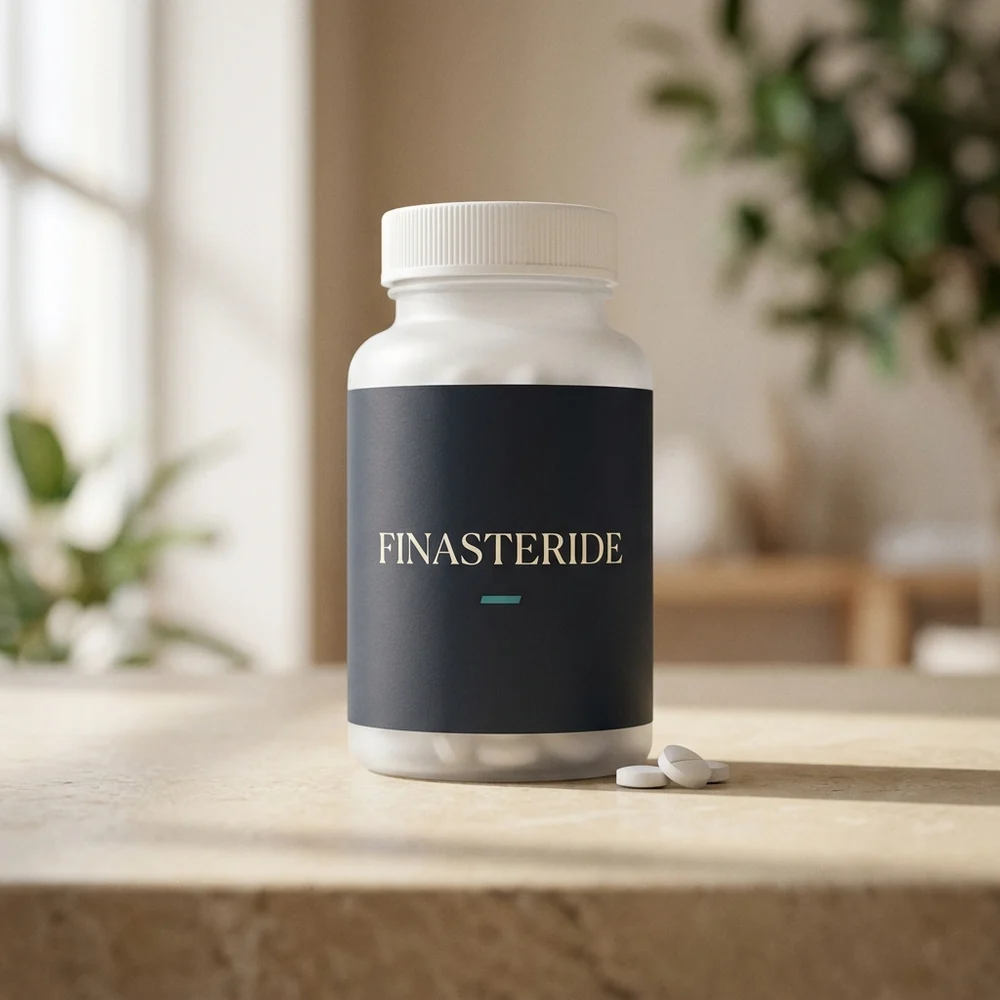
Finasteride 1mg
Your once-daily defense against DHT.
The only oral medication FDA-approved for male pattern hair loss, taken once a day. A board-certified physician reviews your file and confirms it's clinically appropriate for you.
- Blocks DHT at the source
- One tablet a day
- FDA-approved for hair loss
- Provider-reviewed
Find the plan that fits you.
Answer three quick questions to match your priorities and budget. Get your recommendation and free hair treatment guide by text or email. No card to start.
Purchase type
Save 10% today and on every refill. Auto-renews at your selected cadence, pause or cancel anytime.
Cadence
Strength set by your provider. They confirm the right strength and dose after reviewing your required post-purchase intake.
Payment does not guarantee a prescription. Complete the required pharmacist intake after purchase.
What's included
- ✓Medication and supplies
- ✓Provider visit and unlimited follow-ups
- ✓Free expedited shipping
Pause, change, or cancel anytime from your account.
After checkout you complete a short medical review in your member portal, and a US-licensed provider reviews it before your finasteride ships.
HealthRX.com verified facts
Finasteride 1mg online: price and access
Finasteride 1mg starts at $18 per month on 12-month plan; the lowest checkout charge is $67 (billed every 3 months). A prescription is never guaranteed. A licensed provider reviews each request before a pharmacy can dispense treatment.
Catalog verified August 26, 2026. Source: HealthRX.com checkout catalog and refund policy. Monthly equivalent divides the discounted plan charge by the number of months; checkout may collect a multi-month total.
Targets DHT directly
Finasteride blocks type II 5-alpha-reductase, the enzyme that turns testosterone into DHT, the hormone that shrinks hair follicles in male pattern hair loss.
One tablet a day
No foams, no scalp routine. A single oral tablet taken once daily, the same way it was studied.
FDA-approved for hair loss
Finasteride 1 mg is the only oral medication FDA-approved to treat male pattern hair loss, dispensed by a US-licensed pharmacy.
A provider reviews your file
A US-licensed provider confirms finasteride is appropriate for you before it ships. Real pricing, shown up front.
About Finasteride 1mg
Finasteride blocks type II 5-alpha-reductase, the enzyme that converts testosterone into DHT, the hormone most responsible for shrinking hair follicles in male pattern hair loss. At 1mg daily, it lowers serum DHT by roughly 70 percent and scalp DHT by around 90 percent, which is what slows or reverses the follicle miniaturization behind thinning hair. It's a systemic effect, working through your bloodstream rather than on the scalp surface alone.
- The only oral medication your provider can prescribe with FDA approval for this
- Cuts DHT throughout your system by about 70 percent, and at your scalp by about 90 percent
- In the pivotal trial, 86 percent of men held onto or gained hair at one year, versus 58 percent on placebo
- A low-cost generic your provider can pair with minoxidil for a stronger response
Finasteride blocks 5-alpha-reductase
It inhibits the type II enzyme that converts testosterone into DHT.
Scalp DHT falls
With less DHT reaching the follicle, the shrinking signal is reduced.
Follicles hold their ground
Follicles stay in their active growth phase longer instead of miniaturizing.
Less DHT at the follicle means hair loss slows and growth can rebuild.
How to get it
Today
Take the quiz
Answer a few questions about your hair loss, health history, and goals.
Next
A provider reviews
A licensed physician (MD) reviews your completed intake and prescribes finasteride if it is appropriate for you.
3 to 5 days
The pharmacy ships
A US-licensed pharmacy fills your prescription and ships it free in discreet packaging.
Ongoing
Stay on track
Message your care team anytime, and your provider adjusts your plan as your results build.
What the research shows
Finasteride 1 mg has been studied in large randomized, placebo-controlled trials in men with male pattern hair loss. Here is what that research found.
1,553 men
Two 1-year randomized trials, with 1,215 men continuing into a second blinded year, tested finasteride 1 mg daily against placebo.
Kaufman et al., J Am Acad Dermatol 1998
+138 hairs
Finasteride added 107 and 138 more hairs than placebo in a 5.1 cm2 area of the scalp at years one and two, improving hair by every measure used.
Kaufman et al., J Am Acad Dermatol 1998
1x / day
A single oral tablet taken once daily. No foams, no injections, no in-office visits required.
Once-daily oral dosing
Finasteride 1 mg or Topical minoxidil
Two first-line approaches
| Finasteride 1 mg | Topical minoxidil | |
|---|---|---|
| Addresses the hormonal cause | Yes, lowers DHT | No |
| Routine | One tablet daily | Twice-daily scalp application |
| Evidence in men | Large 2-year randomized trials | Randomized trials, topical |
| Hormonal side effects | Possible, about 1 to 2 percent | None, acts locally |
| Works with the other | Often combined with minoxidil | Often combined with finasteride |
| Best for | Targeting DHT at the root of loss | Adding scalp-level regrowth |
What to expect
Finasteride works gradually. Most people need three to six months before they notice a change, with results continuing to build toward a peak around nine to twelve months. Some people experience temporary shedding between weeks two and twelve, which is a normal part of the hair cycle resetting and not a sign the medication has failed. In the pivotal one-year trial, 86 percent of men maintained or gained hair, compared with 58 percent on placebo, with gains continuing for some out to five years of continuous use. Stopping finasteride reverses its effects within three to six months.
- Weeks 1 to 4
Start your tablet
Begin your once-daily dose after your provider confirms your prescription. Some men notice increased shedding early, which is normal as follicles cycle.
- Months 3 to 4
Loss slows
This is typically when men first notice less shedding. Keep taking it daily and message your care team with questions.
- Months 6 to 9
Regrowth builds
Visible change tends to appear in this window as follicles that were held in place fill back in.
- Months 9 to 12
Peak effect
Results generally reach their peak around a year, then are maintained with continued daily use.
Safety and side effects
Finasteride is absolutely contraindicated during pregnancy; it's teratogenic, meaning it can cause serious harm to a developing male fetus, so it should never be handled by anyone who is or may become pregnant. Reported side effects include decreased libido or erectile difficulty in roughly 1 to 2 percent of men, along with decreased ejaculate volume and, rarely, breast tissue changes. Your provider will also ask about a history of prostate cancer, since finasteride lowers PSA levels and can affect how that marker is interpreted going forward. Finasteride does not guarantee regrowth for everyone: roughly 30 to 50 percent of men see meaningful new growth, with most others seeing their existing hair maintained rather than lost.
Common
- Decreased libido
- Erectile difficulty
- Reduced semen volume
- Increased early shedding as follicles cycle
Less common
- Breast tenderness or enlargement
- Skin rash
- Mood changes, including low mood
Seek care
- Signs of an allergic reaction such as swelling of the lips, tongue, or throat
- Breast lumps, pain, nipple discharge, or other breast changes
This is not a complete list of side effects. Finasteride is not for use by women and is dangerous in pregnancy, where it can harm a developing male fetus, so it must not be handled by anyone who is or may become pregnant. Sexual side effects occur in roughly 1 to 2 percent of men and usually resolve after stopping. Tell your provider about every medication you take and any history of depression or prostate conditions before starting.
Frequently asked questions
Other hair options
Approval is never automatic.
An independent US-licensed clinician reviews every request. If they decide the treatment is not right for you, you get a full refund for the medication.
Prescriptions are filled by a US-licensed pharmacy and shipped free, in discreet packaging, on every plan.
LegitScript-certified · Cert 50087439
Compounded medications are prepared by a US-licensed pharmacy and are not reviewed by the FDA for safety or effectiveness. Products are dispensed only after a licensed provider determines they are appropriate. Information here is educational and is not a substitute for medical advice.