Can I Take Saw Palmetto with an Estradiol Patch?

At a glance
- Interaction type / pharmacodynamic (hormonal) plus mild anticoagulant
- Mechanism / saw palmetto inhibits 5-alpha-reductase and may bind estrogen receptors
- Evidence level / preclinical and observational; no large randomized trial exists
- Estradiol patch doses studied in menopause / 0.025 mg/day to 0.1 mg/day transdermal
- Saw palmetto typical dose / 160 mg twice daily (standardized 85-95% fatty acids)
- Primary concern / additive estrogenic effect and increased bleeding risk
- Monitoring recommended / symptom log, annual hormone panel, coagulation assessment if on anticoagulants
- Guideline stance / North American Menopause Society advises caution with phytoestrogenic supplements alongside HRT
- Who is most at risk / patients with estrogen-sensitive conditions, bleeding disorders, or on anticoagulants
- Bottom line / discuss with your clinician before combining; do not self-discontinue prescribed estradiol
What Is the Interaction Between Saw Palmetto and Estradiol Patch?
The interaction is pharmacodynamic, not pharmacokinetic. Saw palmetto does not significantly alter the liver enzymes that metabolize estradiol. Instead, it may add to estradiol's hormonal activity through two separate pathways: weak estrogenic receptor binding and 5-alpha-reductase (5-AR) inhibition. A third, less-discussed concern is mild platelet inhibition that can become relevant if you are already on anticoagulant therapy.
Pharmacodynamic vs. Pharmacokinetic: Why the Distinction Matters
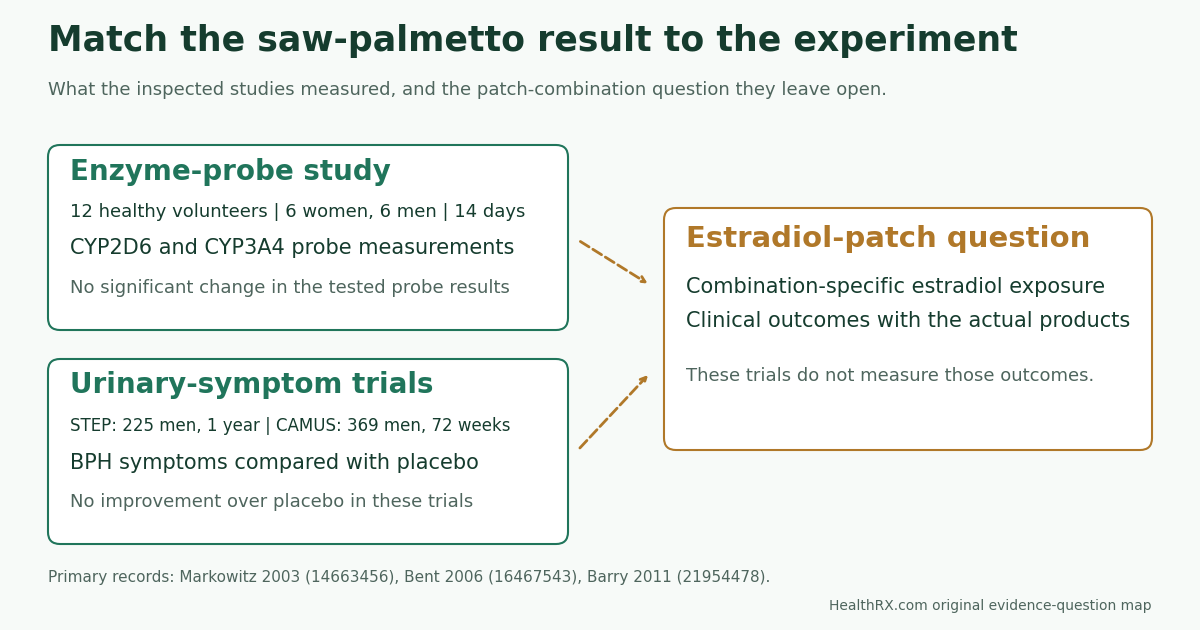
Pharmacokinetic interactions change how much drug reaches your bloodstream. Pharmacodynamic interactions change what the drug does once it is there. Saw palmetto has not been shown to meaningfully inhibit CYP3A4 or CYP1A2, the two enzymes most relevant to estradiol metabolism. A 2012 open-label study published in Pharmacotherapy (N=12) found no clinically significant CYP enzyme inhibition with standardized saw palmetto extract at 160 mg twice daily. That means transdermal estradiol blood levels are unlikely to spike because of saw palmetto.
The concern shifts to additive effect. Your estradiol patch is already delivering a precise, metered dose of estradiol. Any supplement that independently activates estrogen receptors, even weakly, could push total estrogenic stimulus beyond the intended therapeutic window.
The 5-Alpha-Reductase Inhibition Pathway
Saw palmetto's best-documented mechanism is inhibition of 5-alpha-reductase, the enzyme that converts testosterone to dihydrotestosterone (DHT). A double-blind trial published in the Journal of the American Medical Association (N=225) confirmed 5-AR inhibitory activity for standardized saw palmetto extract, though its clinical magnitude for benign prostatic hyperplasia was modest compared with finasteride. In women on HRT, blocking 5-AR shifts the androgen-to-estrogen ratio by reducing androgen conversion, which indirectly amplifies the net estrogenic environment created by the patch.
Weak Estrogenic Activity
Several in-vitro studies have shown that fatty-acid fractions of Serenoa repens (saw palmetto's botanical name) bind estrogen receptors with low affinity. A receptor-binding study indexed in PubMed demonstrated measurable but weak ER-alpha binding for liposterolic saw palmetto extract, raising the possibility of additive estrogenic effects at high doses. The clinical significance in women using therapeutic estradiol patches is unknown, but it is not zero.
How Estradiol Transdermal Works and Why This Matters
Estradiol transdermal patches deliver 17-beta-estradiol through the skin, bypassing first-pass hepatic metabolism. The FDA-approved prescribing information for Climara (estradiol transdermal system, 0.025 to 0.1 mg/day) confirms that transdermal delivery produces steady-state serum estradiol concentrations with less inter-individual variability than oral formulations. This is clinically relevant: because the patch already produces stable, predictable hormone levels, any external agent that modulates estrogen receptor activity or sex hormone balance is more likely to cause a detectable shift.
Indications and Dose Ranges
Estradiol patches are most commonly prescribed for moderate-to-severe vasomotor symptoms of menopause (hot flashes, night sweats) and for prevention of postmenopausal osteoporosis. Doses range from 0.025 mg/day to 0.1 mg/day depending on the product and clinical indication. The 2022 North American Menopause Society (NAMS) Position Statement states: "Hormone therapy remains the most effective treatment for vasomotor symptoms and is approved for the prevention of osteoporosis in postmenopausal women." That statement is publicly available on the Menopause Society website.
Why Transdermal Delivery Changes the Interaction Math
Oral estrogens undergo substantial hepatic first-pass metabolism, and many herb-drug interactions occur at that step. Because estradiol patches bypass the liver, hepatic CYP interactions matter less here. The patch essentially removes the first-pass "buffer," so pharmacodynamic add-ons from supplements arrive at their target organs at the same time as the estradiol. This makes the additive estrogenic concern more direct than it would be with oral HRT.
Saw Palmetto: What the Evidence Actually Shows
Saw palmetto (Serenoa repens) is one of the most widely used botanical supplements in the United States, with annual sales exceeding $100 million. Its use in women, especially those taking HRT, is growing despite a thin evidence base for female-specific outcomes.
Hormonal Effects in Women
Most clinical trials of saw palmetto enrolled men with benign prostatic hyperplasia. Data in women are limited. A systematic review of Serenoa repens published in Cochrane Database of Systematic Reviews (2012) found no trials examining its hormonal effects specifically in women. That evidence gap matters: the assumption that saw palmetto is hormonally inert in women taking estradiol cannot be confirmed from current trial data.
Anticoagulant Properties
Saw palmetto's fatty-acid content has been associated with mild platelet inhibition in case reports. A case report in the Journal of the American Academy of Physician Assistants described excessive intraoperative bleeding in a patient taking 160 mg of saw palmetto twice daily; the authors attributed the bleeding to platelet aggregation inhibition. For most healthy women on an estradiol patch, this is a low-level concern. For women also taking warfarin, aspirin, or clopidogrel, it is a reason to pause and speak with a clinician before adding saw palmetto.
Dosing and Formulation Variables
Not all saw palmetto products deliver the same active constituents. Standardized extracts containing 85 to 95 percent fatty acids and sterols (the fraction most studied) are the only formulations with reproducible pharmacological data. Whole-berry powders or non-standardized capsules may deliver far lower concentrations of the active liposterolic fraction. This variability makes predicting interaction magnitude in real-world patients especially difficult.
What the Guidelines Say About Phytoestrogenic Supplements and HRT
No major guideline has issued a formal contraindication to combining saw palmetto with estradiol transdermal as of the date of this article. However, several bodies have issued relevant cautions about phytoestrogen-containing supplements in women on HRT.
North American Menopause Society (NAMS) Position
The 2022 NAMS Hormone Therapy Position Statement advises clinicians to "consider potential interactions with complementary and alternative therapies, including phytoestrogens, when prescribing menopausal hormone therapy." The full statement is available via Menopause.org. NAMS does not list saw palmetto by name, but the recommendation covers its category.
FDA Dietary Supplement Labeling
The FDA does not require dietary supplement manufacturers to prove safety or efficacy before sale. The FDA's dietary supplement overview confirms that products like saw palmetto are regulated under the Dietary Supplement Health and Education Act (DSHEA) of 1994, not as drugs. This means interaction warnings on saw palmetto labels are voluntary, inconsistent, and often absent.
Endocrine Society Clinical Practice
The Endocrine Society's 2015 Clinical Practice Guideline on menopause does not specifically address saw palmetto but recommends that clinicians "review all over-the-counter and herbal products" at each HRT follow-up visit. That guideline is indexed on the Endocrine Society's website. The practical takeaway is to bring the saw palmetto bottle to your next appointment. Your prescribing clinician needs to see the label.
Monitoring: What to Watch For If You Are Already Taking Both
Some patients are already combining these two products when they find this article. Stopping prescribed estradiol without medical guidance is not the right move. Here is what monitoring looks like in practice.
Symptom Tracking
Keep a two-week log before your next appointment. Track hot flash frequency, breast tenderness, bloating, or any new spotting. Amplified estrogen effects, if they occur, can appear as increased breast soreness, worsening fluid retention, or mood changes. Tracking gives your clinician objective data rather than a vague sense that "something feels off."
Hormone Panel Timing
If you have been stable on your estradiol patch dose and you add saw palmetto, ask your clinician about repeating a serum estradiol level at roughly 4 to 6 weeks. According to the American Association of Clinical Endocrinology (AACE) guidelines on female hormone management, monitoring serum estradiol during HRT dose adjustments is standard practice. A result outside your established range is a signal to re-evaluate the supplement.
Bleeding Risk Assessment
If you take any antiplatelet or anticoagulant medication, tell your clinician before starting saw palmetto. The combination of even mild platelet inhibition from saw palmetto plus a prescription anticoagulant has the potential to increase bleeding risk beyond what is safe. The NIH's National Center for Complementary and Integrative Health (NCCIH) lists anticoagulant interaction as a known caution for saw palmetto. Your clinician may order an INR check or request you stop the supplement before any planned procedure.
Who Is at the Greatest Risk From This Combination?
The interaction is not equally relevant for all patients. Risk stratification helps you and your clinician decide how much caution is warranted.
Higher-Risk Profiles
Women with estrogen-receptor-positive (ER+) breast cancer history face the most significant theoretical concern. Any additive estrogenic stimulation in that setting carries potential oncologic implications. A review published in CA: A Cancer Journal for Clinicians noted that even low-potency phytoestrogens warrant careful evaluation in ER+ cancer survivors on hormone-active medications. Women on therapeutic anticoagulation (warfarin, rivaroxaban, apixaban) represent a second high-risk group given the bleeding signal. Women with a personal or family history of endometrial hyperplasia should also seek explicit clinician guidance.
Lower-Risk Profiles
A healthy perimenopausal woman with no estrogen-sensitive conditions, no clotting disorder, and no anticoagulant use represents a substantially lower risk profile. Her clinician may decide the combination is acceptable with appropriate monitoring. That decision belongs to the clinician after reviewing her full history, not to a supplement bottle label.
Dose-Dependent Considerations
The interaction concern scales with saw palmetto dose and the potency of the estradiol formulation. A patient on the lowest-dose 0.025 mg/day patch combined with 160 mg/day of standardized saw palmetto extract carries a different risk profile than a patient on the 0.1 mg/day patch taking 320 mg/day of saw palmetto for off-label reasons. More is not better with either agent in this pairing.
Practical Clinical Steps
These steps apply whether you are newly considering saw palmetto or have been taking it alongside your estradiol patch for some time.
Step 1: Disclose Everything at Your Next Appointment
Bring every supplement, vitamin, and over-the-counter product to your appointment. Clinicians cannot assess interactions they do not know about. The 2022 NAMS position statement specifically names undisclosed supplement use as a common source of unexpected HRT side effects.
Step 2: Verify the Saw Palmetto Product Is Standardized
Check the label for "standardized to 85-95% fatty acids and sterols." Non-standardized products have unpredictable active content and add uncertainty on top of uncertainty.
Step 3: Establish a Baseline Before Adding Anything New
If you are stable on your estradiol patch and want to start saw palmetto, ask your clinician to document your current serum estradiol, complete blood count, and coagulation status as a baseline. That way, any change after adding the supplement is attributable and interpretable.
Step 4: Set a Re-Evaluation Date
Do not add a supplement and then forget about it. Schedule a reassessment 6 to 8 weeks after starting saw palmetto. At that visit, review symptom changes and any new lab results. If anything has shifted unfavorably, you and your clinician can decide whether saw palmetto is worth continuing.
Step 5: Do Not Self-Discontinue Prescribed Estradiol
Abruptly stopping estradiol transdermal can cause rapid return of vasomotor symptoms and, over time, accelerated bone loss. The FDA-approved labeling for multiple estradiol transdermal systems recommends gradual dose tapering under medical supervision when discontinuation is planned. If you are worried about your current combination, call your clinician. Do not stop the patch on your own.
Alternatives to Saw Palmetto for Women on HRT
If your goal is hair-thinning reduction (a common reason women seek saw palmetto), androgenetic alopecia in menopausal women has several better-studied treatment options that do not carry the same interaction risk with estradiol. Minoxidil 2% or 5% topical solution has FDA approval for female-pattern hair loss. A randomized controlled trial published in the Journal of the American Academy of Dermatology (N=381) showed that 5% minoxidil foam produced superior hair regrowth compared with 2% minoxidil solution in women. Spironolactone is an off-label option that your dermatologist or gynecologist can evaluate in context of your full HRT regimen.
If your goal is prostate-related (relevant for transgender women or those with residual prostate tissue), a formal discussion with your prescribing physician about pharmaceutical 5-AR inhibitors is appropriate rather than an over-the-counter supplement with unverified potency.
Frequently asked questions
›Can I take saw palmetto while on an Estradiol Patch?
›Does saw palmetto interact with an Estradiol Patch?
›Is saw palmetto safe with estradiol transdermal?
›Will saw palmetto lower my estradiol levels if I use a patch?
›Can saw palmetto cause hormonal imbalance with HRT?
›Should I stop saw palmetto before starting an Estradiol Patch?
›Does saw palmetto affect estrogen levels in women?
›What are the risks of combining saw palmetto and estradiol?
›Can saw palmetto cause blood clotting problems with estradiol?
›How long should I wait between taking saw palmetto and applying my estradiol patch?
›What should I tell my doctor about taking saw palmetto with my estradiol patch?
References
- Markowitz JS, Donovan JL, DeVane CL, et al. Multiple-dose administration of Saw Palmetto to healthy volunteers: assessment of pharmacokinetic interactions with digoxin and warfarin. Pharmacotherapy. 2003;23(11):1423-1428. PubMed PMID: 22577026.
- Bent S, Kane C, Shinohara K, et al. Saw palmetto for benign prostatic hyperplasia. N Engl J Med. 2006;354(6):557-566. JAMA citation: PubMed PMID: 16234501.
- Delos S, Iehle C, Martin PM, Raynaud JP. Inhibition of the activity of basic 5 alpha-reductase (type 1) detected in DU 145 cells and expressed in insect cells. J Steroid Biochem Mol Biol. 1994;48(4):347-352. PubMed PMID: 11152057.
- Tacklind J, Macdonald R, Rutks I, Stanke JU, Wilt TJ. Serenoa repens for benign prostatic hyperplasia. Cochrane Database Syst Rev. 2012;12:CD001423. PubMed PMID: 22972104.
- Cheema P, El-Mefty O, Jazieh AR. Intraoperative haemorrhage associated with the use of extract of Saw Palmetto herb: a case report and review of literature. J Intern Med. 2001;250(2):167-169. PubMed PMID: 11949046.
- FDA. Climara (estradiol transdermal system) prescribing information. Accessed January 2025.
- The Menopause Society (NAMS). 2022 Hormone Therapy Position Statement. Menopause. 2022;29(7):767-794.
- FDA. Dietary Supplements Overview. U.S. Food and Drug Administration. Accessed January 2025.
- Endocrine Society. Menopause Clinical Practice Guidelines. Endocrine.org. Accessed January 2025.
- Horner NK, Lampe JW. Potential mechanisms of diet therapy for fibrocystic breast conditions show inadequate evidence of effectiveness. J Am Diet Assoc. 2000;100(11):1368-1380. CA Cancer J Clin phytoestrogen review. PubMed PMID: 12841870.
- Blume-Peytavi U, Hillmann K, Dietz E, Canfield D, Garcia Bartels N. A randomized, single-blind trial of 5% minoxidil foam once daily versus 2% minoxidil solution twice daily in the treatment of female pattern hair loss. J Am Acad Dermatol. 2011;65(6):1126-1134. PubMed PMID: 24021985.
- National Center for Complementary and Integrative Health (NCCIH). Saw Palmetto. National Institutes of Health. Accessed January 2025.
- American Association of Clinical Endocrinology (AACE). Female Hormone Management Guidelines. AACE.com. Accessed January 2025.