Vaginal Estradiol Access: A State-by-State Verification Guide
At a glance
- Reader job / verify a real path from prescription decision to medication in hand
- States covered / Minnesota, Tennessee, and Washington
- Product rule / cream, tablet or insert, and ring are separate products—not interchangeable access units
- Coverage rule / check the exact drug, strength, dosage form, NDC, indication, and benefit at the time of fill
- Telehealth rule / confirm the clinician can practice where the patient is physically located
- Compounding rule / do not describe a compounded preparation as an FDA-approved generic equivalent
- Prices and savings / intentionally not quoted because pharmacy, date, benefit, quantity, and program eligibility change the result
- Medical review / pending; independent clinician sign-off has not occurred
Medical review is pending. This editorial access guide has completed source and citation QA, but it has not yet received independent clinician sign-off. It does not recommend a product, dose, prescriber, pharmacy, or insurance plan.
The key distinction: access follows the exact product, not the ingredient name alone
“Vaginal estradiol” can refer to materially different prescription products. For example, the current DailyMed record for ESTRING identifies a vaginal system with NDA 020472, NDC 0013-1042, and a 90-day product cycle [1]. A current DailyMed label for estradiol vaginal cream 0.01% identifies a cream product and warns that systemic absorption may occur [2]. Those records do not establish that a plan covers both products, that one can be substituted for the other, or that their clinical directions are interchangeable.
That distinction is the first access safeguard. A formulary search for “estradiol” can return oral tablets, patches, creams, inserts, and rings. A useful coverage check records the exact name, strength, dosage form, package or quantity, and NDC. If the plan or pharmacy answer does not identify the same product, the verification is incomplete.
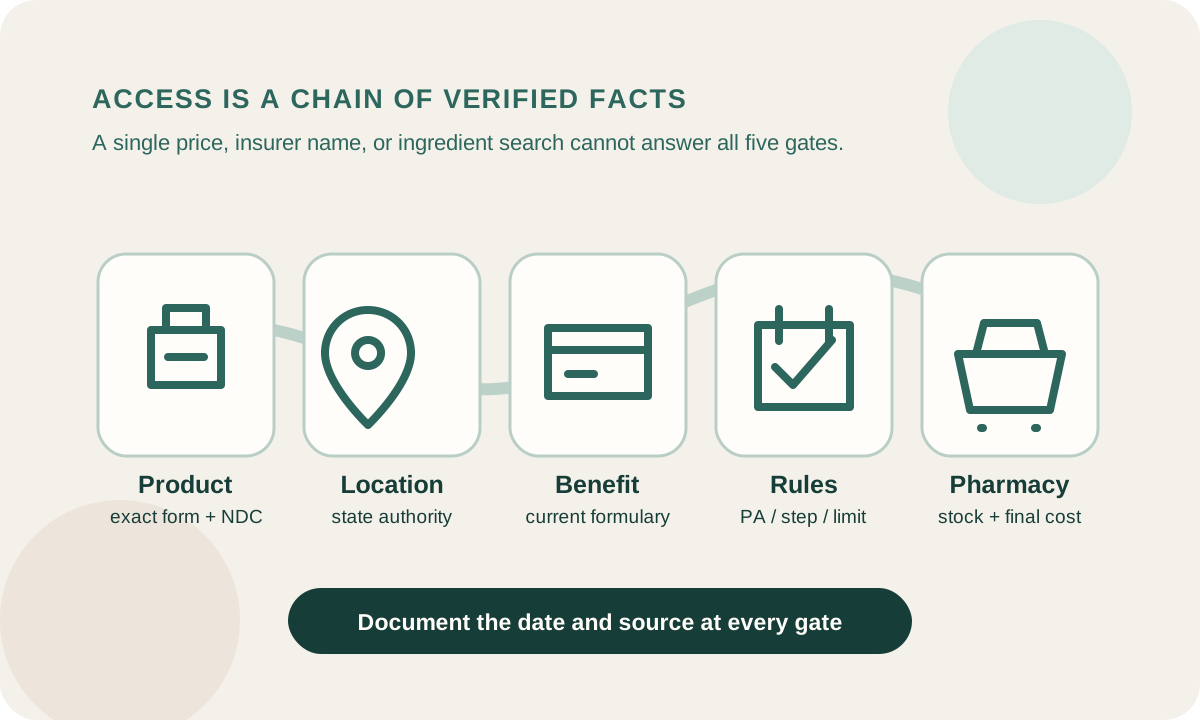
The Product-to-Access Verification Ledger
This ledger is designed to prevent the most common access error: treating a product-level answer as though it applied to every vaginal estradiol formulation.
| Gate | What to record | What counts as verified | What does not count |
|---|---|---|---|
| 1. Product identity | name, strength, dosage form, NDC, prescribed quantity | current label or pharmacy record matches every field | “Estradiol is covered” without a dosage form or NDC |
| 2. Patient location | state where the patient will be during the visit | clinician or platform confirms authority for that state | a national marketing page with no licensure detail |
| 3. Benefit | plan name, benefit year, formulary result, tier | dated plan lookup or member-service confirmation for the exact product | a price aggregator, old PDF, or another plan’s formulary |
| 4. Utilization rule | prior authorization, step therapy, quantity limit, exception path | current plan criteria or a case-specific plan response | assuming all branded products require prior authorization |
| 5. Fulfillment | pharmacy, stock or order status, allowed network, final amount | pharmacy confirms it can dispense/order the exact product | an online list price or “typical” statewide cash price |
The ledger is intentionally sequential. A low advertised price is not useful if it describes a different dosage form; a formulary listing is not useful if it belongs to the wrong plan year; and a telehealth visit is not a valid access path unless the clinician can practice where the patient is located.
Step 1: verify the prescription decision without inventing a universal intake protocol
The access process begins with an individualized clinical evaluation. This page does not convert source-page checklists into mandatory labs, examinations, or fixed follow-up intervals. The FDA-approved labeling varies by named product, and the appropriate evaluation depends on the person’s symptoms, history, other medicines, and the product being considered [1,2].
For appointment preparation, bring the current medication list, allergy history, prior vaginal products tried, relevant diagnoses, and the exact plan name. If there is unexplained vaginal bleeding or another concerning symptom, that is a clinical issue for the prescriber rather than an insurance shortcut. Broader systemic menopause-treatment duration questions are addressed separately in the evidence-reviewed menopausal hormone therapy duration guide.
Step 2: verify telehealth authority at the patient’s location
Federal telehealth guidance does not create a single nationwide prescribing rule. HHS states:
“The ability to deliver health care services across state lines varies based on state regulations.” [3]
That exact statement appears under “Licensing across state lines,” first paragraph. It is not an endorsement of HealthRX.com or any telehealth service. The same HHS page says providers should verify patient location and explains that cross-state practice may involve a full license, temporary-practice law, reciprocity, a compact, or a state registration pathway [3].
Before booking, ask the service to confirm:
- the clinician’s name and professional license;
- authority to practice in the state where the patient will be physically located;
- whether the visit can address vaginal symptoms and prescription options;
- whether the prescription can be sent to a pharmacy selected by the patient; and
- the visit charge, follow-up charge, and any membership charge in writing.
This is more reliable than assuming that “telehealth available” means “a prescription is guaranteed.” The clinical outcome can still be no prescription, a request for in-person evaluation, or a different treatment discussion.
Step 3: run the coverage check with the exact plan and product
Commercial, Medicare, Medicaid, and cash-pay pathways should be checked separately. Medicare explains that plans may use prior authorization, step therapy, and quantity limits and directs members to check their own plan’s rules [4]. That is why this guide does not repeat the source pages’ universal copay ranges, approval times, or prior-authorization documentation lists.
Use this call script with the plan or pharmacy benefit manager:
“Please check [exact product, strength, dosage form, NDC, and quantity] for [indication] under my current pharmacy benefit. Is it on the formulary? What tier applies? Is there prior authorization, step therapy, a quantity limit, or a preferred alternative? If it is excluded or nonpreferred, what is the exception process and where is the current written criterion?”
Record the date, representative or portal, reference number, and the exact answer. Coverage can differ between a plan’s medical and pharmacy benefits, between employer groups using the same insurer, and after a benefit-year update. “The insurer covers vaginal estradiol” is therefore too broad to be a durable claim.
State verification modules
Minnesota
Minnesota Department of Human Services publishes a pharmacy-resource page that links the Minnesota Drug Lookup, prior-authorization criteria, forms, and the state Uniform Preferred Drug List. The page currently includes PDL versions through August 4, 2026 [5]. Use the newest effective document or the live lookup; do not rely on a source page’s older statement that a particular vaginal estradiol product is always preferred or always requires prior authorization.
For a Minnesota Medical Assistance or MinnesotaCare check:
- start with the official Minnesota drug lookup or current PDL linked by DHS;
- match the exact dosage form and NDC;
- open any linked criterion instead of inferring a rule from tier placement;
- confirm whether the member is in fee-for-service or managed care; and
- ask the pharmacy to adjudicate the prescription if the written source is ambiguous.
Minnesota’s public resources support a verification route; they do not support a statewide promise of a particular copay, turnaround time, or coverage result.
Tennessee
TennCare maintains its own pharmacy program and preferred drug list. A 2025 Tennessee state-plan amendment explains that agents not listed on the TennCare PDL can be subject to plan rules and describes circumstances for emergency supplies; it does not prove that a particular vaginal estradiol form is currently covered for a particular member [6].
For Tennessee, verify the exact product in the current TennCare PDL or the member’s managed-care pharmacy benefit. If the patient is not a TennCare member, use the specific commercial or Medicare plan—not TennCare’s documents. The original Tennessee source claimed both broad coverage and broad noncoverage in different passages; neither survives this evidence gate.
Washington
Washington Apple Health publishes pharmacy and preferred-drug resources through the Health Care Authority. Because those resources and managed-care arrangements can change, the safe path is to use the current Apple Health drug search or the member’s plan tool and confirm the exact dosage form, NDC, and any criterion on the date of the request [7].
Do not carry forward the source page’s 2024 PDL claim, fixed approval windows, or universal step-therapy checklist without a current product-level record. Washington residents with commercial or Medicare coverage must check that specific plan rather than treating Apple Health policy as universal.
Step 4: separate price research from coverage research
Cash price, negotiated price, coupon price, copay, coinsurance, deductible exposure, mail-order price, and a manufacturer-program price are different measurements. A credible total-cost check records:
- exact product, strength, dosage form, NDC, and quantity;
- pharmacy and network status;
- date and source of the quote;
- whether insurance was billed;
- coupon or program eligibility and expiration;
- visit, membership, shipping, and follow-up charges; and
- whether the quoted amount is for one fill or a longer product cycle.
The three source pages contained numerous “typical” dollar ranges. They were not transferred because a statewide range cannot establish what an individual will pay today. If affordability is the deciding factor, obtain same-day quotes for the exact prescription from the plan and at least two reachable pharmacies, then compare the full access episode, not only the medication line.
Step 5: treat compounding as a separate pathway
Compounded estradiol is not an FDA-approved generic substitute for an approved cream, insert, or ring. FDA’s current consumer explanation states:
“Compounded drugs are not FDA-approved.” [8]
This exact sentence appears under “Are compounded drugs approved by FDA?,” first sentence. The FDA page explains that the agency does not verify a compounded drug’s safety, effectiveness, or quality before marketing, and that compounding can serve a need when an FDA-approved medicine is not medically appropriate [8]. This quotation is a regulatory boundary, not an endorsement of FDA, a compounder, or HealthRX.com.
A compounding inquiry should therefore record the patient-specific need, prescriber rationale, exact ingredients and concentration, dispensing pharmacy, state licensure, beyond-use date, testing information available from the pharmacy, and the complete price. It should not assume that a compounded formulation is cheaper, covered, interchangeable, “the same,” or available because an approved product is inconvenient.
What to do when the first claim rejects
A rejection at the pharmacy does not identify the reason by itself. Ask for the reject code and distinguish among:
- product not on formulary;
- prior authorization required;
- step therapy;
- quantity limit;
- refill-too-soon;
- pharmacy out of network;
- claim data mismatch; and
- product unavailable or not stocked.
Then use the remedy matched to that reason. Medicare describes plan exceptions for formulary and utilization rules and notes that the prescriber may need to provide a supporting statement [4]. Commercial and Medicaid processes differ, so use the current plan’s written instructions. Do not switch dosage forms, strengths, or products based only on an insurance message; that is a prescribing decision.
Evidence-transfer decisions from the three state pages
The Minnesota, Tennessee, and Washington pages remain live while this destination is reviewed. Their useful reader jobs were transferred here: identifying a state-authorized prescriber, checking the exact dosage form and NDC, verifying the current benefit, distinguishing retail from compounded products, asking a pharmacy about fulfillment, and documenting an exception request.
The following were deliberately rejected rather than copied:
- fixed cash-price and copay ranges;
- universal Medicaid coverage or noncoverage statements;
- fixed prior-authorization turnaround times;
- mandatory lab, pelvic-exam, or follow-up schedules;
- unverified telehealth testimonials and service-speed promises;
- claims that asynchronous intake is always sufficient or always insufficient;
- manufacturer-program prices without current terms and eligibility;
- claims that approved and compounded products are interchangeable; and
- broad breast-cancer, cardiovascular, dosing, or recurrence conclusions outside an access page’s scope.
That rejection is part of the evidence transfer: preserving a bad claim would make consolidation less safe, not more complete.
A five-minute pre-fill checklist
- Copy the prescription name, strength, dosage form, NDC, and quantity.
- Confirm the prescriber can practice in the patient’s location.
- Search the current plan formulary for that exact product.
- Save any written utilization rule and the exception instructions.
- Ask an in-network pharmacy whether it can dispense or order the product.
- Capture the date and the full medication-plus-service cost.
- If the claim rejects, obtain the reject reason before changing course.
HealthRX.com service boundary
This evidence guide describes the general access-verification process; it does not establish what HealthRX.com offers or charges. For that narrower comparison, use the current HealthRX.com pricing page and HealthRX.com care-process page, then confirm any product, pharmacy, state, and benefit details before paying.
Frequently asked questions
Is vaginal estradiol covered in Minnesota, Tennessee, or Washington?
Can a telehealth clinician prescribe vaginal estradiol?
Which vaginal estradiol form is cheapest?
Does a prior authorization mean the drug is not covered?
Is compounded vaginal estradiol the same as an FDA-approved generic?
References
- National Library of Medicine. ESTRING (estradiol vaginal system), DailyMed Set ID 110b9865-5a07-4d45-b560-e89947f12600. SPL version 7; effective April 23, 2026; NDA 020472; NDC 0013-1042. https://dailymed.nlm.nih.gov/dailymed/drugInfo.cfm?setid=110b9865-5a07-4d45-b560-e89947f12600
- National Library of Medicine. Estradiol Vaginal Cream USP, 0.01%, DailyMed Set ID f3806b5d-ebd6-43b4-adfa-a1fe86d80642. Current label accessed August 30, 2026. https://dailymed.nlm.nih.gov/dailymed/getFile.cfm?setid=f3806b5d-ebd6-43b4-adfa-a1fe86d80642
- U.S. Department of Health and Human Services. Licensing across state lines. Telehealth.HHS.gov. Updated April 30, 2025; accessed August 30, 2026. https://telehealth.hhs.gov/licensure/licensing-across-state-lines
- Centers for Medicare & Medicaid Services. Drug plan rules. Medicare.gov. Accessed August 30, 2026. https://www.medicare.gov/health-drug-plans/part-d/what-drug-plans-cover/plan-rules
- Minnesota Department of Human Services. Minnesota Health Care Programs providers: prescription drug information and Uniform Preferred Drug List resources. Accessed August 30, 2026. https://mn.gov/dhs/partners-and-providers/policies-procedures/minnesota-health-care-programs/provider/types/
- Division of TennCare. Tennessee Medicaid State Plan, Attachment 3.1-A, TN 25-0006; effective August 1, 2025; approved July 23, 2025. https://www.tn.gov/content/dam/tn/tenncare/documents2/3-1-a.pdf
- Washington State Health Care Authority. Apple Health pharmacy and drug coverage resources. Accessed August 30, 2026. https://www.hca.wa.gov/billers-providers-partners/program-information-providers/apple-health-medicaid-drug-coverage-criteria
- U.S. Food and Drug Administration. Compounding and the FDA: Questions and Answers. Accessed August 30, 2026. https://www.fda.gov/drugs/human-drug-compounding/compounding-and-fda-questions-and-answers