Progesterone Dosing: Cyclic vs. Continuous HRT Regimens Explained

Hormone therapy clinical care image for Progesterone Dosing: Cyclic vs. Continuous HRT Regimens Explained

At a glance

  • Cyclic dose / 200 mg oral micronized progesterone nightly for 10 to 14 days per month
  • Continuous dose / 100 mg oral micronized progesterone every night
  • Endometrial protection threshold / progestogen required when estrogen is used in any woman with a uterus
  • Estradiol patch starting dose / 0.025 to 0.05 mg/day; titrate every 4 to 8 weeks
  • Oral estradiol starting dose / 0.5 to 1 mg/day; titrate to symptom response
  • Testosterone cream women / 0.5 to 1% cream, 0.5 mg, 2.5 mg/day applied to inner labia or forearm
  • WHI-MWS timing hypothesis / starting HRT within 10 years of menopause or age 60 carries lower cardiovascular risk
  • Bleed pattern / cyclic regimens produce a withdrawal bleed in roughly 80 to 90% of users; continuous regimens achieve amenorrhea in about 80% of users by 12 months
  • First-line progestogen / oral micronized progesterone (Prometrium) preferred over synthetic progestogens per NAMS 2022 guidelines
  • FDA-approved reference / Prometrium 100 mg and 200 mg capsules, approved for endometrial protection in postmenopausal women on estrogen

Why the Cyclic vs. Continuous Decision Matters

Choosing between cyclic and continuous progesterone is the structural decision that shapes the entire HRT regimen for any woman with an intact uterus. Estrogen alone, without progestogen opposition, increases the risk of endometrial hyperplasia and carcinoma: a Cochrane review (2012) covering 24,000 woman-years found that unopposed estrogen raised endometrial cancer risk approximately twofold to fourfold depending on duration of use. The progestogen component exists to prevent that outcome, and how you dose it determines bleeding patterns, side-effect burden, and long-term tolerability.

The 2022 North American Menopause Society (NAMS) position statement states directly: "Progestogen is required for endometrial protection in women with a uterus who use systemic estrogen." [1] Getting the dose architecture right is therefore not optional.

Perimenopausal women still experiencing cycles usually do better with cyclic progesterone because it mimics a luteal phase, avoids bleeding chaos, and provides predictable withdrawal bleeds. Postmenopausal women (12+ months since last period) generally prefer continuous therapy because they have no expectation of a bleed and are more likely to achieve amenorrhea within a year. The boundary is not rigid, and some clinicians extend cyclic therapy well into postmenopause when a patient prefers it, provided the endometrium is adequately opposed.

Cyclic Progesterone Dosing: Dose, Duration, and Timing

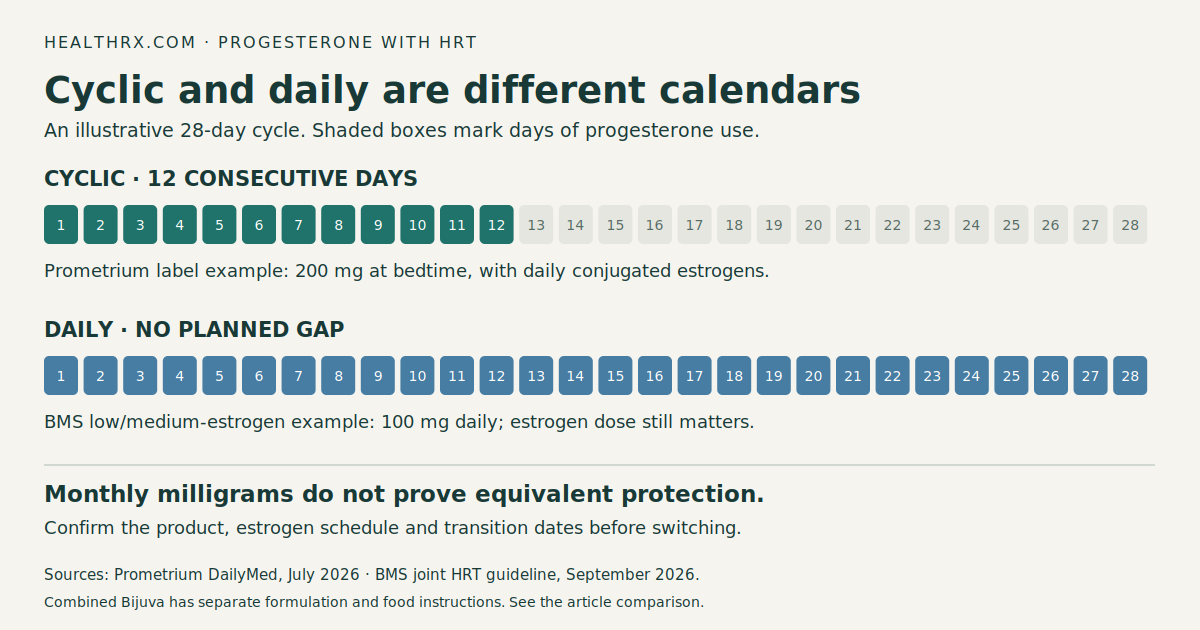
Cyclic progesterone means giving a progestogen for 10 to 14 consecutive days every calendar month, then stopping for the remaining days. The standard FDA-labeling dose for oral micronized progesterone (Prometrium) is 200 mg taken orally at bedtime for 12 days per 28-day cycle. [2] The bedtime instruction matters: progesterone's sedating metabolites (allopregnanolone, primarily) cause drowsiness in roughly 25 to 30% of users, and taking the capsule at night converts that side effect into a sleep benefit.

Duration of the progestogen phase is as important as dose. Ten days of coverage may be sufficient to prevent simple hyperplasia, but the PEPI trial (N=875) showed that 12 days of progestogen per cycle produced significantly lower rates of endometrial hyperplasia than 10-day regimens at 3-year follow-up. [3] The practical recommendation is therefore 12 to 14 days, not 10.

Timing options within the cyclic protocol:

  • Calendar-based: days 1, 12 or days 14, 28 of each calendar month, regardless of the patient's remaining cycle
  • Estrogen-coupled: progesterone added during the last 12 to 14 days of each estrogen cycle if the patient is using estrogen cyclically (uncommon in modern practice)

Most prescribers in the United States now use the calendar-based approach with continuous estradiol plus cyclic progesterone for 12 to 14 days monthly. Breakthrough bleeding outside the expected withdrawal window is an indication for endometrial biopsy, not a dose adjustment.

What to expect from cyclic regimens

Withdrawal bleeds typically begin 2 to 5 days after the last progesterone capsule. They tend to be lighter and shorter than natural periods. A withdrawal bleed that becomes heavy (soaking more than one pad per hour for two consecutive hours) warrants ultrasound assessment of endometrial thickness regardless of the expected timing.

Continuous Progesterone Dosing: Dose, Protocol, and Amenorrhea Timeline

Continuous combined HRT means daily estrogen plus daily progestogen, with no pill-free interval. For oral micronized progesterone, the standard continuous dose is 100 mg every night. [2] This is half the cyclic dose, reflecting the shift from 12 days of coverage per month to 30 days of coverage per month (providing roughly the same total monthly progestogen exposure).

The Women's Health Initiative (WHI) used conjugated equine estrogens plus medroxyprogesterone acetate (CEE/MPA) in its continuous combined arm and is the most-cited RCT in this space. The breast cancer signal from WHI's combined arm (hazard ratio 1.26 at mean 5.6 years) [4] has been substantially attributed to the MPA component and the older age at initiation, not to progesterone per se. Oral micronized progesterone does not appear to carry the same breast cancer risk signal: the French E3N cohort study (N=80,377, follow-up 8.1 years) found no significantly elevated breast cancer risk in users of transdermal estradiol combined with oral micronized progesterone. [5]

Amenorrhea timeline with continuous regimens:

Irregular spotting is common in the first 3 to 6 months of continuous combined HRT as the endometrium atrophies. By 12 months, approximately 80% of postmenopausal women on continuous combined therapy are bleed-free. Persistent or heavy bleeding after 6 months requires evaluation. Endometrial thickness <4 mm on transvaginal ultrasound in a postmenopausal woman provides good reassurance (sensitivity approximately 96% for ruling out endometrial cancer, per a 1995 NEJM study by Karlsson et al.). [6]

Progestogen alternatives in continuous regimens

When oral micronized progesterone is not tolerated (rare peanut-oil allergy is a contraindication to Prometrium), alternatives include:

  • Medroxyprogesterone acetate (MPA) 2.5 mg/day continuously (FDA-approved, widely studied, but carries the breast and cardiovascular risk signals from WHI)
  • Norethindrone acetate 0.1 mg/day (often combined with estradiol in FDA-approved products like Activella)
  • Levonorgestrel-releasing IUD (Mirena 52 mg), which provides highly localized endometrial protection with minimal systemic progestogen exposure, though not FDA-labeled specifically for this indication

Estradiol Patch Dosing in HRT Regimens

The estradiol patch delivers estradiol transdermally, bypassing first-pass hepatic metabolism. This is clinically relevant: oral estrogen increases hepatic synthesis of coagulation factors and C-reactive protein in a dose-dependent way, whereas transdermal estradiol at standard doses does not produce the same thrombotic risk. A 2007 observational study published in Circulation (ESTHER study, N=881) found that oral estradiol was associated with an odds ratio of 4.2 for venous thromboembolism, while transdermal estradiol showed no significant VTE elevation (OR 0.9 to 95% CI 0.5, 1.6). [7]

Standard patch dosing:

  • Starting dose: 0.025 mg/day or 0.0375 mg/day for perimenopausal women; 0.05 mg/day for clearly postmenopausal women with moderate-to-severe vasomotor symptoms
  • Titration interval: reassess at 4 to 8 weeks; increase by 0.025 mg/day increments
  • Typical therapeutic range: 0.05 to 0.1 mg/day; some women require 0.1 to 0.15 mg/day for symptom control
  • Maximum approved dose: varies by product; Vivelle-Dot goes up to 0.1 mg/day, Climara up to 0.1 mg/day

Patches are changed twice weekly (most products) or once weekly (Climara, Menostar). Rotation sites (lower abdomen, buttock) reduce skin irritation. Serum estradiol levels of 40, 80 pg/mL are generally considered adequate for vasomotor symptom control; levels <20 pg/mL usually indicate insufficient dosing or poor patch adherence.

Oral Estradiol Dosing

Oral estradiol (17-beta estradiol) is the most commonly prescribed estrogen in the United States. Conjugated equine estrogens (Premarin) remain available but are used less frequently as prescribers shift toward bioidentical 17-beta estradiol.

Oral 17-beta estradiol dosing:

  • Starting dose: 0.5 mg/day in perimenopausal women or those with mild symptoms; 1 mg/day for moderate-to-severe symptoms
  • Titration: increase to 2 mg/day if 1 mg/day provides inadequate symptom relief at 8 weeks
  • Upper dose: 4 mg/day is occasionally used for severe symptoms but requires close monitoring

Oral estradiol undergoes significant first-pass metabolism to estrone and estrone sulfate. Serum estrone levels on oral estradiol exceed estradiol levels, which differs from the premenopausal ratio. This is not considered clinically harmful but is biochemically different from transdermal delivery. For women with a personal or strong family history of VTE, migraine with aura, or hypertriglyceridemia, the patch or gel is preferred over oral estradiol.

Conjugated equine estrogens (CEE) dosing for reference:

  • 0.3 mg/day (low dose), 0.45 mg/day, 0.625 mg/day (standard), or 0.9 mg/day
  • 0.625 mg CEE is roughly equivalent in vasomotor symptom relief to 1 mg oral 17-beta estradiol, though pharmacokinetic equivalence is imprecise

Testosterone Cream Dosing in Women

Testosterone is not FDA-approved for women in the United States, but the 2019 Global Consensus Position Statement on the Use of Testosterone Therapy for Women (published simultaneously in the Journal of Clinical Endocrinology and Metabolism, Climacteric, and Menopause) recommended testosterone therapy for postmenopausal women with hypoactive sexual desire disorder (HSDD) when other causes have been excluded. [8]

The evidence base for testosterone in women is strongest for HSDD. APHRODITE (N=814), a randomized controlled trial, found that a testosterone patch delivering 300 mcg/day increased satisfying sexual events by a mean of 2.1 per 4-week period vs. 0.7 with placebo (P<0.001) at 52 weeks. [9]

Testosterone cream dosing (compounded, 0.5 to 1% cream):

  • Starting dose: 0.5 mg/day (approximately 0.1 mL of a 0.5% cream)
  • Typical therapeutic dose: 1 to 2.5 mg/day
  • Application site: inner labia minora, inner forearm, or inner upper arm; avoid the clitoris to reduce virilization risk
  • Titration interval: check free and total testosterone at 4 to 6 weeks; target a free testosterone level in the upper quartile of the normal female range (generally 1.0, 3.5 pg/mL free testosterone, though lab reference ranges vary)
  • Monitoring: assess for androgenic side effects (acne, hirsutism, voice change) at each follow-up visit

Supraphysiologic testosterone levels in women correlate with acne, clitoral enlargement, and potential cardiovascular risk. Keeping levels within the female physiologic range is the target, not the male range. DHEA (intrarosa, 6.5 mg vaginal insert, FDA-approved) is a related option for genitourinary syndrome of menopause with some androgenic activity at the vaginal mucosa level. [10]

HRT Titration: A Practical Framework

Titration is the iterative process of adjusting doses after the initial prescription to find the lowest effective dose for each individual. There is no universally correct HRT dose because symptom thresholds, receptor sensitivity, and absorption vary substantially between women.

HealthRX Step-Up Titration Framework for Combined HRT:

Step 1. Establish baseline (Visit 0): Document FSH, LH, estradiol, total and free testosterone, SHBG, CBC, metabolic panel, lipid panel, and blood pressure. Record symptom severity using a validated tool such as the Menopause Rating Scale (MRS) or Greene Climacteric Scale.

Step 2. Start low (Weeks 0, 8): Initiate estradiol at the lowest effective dose (0.025 mg/day patch or 0.5 to 1 mg/day oral). Add progesterone per the cyclic or continuous protocol appropriate to menstrual status. Avoid starting testosterone simultaneously so any side effects are attributable to a single agent.

Step 3. First titration point (Week 8): Repeat symptom score. If vasomotor symptoms remain moderate or severe (MRS item score 2, 3), increase estradiol by one step (e.g., 0.025 to 0.05 mg patch, or 1 mg to 2 mg oral). If symptoms are controlled, maintain dose.

Step 4. Second titration point (Week 16): Re-evaluate. If symptoms persist despite two dose increments, check serum estradiol level to assess adherence and absorption. A level <20 pg/mL suggests subtherapeutic delivery; a level 80, 120 pg/mL with persistent symptoms may indicate non-hormonal contributors (sleep apnea, thyroid dysfunction, depression).

Step 5. Consider testosterone (Week 16, 24): If libido or sexual satisfaction remains low despite adequate estrogen replacement and optimization of vaginal health, introduce testosterone cream at 0.5 mg/day. Check free testosterone 6 weeks after initiation. Titrate to the upper quartile of the normal female range.

Step 6. Annual review: Attempt a 10 to 20% dose reduction annually after 2 years of stable therapy to identify the minimum effective dose. The NAMS 2022 position statement does not specify a mandatory duration limit for HRT in women who are deriving benefit and have no contraindications, provided annual individualized risk-benefit assessment is performed. [1]

Monitoring: Labs, Endometrial Safety, and Red Flags

Routine serum hormone monitoring is not required for symptom titration in otherwise healthy women on standard doses, but it becomes useful when symptoms are not controlled at expected doses, when supraphysiologic levels are suspected, or when testosterone is part of the regimen.

Serum targets during HRT (general guidance):

  • Estradiol: 40, 80 pg/mL for vasomotor symptom control; some women require 80, 120 pg/mL
  • Total testosterone (women on testosterone therapy): within or just below the upper limit of the normal female range (15 to 70 ng/dL, lab-dependent)
  • Free testosterone: upper quartile of female range, typically 1.0, 3.5 pg/mL
  • SHBG: elevated SHBG (common on oral estradiol) reduces free testosterone availability; switching to transdermal estradiol often lowers SHBG and improves free testosterone bioavailability without changing testosterone dose

Endometrial safety checkpoints:

Unscheduled bleeding in a woman on cyclic HRT (bleeding outside the expected withdrawal window) and any bleeding in a woman on continuous combined HRT after 12 months of amenorrhea both require prompt investigation. Transvaginal ultrasound with endometrial thickness measurement is the first-line investigation. Endometrial thickness <4 mm in a postmenopausal woman makes significant pathology unlikely; thickness greater than or equal to 4 mm requires biopsy. [6]

Contraindications to systemic HRT (absolute):

  • Active or recent (within 12 months) breast cancer, endometrial cancer, or other hormone-sensitive cancer
  • Active VTE or arterial thromboembolic event
  • Undiagnosed vaginal bleeding
  • Known thrombophilia on anticoagulation (relative; requires specialist input)
  • Liver disease with impaired hepatic function (transdermal route may be considered after specialist review)

Comparing Regimen Architectures at a Glance

Three regimen types cover the majority of clinical scenarios:

Sequential (cyclic) combined HRT: Continuous estradiol plus cyclic progesterone for 12 to 14 days/month. Produces a monthly withdrawal bleed. Best for perimenopausal women (<12 months since last period) and women within 1 to 2 years of final menstrual period.

Continuous combined HRT: Daily estradiol plus daily progesterone (100 mg/night). No scheduled bleed; irregular spotting expected for up to 6 months. Best for women more than 12 months past the final menstrual period.

Estrogen-only HRT: Reserved strictly for women who have had a hysterectomy. No progestogen required. Avoids all progestogen-related side effects (bloating, mood changes, breast tenderness). The WHI estrogen-only arm (CEE 0.625 mg/day, N=10,739) actually showed a trend toward reduced breast cancer risk (HR 0.77 to 95% CI 0.59, 1.01) at 7 years, though the reduction was not statistically significant at conventional thresholds. [4]

Frequently asked questions

What is the difference between cyclic and continuous progesterone in HRT?
Cyclic progesterone is taken for 10 to 14 days per calendar month (typically 200 mg oral micronized progesterone at bedtime), producing a scheduled withdrawal bleed. Continuous progesterone is taken every night (100 mg), producing no planned bleed but often causing irregular spotting for the first 3 to 6 months. Cyclic regimens suit perimenopausal women; continuous regimens suit postmenopausal women who prefer to be bleed-free.
What dose of oral micronized progesterone is needed to protect the endometrium?
The FDA-approved dose for endometrial protection is 200 mg/night for 12 days per cycle (cyclic regimen) or 100 mg/night every night (continuous regimen). Both provide adequate progestogen opposition to standard estradiol doses. Lower doses have not been validated for endometrial protection and should not be used as substitutes.
Can I take progesterone every night instead of cyclically?
Yes. Continuous daily progesterone at 100 mg/night is standard for postmenopausal women. It eliminates scheduled withdrawal bleeds and is preferred by many women who are clearly postmenopausal. Perimenopausal women are generally kept on cyclic progesterone until they have been bleed-free for 12 months, at which point switching to continuous dosing is appropriate.
What is the standard starting dose for an estradiol patch?
The standard starting dose is 0.025 to 0.05 mg/day depending on symptom severity. Patches are changed twice weekly (most brands) or once weekly (Climara). Dose is reassessed at 4 to 8 weeks and increased in 0.025 mg/day increments if symptoms remain inadequately controlled. Therapeutic range is typically 0.05 to 0.1 mg/day.
How does estradiol patch dosing compare to oral estradiol dosing?
Roughly speaking, 0.05 mg/day transdermal estradiol produces serum estradiol levels comparable to 1 mg/day oral 17-beta estradiol, though individual variation is substantial. Transdermal delivery avoids first-pass hepatic metabolism, which means lower VTE risk and no increase in triglycerides, making the patch preferable for women with VTE history or hypertriglyceridemia.
What is the correct testosterone cream dose for women?
Compounded testosterone cream (0.5 to 1%) is typically started at 0.5 mg/day and titrated to 1 to 2.5 mg/day based on symptom response and free testosterone levels. Free testosterone should remain within the upper quartile of the normal female range (roughly 1.0, 3.5 pg/mL). Application sites include the inner forearm or inner labia minora. Monitor for androgenic side effects at each visit.
How long does it take for continuous HRT to stop breakthrough bleeding?
Most women experience irregular spotting for the first 3 to 6 months of continuous combined HRT as the endometrium thins. By 12 months, approximately 80% of postmenopausal users achieve amenorrhea. Persistent or heavy bleeding after 6 months requires transvaginal ultrasound and possible endometrial biopsy regardless of when HRT was started.
Is micronized progesterone safer than medroxyprogesterone acetate (MPA)?
Observational data, including the French E3N cohort (N=80,377), consistently show a more favorable breast cancer risk profile for oral micronized progesterone compared with MPA. MPA also has less favorable effects on HDL cholesterol and mood. The NAMS 2022 guidelines list oral micronized progesterone as the preferred progestogen when available and tolerated.
Do women with a hysterectomy need progesterone with HRT?
No. Women who have had a total hysterectomy do not have endometrial tissue to protect and do not need a progestogen. Estrogen-only therapy is appropriate and preferred, as it avoids progestogen-related side effects and may carry a more favorable breast cancer risk profile than combined therapy.
When should HRT be started for the lowest cardiovascular risk?
The 'timing hypothesis' (also called the 'window of opportunity') holds that starting HRT within 10 years of menopause onset or before age 60 is associated with neutral or beneficial cardiovascular effects. The NAMS 2022 position statement supports this interpretation, noting that the absolute cardiovascular risk of combined HRT in healthy women under 60 who initiate therapy within 10 years of menopause is low.
How often should HRT doses be reviewed?
Dose titration checkpoints occur at 4 to 8 weeks after initiation and after each dose change. A stable patient should have a formal annual review addressing symptom control, side effects, any new contraindications, and the ongoing risk-benefit balance. An attempt to taper to the minimum effective dose is reasonable after 2 years of stable therapy.
What blood tests are needed when starting or adjusting HRT?
Baseline labs before starting HRT typically include FSH, LH, estradiol, total and free testosterone, SHBG, CBC, metabolic panel, and lipid panel. Routine monitoring of estradiol is not required for symptom titration in healthy women on standard doses but becomes useful when symptoms are not controlled at expected doses, when testosterone is added, or when supraphysiologic levels are suspected.

References

  1. The Menopause Society (formerly NAMS). The 2022 Hormone Therapy Position Statement of The Menopause Society. Menopause. 2022;29(7):767-794. https://pubmed.ncbi.nlm.nih.gov/35797481/
  2. FDA. Prometrium (progesterone, USP) capsules 100 mg and 200 mg prescribing information. Accessed 2025. https://www.accessdata.fda.gov/drugsatfda_docs/label/2017/019781s023lbl.pdf
  3. Writing Group for the PEPI Trial. Effects of hormone replacement therapy on endometrial histology in postmenopausal women. JAMA. 1996;275(5):370-375. https://pubmed.ncbi.nlm.nih.gov/8569017/
  4. Chlebowski RT, Hendrix SL, Langer RD, et al. Influence of estrogen plus progestin on breast cancer and mammography in healthy postmenopausal women: the WHI randomized trial. JAMA. 2003;289(24):3243-3253. https://pubmed.ncbi.nlm.nih.gov/12824205/
  5. Fournier A, Berrino F, Clavel-Chapelon F. Unequal risks for breast cancer associated with different hormone replacement therapies: results from the E3N cohort study. Breast Cancer Res Treat. 2008;107(1):103-111. https://pubmed.ncbi.nlm.nih.gov/17333341/
  6. Karlsson B, Granberg S, Wikland M, et al. Transvaginal ultrasonography of the endometrium in women with postmenopausal bleeding, a Nordic multicenter study. Am J Obstet Gynecol. 1995;172(5):1488-1494. https://pubmed.ncbi.nlm.nih.gov/7755059/
  7. Canonico M, Oger E, Plu-Bureau G, et al. Hormone therapy and venous thromboembolism among postmenopausal women: impact of the route of estrogen administration and progestogens: the ESTHER study. Circulation. 2007;115(7):840-845. https://pubmed.ncbi.nlm.nih.gov/17309934/
  8. Davis SR, Baber R, Panay N, et al. Global consensus position statement on the use of testosterone therapy for women. J Clin Endocrinol Metab. 2019;104(10):4660-4666. https://pubmed.ncbi.nlm.nih.gov/31498871/
  9. Shifren JL, Braunstein GD, Simon JA, et al. Transdermal testosterone treatment in women with impaired sexual function after oophorectomy. N Engl J Med. 2000;343(10):682-688. https://pubmed.ncbi.nlm.nih.gov/10974131/
  10. FDA. Intrarosa (prasterone) vaginal inserts 6.5 mg prescribing information. Accessed 2025. https://www.accessdata.fda.gov/drugsatfda_docs/label/2016/208470s000lbl.pdf