Anastrozole Dosing for TRT: The Evidence-Based Guide to Estrogen Management
At a glance
- FDA-approved male TRT dose / none
- Labeled dose / 1 mg once daily for specified breast-cancer uses in postmenopausal women, not a TRT instruction
- Guideline context / persistent breast symptoms or gynecomastia with elevated estradiol after assessment
- Universal estradiol threshold / not established
- Best timing with a testosterone injection / not established
- Daily microdosing protocol / not established by a male TRT trial
- Strongest direct TRT evidence / one single-center retrospective series with 44 analyzed men
- Important tradeoff / estradiol contributes to male bone, body-composition, and sexual physiology
- Publication status / evidence-reconciled draft; medical approval required
The first dosing fact is that no TRT dose is approved
Current U.S. anastrozole labeling recommends one 1 mg tablet once daily for its approved breast-cancer uses in postmenopausal women. The label does not include male hypogonadism, testosterone-associated estradiol elevation, gynecomastia during TRT, or a target estradiol concentration.
The current Zydus prescribing information says, “The dose of anastrozole tablet is one 1 mg tablet taken once a day.” [1] Its section 2.1 sits beneath breast-cancer indications for postmenopausal women. Quoting it here identifies the source of a commonly misapplied number; it does not turn that number into a TRT regimen or imply manufacturer endorsement of off-label use.
That distinction matters because the labeled dose is sometimes presented online as a reference point for TRT. It is not. The population, indication, treatment goal, and safety evidence are different. Off-label prescribing can be clinically appropriate, but the dose requires a patient-specific rationale that cannot be imported from the oncology label.
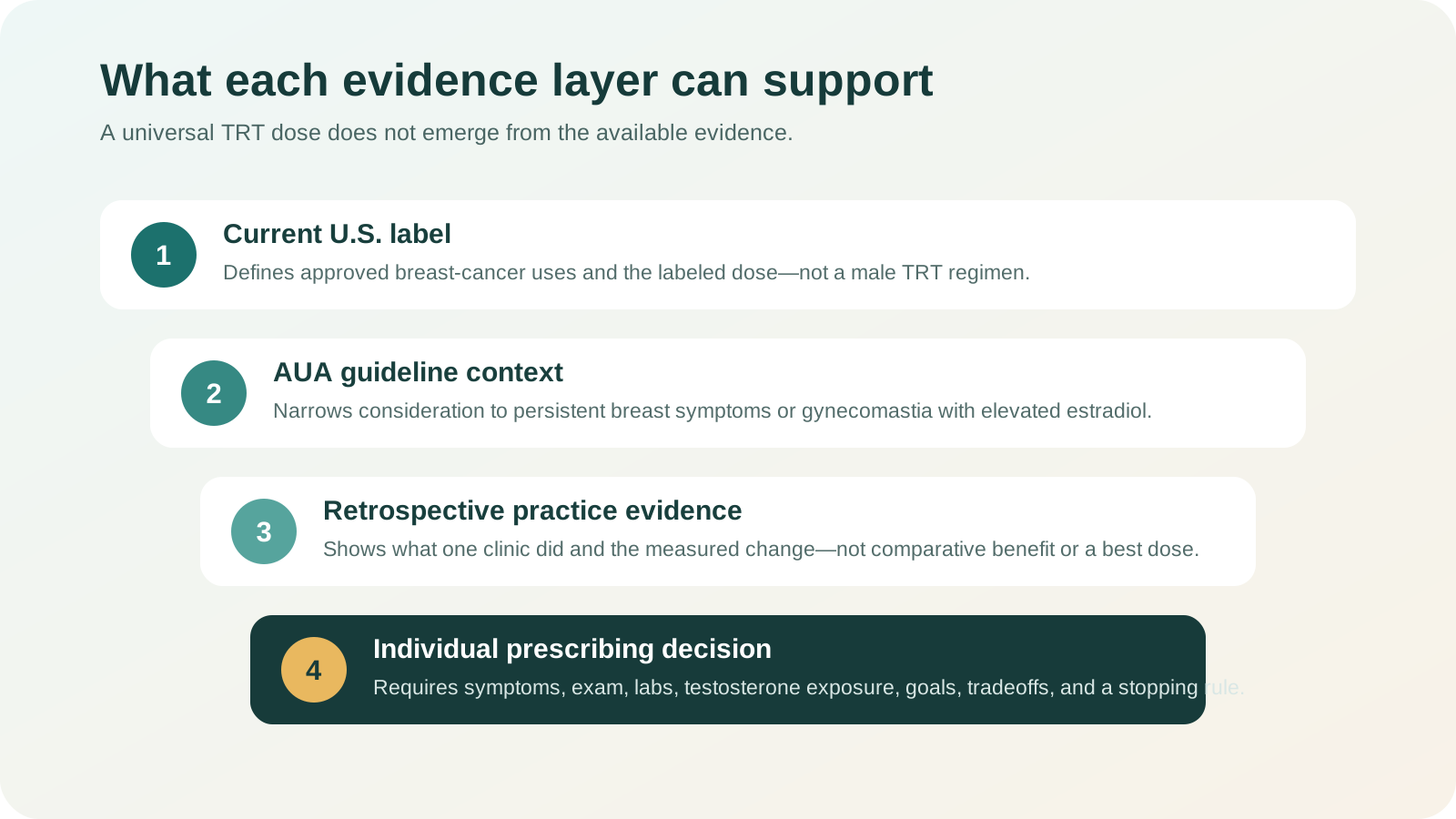
Figure 1. Evidence ladder for anastrozole dose decisions on TRT. HealthRX.com editorial synthesis, August 29, 2026. Sources: current DailyMed labeling, the AUA testosterone-deficiency guideline, and Punjani et al. (2021). Method: each source was limited to the conclusion its design can support. Limitation: this is a decision aid, not a treatment algorithm. The accessible evidence table below contains the same information.
What each evidence layer can support
| Evidence layer | What it can support | What it cannot support |
|---|---|---|
| Current anastrozole label | Approved breast-cancer indications; labeled 1 mg once-daily dose; warnings about bone mineral density and cholesterol | A male TRT indication, TRT dose, injection-day timing, or estradiol target |
| AUA testosterone-deficiency guideline | Estradiol assessment for breast symptoms or gynecomastia; monitoring of persistent symptoms; consideration of testosterone exposure before an AI | Routine preventive use, a symptom-free lab threshold, or one dose schedule |
| 2021 single-center retrospective series | One practice used 0.5 mg three times weekly under its own symptom and estradiol criteria; measured estradiol declined in 44 analyzed men | Randomized benefit, comparative safety, the best threshold, or applicability to every TRT patient |
| Male physiology and bone studies | Estradiol has clinically relevant roles in male fat regulation, sexual function, and bone metabolism | A universal “ideal” result or proof that lowering estradiol will improve a particular symptom |
| Individual clinical assessment | Can combine the symptom, exam, testosterone exposure, assay, history, goals, and alternatives | Cannot turn weak population evidence into certainty |
The evidence gets more specific as it moves downward, but not stronger in a way that creates a ready-made prescription. The final decision needs more inputs precisely because the research does not supply a universal regimen.
What the AUA pathway actually asks clinicians to distinguish
The AUA recommends measuring estradiol before testosterone therapy in patients who already have breast symptoms or gynecomastia. If breast symptoms develop during treatment, the guideline describes monitoring because symptoms sometimes abate.
For persistent breast symptoms with elevated estradiol, the pathway then separates two testosterone contexts. When on-treatment testosterone is in the upper range of normal, the guideline describes adjusting the testosterone dose. When testosterone is low or normal, it says estradiol reduction can be accomplished with an aromatase inhibitor.
This is not a general endorsement of treating edema, mood change, libido change, or a laboratory flag with anastrozole. Those complaints have broad differentials. It is also not a dosing recommendation.
For the wider clinical context—label status, male physiology, and the AUA pathway—see the anastrozole-on-TRT evidence map.
The published TRT regimen is a study fact, not a dose ladder
Punjani and colleagues reviewed 1,708 men receiving testosterone at one sexual-medicine practice between 2005 and 2019. Fifty-one received anastrozole, and 44 remained after exclusions. The practice used 0.5 mg three times weekly for men with estradiol above 60 pg/mL regardless of symptoms or 40–60 pg/mL with subjective symptoms. Median estradiol declined from 65 to 22 pg/mL; median total testosterone did not change significantly.
Those numbers are useful when kept inside the study's boundaries:
- The design was retrospective, not randomized.
- The treated group was a small, selected fraction of one practice.
- The selection thresholds and schedule were that practice's protocol.
- There was no untreated comparison group for the same clinical question.
- The study was not designed to establish symptom benefit, fracture risk, fertility outcomes, or the best long-term dose.
The defensible conclusion is that the regimen lowered measured estradiol in the selected men. It is not that 0.5 mg three times weekly is a standard starting dose.
Why a fixed target or “danger floor” overstates the evidence
The old version of this page presented 20–40 pg/mL as a required target, below 15 pg/mL as a universal danger threshold, and several higher values as automatic dose-escalation points. The cited sources did not establish that algorithm.
Estradiol interpretation depends on the assay and clinical question. The AUA guideline discusses elevated estradiol in the setting of breast symptoms, but does not create a single therapeutic range for every man on TRT. A result should be read with the laboratory method and range, prior results, symptom timing, testosterone concentration, formulation, prescribed dose, and collection timing.
That does not make the number irrelevant. It means the number is evidence within a case, not the case itself.
Why lowering estradiol has a real tradeoff
In a controlled physiology experiment, investigators suppressed endogenous gonadal steroids in men and used graded testosterone replacement with or without anastrozole. Estrogen deficiency primarily accounted for increases in body fat, while both androgen and estrogen deficiency contributed to reduced sexual function. The experiment clarified physiology; it did not define a TRT target.
Bone findings are also consequential. In a one-year randomized placebo-controlled trial in 69 older men with low or borderline-low testosterone, daily anastrozole increased testosterone, decreased estradiol, and was associated with lower posterior-anterior spine bone mineral density compared with placebo. A separate short study in 15 older men found increasing markers of bone resorption during aromatase inhibition.
These studies used different populations and doses from typical off-label practice. They cannot quantify the risk of a proposed regimen. They do show why a plan needs a benefit to pursue, a way to detect excessive suppression, and a stopping rule.
The dosing worksheet a prescriber should be able to complete
| Decision input | Why it changes the prescription |
|---|---|
| Exact symptom and examination finding | New tender breast tissue, longstanding gynecomastia, edema, low libido, and mood symptoms are not interchangeable |
| Baseline and current estradiol, including assay | A result has less meaning without method, reference range, and trend |
| Current testosterone result, dose, formulation, and collection timing | The AUA pathway considers testosterone exposure before adding an AI |
| Other medicines and health conditions | Several drugs and endocrine conditions can contribute to breast symptoms or altered hormone results |
| Bone history and expected duration | Age, fracture history, low bone density, and longer exposure change the cost of estrogen suppression |
| Fertility goal | Exogenous testosterone and fertility-preserving treatment are separate decisions |
| Measurable treatment outcome | A drug should not continue indefinitely when the intended symptom does not improve |
| Reassessment and stopping rule | The plan needs a response to lack of benefit, adverse effects, or unexpectedly low estradiol |
This worksheet is intentionally not a calculator. Current evidence does not support converting the answers into an automated dose.
Daily microdosing and injection-day timing remain unproven protocols
The previous page recommended 0.125 mg daily liquid anastrozole and tied twice-weekly dosing to testosterone injection days. It also claimed that the drug's half-life proves once-weekly dosing causes a rebound pattern. The current label reports an average elimination half-life of about 50 hours, but half-life alone does not validate a clinical schedule or predict symptom benefit.
No cited male TRT trial established that daily compounded microdosing, same-day timing, next-day timing, or another schedule is superior. Compounded liquid also introduces formulation and concentration questions that the approved 1 mg tablet label does not answer.
If a clinician proposes one of these schedules, reasonable questions are: What patient-specific problem is it meant to solve? What evidence supports the starting point? What will be measured? When will benefit and harm be reassessed? What triggers a change or stop?
Fertility is a separate treatment branch
The AUA/ASRM male-infertility guideline says clinicians may use aromatase inhibitors, hCG, selective estrogen receptor modulators, or combinations for infertile men with low serum testosterone; the recommendation is conditional and the evidence level is Grade C. Its current Statement 42 says exogenous testosterone therapy should not be prescribed to men interested in current or future fertility.
That pathway concerns stimulating endogenous testosterone while trying not to impair spermatogenesis. It is not evidence for automatically adding anastrozole to exogenous testosterone, and it does not make a TRT dose appropriate for an infertility patient. Fertility goals should be surfaced before the testosterone and anastrozole decisions are treated as settled.
What this page removed and why
The prior version supplied a 0.25-to-0.5-mg dose ladder, daily liquid microdosing, fixed estradiol thresholds, injection instructions, DEXA schedules, dose changes after weight loss, and a purported HealthRX.com clinical protocol. It also attributed claims to PubMed records that did not match the displayed titles.
Those elements were removed because the cited evidence did not establish them. The replacement preserves the reader's real task—understanding what a dose decision should be based on—without pretending that public evidence can generate an individualized prescription.
Questions to take to the prescribing visit
- What exact symptom or finding are we treating?
- Does the result need confirmation or interpretation with a different assay or collection time?
- What does my on-treatment testosterone result suggest about the current testosterone prescription?
- What alternatives should be considered before adding another drug?
- What evidence supports the proposed dose and schedule for my situation?
- What outcome would count as benefit, and by when?
- What adverse effect or laboratory result would trigger a dose change or stop?
- How do my bone history and fertility plans change the decision?
Frequently asked questions
What is the standard anastrozole dose for TRT?
Is 1 mg daily the FDA dose for TRT?
Does the AUA provide an anastrozole dose?
Can I use the 2021 study's dose?
Should anastrozole be taken on injection day?
Why does bone history matter?
References
-
DailyMed. Anastrozole tablets, current U.S. prescribing information; revised June 2026. https://dailymed.nlm.nih.gov/dailymed/drugInfo.cfm?setid=f5b53383-0366-4ae2-9aa4-88b56c0bbd07
-
American Urological Association. Evaluation and Management of Testosterone Deficiency: AUA Guideline. https://www.auanet.org/Documents/Guidelines/PDF/Testosterone%20Website%20Final%280%29.pdf
-
Punjani N, Bernie H, Salter C, Flores J, Benfante N, Mulhall JP. The Utilization and Impact of Aromatase Inhibitor Therapy in Men With Elevated Estradiol Levels on Testosterone Therapy. Sex Med. 2021 Aug;9(4):100378. doi:10.1016/j.esxm.2021.100378. PMID:34090245. PMCID:PMC8360915. PubMed record PMC full text
-
Finkelstein JS, Lee H, Burnett-Bowie SA, Pallais JC, Yu EW, Borges LF, Jones BF, Barry CV, Wulczyn KE, Thomas BJ, Leder BZ. Gonadal steroids and body composition, strength, and sexual function in men. N Engl J Med. 2013 Sep 12;369(11):1011-22. doi:10.1056/nejmoa1206168. PMID:24024838. PMCID:PMC4142768. NCT:NCT00114114. PubMed record PMC full text
-
Burnett-Bowie SA, McKay EA, Lee H, Leder BZ. Effects of aromatase inhibition on bone mineral density and bone turnover in older men with low testosterone levels. J Clin Endocrinol Metab. 2009 Dec;94(12):4785-92. doi:10.1210/jc.2009-0739. PMID:19820017. PMCID:PMC2795655. PubMed record PMC full text
-
Taxel P, Kennedy DG, Fall PM, Willard AK, Clive JM, Raisz LG. The effect of aromatase inhibition on sex steroids, gonadotropins, and markers of bone turnover in older men. J Clin Endocrinol Metab. 2001 Jun;86(6):2869-74. doi:10.1210/jcem.86.6.7541. PMID:11397902. PubMed record
-
American Urological Association and American Society for Reproductive Medicine. Diagnosis and Treatment of Infertility in Men: AUA/ASRM Guideline (2020; amended 2024). See Statements 41 and 42. 2024 unabridged guideline