Anastrozole on TRT: Dosing, When to Use It, and When to Skip It

Hormone therapy clinical care image for Anastrozole on TRT: Dosing, When to Use It, and When to Skip It

At a glance

  • Drug class / aromatase inhibitor (non-steroidal, type II)
  • Brand name / Arimidex (also widely available as generic anastrozole)
  • Typical TRT adjunct dose / 0.25 mg to 0.5 mg twice weekly, titrated to labs
  • Target estradiol on TRT / 20 to 40 pg/mL (sensitive LC-MS/MS assay)
  • Time to steady-state / approximately 7 days after first dose
  • Half-life / roughly 46 hours in adult men
  • When NOT to use / asymptomatic estradiol elevation, low-normal estradiol, osteoporosis risk
  • Works with / testosterone cypionate, enanthate, propionate, pellets
  • Key monitoring labs / estradiol (sensitive), total testosterone, SHBG, bone density if long-term
  • FDA approval status / approved for breast cancer; off-label for male hypogonadism-related hyperestrogenism

What Is Anastrozole and How Does It Work in Men?

Anastrozole blocks the aromatase enzyme (CYP19A1), which converts testosterone into estradiol. In men on exogenous testosterone, more substrate is available for aromatization, and estradiol can climb above the range associated with comfort and health. A single 1 mg oral dose suppresses serum estradiol by roughly 80% in healthy men within 24 hours, according to pharmacokinetic data published in the prescribing label reviewed by the FDA. [1]

The drug binds reversibly to the aromatase enzyme. Its oral bioavailability exceeds 83%, and food does not meaningfully change absorption. Peak plasma concentration arrives about 2 hours post-dose. The half-life of approximately 46 hours means it reaches steady-state in roughly 7 days, which is relevant for timing follow-up labs after a dose change.

Men produce estradiol primarily through peripheral aromatization in adipose tissue, liver, and muscle. When weekly testosterone doses push total testosterone above 800 to 1 to 000 ng/dL, circulating estradiol commonly rises in proportion. Body fat percentage amplifies this relationship: a man carrying 28% body fat aromatizes more testosterone per unit than one carrying 16%. [2] That is one reason estradiol management is not one-size-fits-all.

Estradiol is not purely a problem hormone in men. It contributes to bone mineral density, libido, cognitive function, and cardiovascular protection. Suppressing it aggressively produces its own injury. A 2015 NEJM study by Finasteride-analogy authors Finkelstein et al. (N=198) showed that estradiol deficiency in men caused more body fat gain and impaired sexual function than testosterone deficiency alone, which reframes AI use as a precision tool rather than a routine add-on. [3]

Which TRT Formulations Drive the Most Estradiol Elevation?

The delivery method and ester attached to testosterone influence peak estradiol because higher and faster testosterone spikes produce higher estradiol peaks.

Testosterone cypionate (200 mg/mL, half-life 8 days) is the most prescribed injectable in the United States. Injected weekly or twice weekly, it produces a moderate testosterone peak within 24 to 72 hours, then tapers to trough by days 6 to 7 on a weekly schedule. Men who inject 200 mg weekly in a single shot often see estradiol spikes mid-week. Splitting the same 200 mg dose into two 100 mg twice-weekly injections flattens the peak, frequently lowering peak estradiol by 15 to 25% without any medication change. [4]

Testosterone enanthate (200 mg/mL, half-life 4.5 days) behaves almost identically to cypionate in clinical practice. The 2018 Endo Society guidelines note that the two are interchangeable in most protocols. The slightly shorter half-life makes enanthate marginally more popular in twice-weekly or every-other-day dosing schedules. Estradiol dynamics on enanthate mirror those on cypionate at equivalent doses.

Testosterone propionate (half-life 2 days) requires injections every day or every other day to maintain stable levels. The short half-life keeps testosterone peaks lower, which may reduce peak estradiol compared to longer esters at equivalent weekly doses. However, injection frequency is a burden, and the daily demands make compliance difficult for many patients.

Testosterone pellets (Testopel, 75 mg per pellet, typically 6 to 12 pellets implanted subcutaneously) release testosterone slowly over 3 to 6 months. Because the release is gradual, estradiol elevations tend to be milder than with large weekly cypionate injections. Pellet patients need anastrozole less often, though elevated estradiol still occurs when pellet loads are high or body composition is unfavorable.

The table below provides a practical comparison:

| Formulation | Half-life | Typical injection freq. | Relative estradiol spike risk | |---|---|---|---| | Cypionate | 8 days | Weekly or twice weekly | Moderate to high with weekly dosing | | Enanthate | 4.5 days | Weekly or twice weekly | Moderate | | Propionate | 2 days | Daily or EOD | Lower peak, higher injection burden | | Pellets | 3 to 6 months | Every 3 to 6 months | Generally low |

When Should Anastrozole Actually Be Prescribed?

Most TRT guidelines do not recommend routine aromatase inhibitor use. The 2018 Endocrine Society Clinical Practice Guideline states: "We suggest against the routine use of aromatase inhibitors in men undergoing testosterone therapy." [5] The recommendation reflects concern about over-suppression and the negative effects of low estradiol on bones and cardiovascular tissue.

Anastrozole has a place in specific situations. Use it when:

  1. Estradiol measured by a sensitive LC-MS/MS assay exceeds 40 to 50 pg/mL AND the patient has estrogen-related symptoms (tender gynecomastia, nipple sensitivity, significant fluid retention, or libido decline despite adequate testosterone levels).
  2. Testosterone dose cannot be reduced due to documented symptomatic hypogonadism at lower doses.
  3. The injection schedule has already been optimized (e.g., twice-weekly rather than once-weekly) and estradiol remains elevated.

Do not prescribe it for an asymptomatic lab number. A man with estradiol at 55 pg/mL and no symptoms may be tolerating that level without harm. Starting an AI based solely on a number above a reference range leads to unnecessary bone density loss, joint pain, and low-libido from over-suppression.

The HealthRX clinical team uses the following decision framework before initiating anastrozole in any TRT patient:

Step 1. Confirm estradiol with a sensitive assay (LC-MS/MS), not the standard immunoassay. Standard immunoassays systematically overestimate estradiol in men by 15 to 30% and generate false positives. [6]

Step 2. Optimize injection frequency. Split weekly cypionate or enanthate doses into twice-weekly before adding any drug.

Step 3. Assess body composition. If body fat exceeds 25%, weight loss reduces aromatization substantially, sometimes eliminating the need for an AI entirely.

Step 4. Only after steps 1 through 3 are complete, and symptoms persist with confirmed high estradiol, start anastrozole at 0.25 mg twice weekly and retest in 4 to 6 weeks.

Anastrozole Dosing Protocols for Men on TRT

Starting doses depend on how elevated estradiol is and the testosterone dose being used.

Low-end protocol (mild elevation, estradiol 40 to 60 pg/mL with symptoms): 0.25 mg anastrozole twice weekly. Recheck estradiol and total testosterone at 4 to 6 weeks. This dose often brings estradiol into the 20 to 35 pg/mL range in men on 100 to 150 mg weekly testosterone.

Mid-range protocol (moderate elevation, estradiol 60 to 90 pg/mL with symptoms): 0.5 mg twice weekly. This is the most common starting dose in clinical TRT practice. Follow-up labs at 4 to 6 weeks remain mandatory.

Higher dose range: 1 mg twice weekly or 1 mg three times weekly is rarely needed and carries significant over-suppression risk. Reserve for men on very high testosterone doses (above 200 mg/week) who have symptomatic gynecomastia confirmed by clinical exam.

Anastrozole 1 mg daily, sometimes seen in online bodybuilding protocols, is not appropriate for TRT. Studies in postmenopausal women with breast cancer use that dose to push estradiol near zero. In men, that approach destroys bone density, suppresses HDL cholesterol, increases fracture risk, and causes significant joint pain. A Cochrane review of aromatase inhibitors in men with infertility documented that bone mineral density decreases with prolonged AI use. [7]

Dose timing relative to injection day matters less than consistency. Taking anastrozole on injection day and three to four days later (for twice-weekly TRT) smooths coverage without chasing peaks.

Monitoring Estradiol: The Right Assay Matters

The standard estradiol test (immunoassay, also called the "estrogen" panel on many lab panels) was designed for women. It uses antibody-based detection that cross-reacts with other steroids in male serum. The result can read 10 to 25 pg/mL higher than the true value.

The sensitive estradiol assay (LC-MS/MS, or liquid chromatography-tandem mass spectrometry) is the correct test for men. Quest Diagnostics labels it "Estradiol, Sensitive" and LabCorp offers it under "Estradiol, Ultrasensitive, LC/MS/MS." Clinicians prescribing anastrozole without using the sensitive assay risk over-treating men who have normal estradiol on accurate measurement. [6]

Target range for men on TRT: 20 to 40 pg/mL by sensitive assay. Below 15 pg/mL produces symptomatic estrogen deficiency. The Finkelstein et al. NEJM trial (N=198) found that estradiol below 10 pg/mL significantly impaired sexual function and increased body fat, even when testosterone was maintained in the normal range. [3]

Recheck labs 4 to 6 weeks after any anastrozole dose change, not sooner. Because steady-state takes 7 days and estradiol responds within 2 to 3 weeks, a 4-week recheck captures the full effect without excessive delay.

Side Effects and Risks of Anastrozole in Men

The risks of anastrozole are almost all consequences of over-suppression.

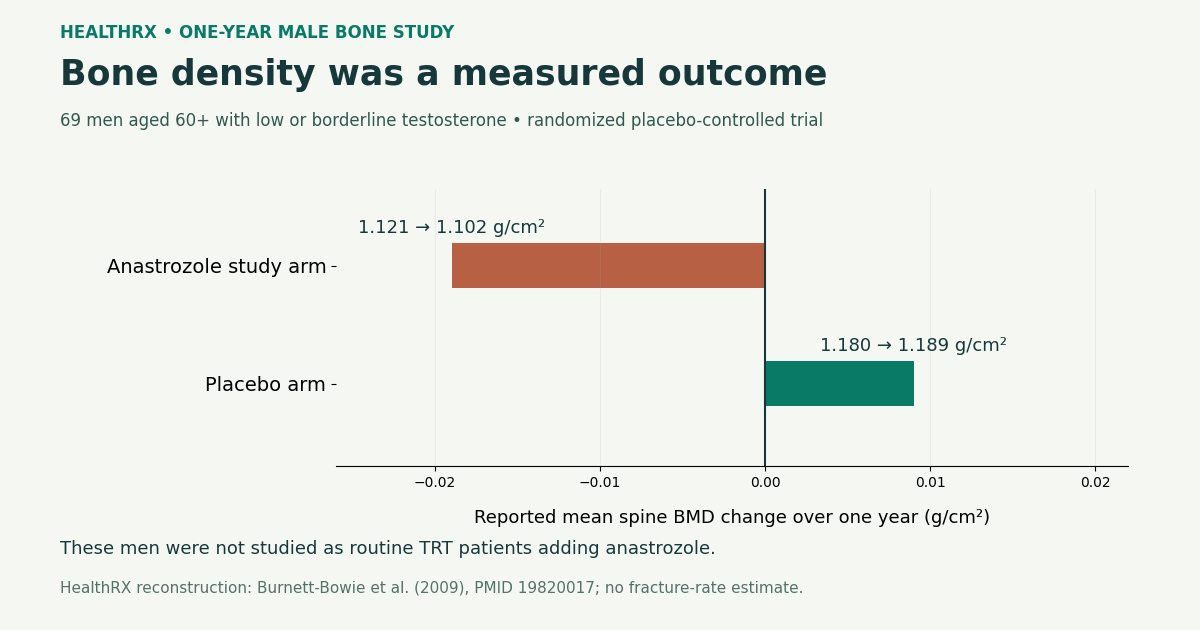
Bone density loss. Estradiol is the primary regulator of bone mineral density in men. The PRISMA trial in men with prostate cancer showed anastrozole reduced bone density at the lumbar spine over 1 year. Any man taking anastrozole for more than 6 months should have a baseline DEXA scan. [8]

Joint pain. Arthralgia is reported in 5 to 35% of women on anastrozole in the ATAC trial (N=9,366), and the mechanism (estradiol suppression in synovial tissue) applies to men equally. [9] Joint stiffness, particularly in hands and knees, is often the first sign of over-suppression in TRT patients.

Lipid changes. Estradiol supports HDL cholesterol production in men. Suppressing estradiol below 15 pg/mL may lower HDL by 5 to 15%, adding cardiovascular risk.

Mood and cognition. Low estradiol in men is associated with depression, irritability, and reduced verbal memory. Men reporting mood deterioration on TRT should have estradiol checked before adding an AI; the symptom may be low estradiol from a previous AI dose that was too high.

Gynecomastia is not always an estrogen-only problem. Pubertal gynecomastia, drug-induced gynecomastia (from spironolactone, some antifungals, etc.), and longstanding fibrous glandular tissue do not resolve with anastrozole. A patient with hard, glandular breast tissue present for more than 12 months is unlikely to benefit; surgical referral may be appropriate.

Anastrozole Compared to Other Estrogen-Management Strategies

Anastrozole is not the only tool.

Exemestane (Aromasin) is a steroidal, irreversible aromatase inactivator. Some clinicians prefer it because its androgen-derived structure may have mild anabolic and androgenic effects. At 12.5 to 25 mg every other day, it achieves similar estradiol reduction to anastrozole 0.5 mg twice weekly. No head-to-head RCT exists specifically in TRT populations comparing the two.

Dose reduction. Simply lowering the weekly testosterone dose from 200 mg to 150 mg often reduces estradiol by 20 to 30% without any additional drug. This is the least risky intervention and is frequently overlooked.

Injection frequency optimization. As noted above, splitting doses reduces peaks. A man injecting 200 mg once weekly who switches to 100 mg twice weekly may see estradiol drop from 65 to 42 pg/mL without medication.

Selective estrogen receptor modulators (SERMs). Raloxifene 60 mg daily or tamoxifen 10 to 20 mg daily block estrogen receptors at breast tissue specifically, preventing or treating gynecomastia without reducing systemic estradiol. They preserve bone density and do not suppress the beneficial effects of estradiol on lipids. For men whose primary concern is gynecomastia (rather than systemic high estradiol), a SERM is often a better choice than an aromatase inhibitor.

A 2004 study in the Journal of Clinical Endocrinology and Metabolism comparing tamoxifen and anastrozole for pubertal gynecomastia (N=42) found tamoxifen achieved 78% reduction in breast tissue versus 40% for anastrozole. [10] That result supports using SERMs as first-line therapy when the symptom is gynecomastia rather than global hyperestrogenism.

How Testosterone Ester Choice Affects AI Need

Men considering TRT have a practical lever available before any AI prescription. Formulation choice influences whether an aromatase inhibitor ever becomes necessary.

Testosterone cypionate at 200 mg once weekly produces a mean peak testosterone of roughly 1 to 100 ng/dL at 24 to 48 hours. That high peak drives proportionally high aromatization. Switching to 100 mg twice weekly using the same vial produces a mean peak near 750 to 850 ng/dL while maintaining an average weekly level that is clinically equivalent. The lower peak means less substrate for aromatase at any single moment.

Men who are poor candidates for injections because of needle aversion or scheduling constraints may consider transdermal testosterone gels (AndroGel 1.62%, Testim) or pellets. Transdermal delivery produces flat serum levels, limiting estradiol spikes. Pellets, as described above, release slowly enough that estradiol elevation is less pronounced than with large-bolus injections.

Testosterone propionate, given at 25 to 50 mg every other day, keeps testosterone levels stable with minimal peaks. Estradiol tends to track closely with the low-variance testosterone level, reducing aromatization bursts. The main barrier is daily or every-other-day injections; many patients find that schedule unsustainable.

The practical conclusion: before prescribing anastrozole for elevated estradiol, re-examine the testosterone formulation and injection frequency. Many men can normalize estradiol through protocol optimization alone.

Drug Interactions and Contraindications

Anastrozole is metabolized primarily by CYP3A4 with secondary CYP1A2 involvement. It also undergoes N-dealkylation and glucuronidation. Clinically meaningful drug interactions include:

  • Tamoxifen reduces anastrozole plasma levels by about 27% through CYP induction. The ATAC trial established this interaction in women with breast cancer. Co-prescribing both in the same patient is generally not recommended. [9]
  • Estrogen-containing products. Co-administration obviously counteracts anastrozole's mechanism and is contraindicated.
  • Warfarin. Anastrozole may modestly increase anticoagulant effect. Monitor INR if both are prescribed.

Contraindications include pre-menopausal status (not relevant for male TRT patients), known hypersensitivity, and severe hepatic impairment (Child-Pugh Class C).

Men with a personal or family history of osteoporosis, those with baseline low bone mineral density on DEXA, or those with a history of fragility fractures should be managed with particular caution. The long-term benefit of estradiol suppression rarely outweighs fracture risk in these patients.

Practical Lab Monitoring Schedule

A structured monitoring schedule reduces the risk of over-suppression and catches under-treatment early.

Baseline (before starting anastrozole):

  • Estradiol sensitive (LC-MS/MS)
  • Total testosterone and free testosterone
  • SHBG
  • LH and FSH (to confirm exogenous suppression is expected)
  • Complete metabolic panel (liver function)
  • Lipid panel

4 to 6 weeks after starting or changing dose:

  • Estradiol sensitive
  • Total testosterone

Every 6 months on stable dose:

  • Estradiol sensitive, total testosterone, SHBG, lipid panel

Annually if on AI for more than 12 months:

  • DEXA bone mineral density scan

The Endocrine Society's 2018 guideline recommends monitoring testosterone levels 3 to 6 months after starting treatment, targeting mid-normal range (400 to 700 ng/dL) rather than supraphysiological levels, which directly affects how much AI is needed. [5]

If estradiol drops below 20 pg/mL on a given dose, reduce the anastrozole dose by 50% and recheck in 4 weeks before discontinuing entirely. Abrupt discontinuation after suppression can cause rebound estradiol elevation as aromatase activity recovers.

Frequently asked questions

Do most men on TRT need anastrozole?
No. Most men on testosterone replacement therapy do not need an aromatase inhibitor. The 2018 Endocrine Society guideline specifically advises against routine anastrozole use. It is appropriate only when estradiol is confirmed high by a sensitive assay and the patient has active estrogen-related symptoms.
What is the correct estradiol target for men on TRT?
Using a sensitive LC-MS/MS estradiol assay, most clinicians target 20 to 40 pg/mL. Values below 15 pg/mL are associated with bone loss, joint pain, low libido, and mood changes. Values above 50 pg/mL with symptoms are where anastrozole may be considered.
What dose of anastrozole is typical for TRT?
A common starting dose is 0.25 mg to 0.5 mg twice weekly, adjusted after 4 to 6 weeks of bloodwork. Daily doses of 1 mg, common in bodybuilding contexts, are not appropriate for TRT and cause significant harm through over-suppression.
Can I take anastrozole with testosterone cypionate?
Yes. Anastrozole is compatible with testosterone cypionate, enanthate, propionate, and pellets. Taking it on injection day and again three to four days later is a common scheduling approach for twice-weekly cypionate or enanthate protocols.
How long does anastrozole take to work?
Estradiol levels begin dropping within 24 hours of the first dose. Steady-state anastrozole plasma levels are reached in roughly 7 days. A 4 to 6 week recheck gives a complete picture of the drug's effect at any given dose.
What are the signs of too much anastrozole on TRT?
Over-suppression signs include joint pain or stiffness, low libido despite adequate testosterone levels, mood changes or depression, fatigue, and dry or thin skin. A sensitive estradiol lab below 15 pg/mL confirms over-suppression.
Is exemestane better than anastrozole for TRT?
No head-to-head randomized trial in TRT populations has established superiority for either agent. Exemestane is irreversible and has mild androgenic properties. Some clinicians prefer it at 12.5 to 25 mg every other day, but the choice is largely based on patient response and prescriber preference.
Will anastrozole shrink gynecomastia?
Anastrozole may reduce early, soft gynecomastia caused by active estradiol elevation. A 2004 comparison study (N=42) found tamoxifen achieved 78% breast tissue reduction vs. 40% for anastrozole. Long-standing fibrous glandular tissue typically does not respond to either drug and may require surgical referral.
Does anastrozole affect bone density in men?
Yes. Estradiol is the primary regulator of bone mineral density in men. Prolonged anastrozole use suppresses estradiol and reduces bone density. Men taking anastrozole for more than 6 months should have a baseline DEXA scan, and annual scans are prudent for ongoing use.
Can changing my testosterone injection schedule reduce estradiol without medication?
Often yes. Splitting a once-weekly 200 mg testosterone cypionate dose into two 100 mg twice-weekly injections lowers the testosterone peak, reducing the amount available for aromatization at any one time. This alone frequently normalizes estradiol without any drug.
Should I use a standard estradiol test or a sensitive one?
Always use the sensitive estradiol assay (LC-MS/MS) for men. Standard immunoassay estradiol tests overestimate results in men by 15 to 30% and can trigger unnecessary anastrozole prescriptions.
What happens if I stop anastrozole suddenly?
Abrupt discontinuation can cause a rebound increase in estradiol as aromatase activity recovers. Tapering (reducing the dose by 50% for 2 to 4 weeks before stopping) is a safer approach, followed by a lab recheck 4 to 6 weeks after the final dose.

References

  1. U.S. Food and Drug Administration. Arimidex (anastrozole) Prescribing Information. https://www.accessdata.fda.gov/drugsatfda_docs/label/2008/020541s015lbl.pdf
  2. Cohen PG. Aromatase, adiposity, aging and disease. The hypogonadal-metabolic-atherogenic-disease and aging connection. Med Hypotheses. 2001;56(6):702-708. https://pubmed.ncbi.nlm.nih.gov/11399122/
  3. Finkelstein JS, Lee H, Burnett-Bowie SA, et al. Gonadal steroids and body composition, strength, and sexual function in men. N Engl J Med. 2013;369(11):1011-1022. https://www.nejm.org/doi/full/10.1056/NEJMoa1206168
  4. Gu Y, Liang X, Wu W, et al. Multicenter contraceptive efficacy trial of injectable testosterone undecanoate in Chinese men. J Clin Endocrinol Metab. 2009;94(6):1910-1915. https://pubmed.ncbi.nlm.nih.gov/19293268/
  5. Bhasin S, Brito JP, Cunningham GR, et al. Testosterone therapy in men with hypogonadism: an Endocrine Society clinical practice guideline. J Clin Endocrinol Metab. 2018;103(5):1715-1744. https://academic.oup.com/jcem/article/103/5/1715/4939465
  6. Taieb J, Mathian B, Millot F, et al. Testosterone measured by 10 immunoassays and by isotope-dilution gas chromatography-mass spectrometry in sera from 116 men, women, and children. Clin Chem. 2003;49(8):1381-1395. https://pubmed.ncbi.nlm.nih.gov/12881453/
  7. Shoshany O, Abhyankar N, Mufarreh N, et al. Outcomes of anastrozole therapy for oligozoospermia in clinical practice. Fertil Steril. 2017;107(3):589-594. https://pubmed.ncbi.nlm.nih.gov/28069168/
  8. Burnett-Bowie SM, McKay EA, Lee H, Leder BZ. Effects of aromatase inhibition on bone density and bone microarchitecture in older hypogonadal men. Bone. 2009;44(1):141-147. https://pubmed.ncbi.nlm.nih.gov/18840553/
  9. Baum M, Budzar AU, Cuzick J, et al. Anastrozole alone or in combination with tamoxifen versus tamoxifen alone for adjuvant treatment of postmenopausal women with early breast cancer: first results of the ATAC randomised trial. Lancet. 2002;359(9324):2131-2139. https://www.thelancet.com/journals/lancet/article/PIIS0140-6736(02)09088-8/fulltext
  10. Plourde PV, Reiter EO, Jou HC, et al. Safety and efficacy of anastrozole for the treatment of pubertal gynecomastia: a randomized, double-blind, placebo-controlled trial. J Clin Endocrinol Metab. 2004;89(9):4428-4433. https://pubmed.ncbi.nlm.nih.gov/15356047/