Aromasin (Exemestane) on TRT: Dosing, Benefits, and How It Compares to Anastrozole
Exemestane, sold under the brand name Aromasin, is an irreversible, steroidal aromatase inhibitor. It is approved in the United States for specified estrogen-receptor-positive breast cancer treatment in postmenopausal women, not for men on testosterone replacement therapy (TRT). Men use it off-label to lower estradiol during testosterone therapy, but no approved male dose exists, and the direct human evidence in males is limited to a short pharmacokinetic study rather than a TRT outcome trial. A decision about adding exemestane needs a defined symptom or finding, a treatment goal and a monitoring plan.
At a glance
- FDA-approved male TRT use / none
- Labeled use / specified breast-cancer treatment in postmenopausal women, as adjuvant therapy after tamoxifen and for advanced disease that progressed on tamoxifen
- Labeled dose / 25 mg once daily after a meal, for the approved indication only
- Mechanism / irreversible, steroidal aromatase inactivator (Type I)
- Direct male evidence / a small short-term pharmacokinetic and hormone-suppression study in healthy young males; not a TRT trial
- Direct male TRT outcome trial / not identified in the evidence reviewed for this page
- Universal TRT dose or estradiol target / not established
- Bone claim / current labeling warns that bone mineral density can decline over time in the approved population
Start with the evidence-domain boundary
The current exemestane label covers adjuvant treatment of certain estrogen-receptor-positive early breast cancers after two to three years of tamoxifen, and treatment of advanced breast cancer that has progressed after tamoxifen, in postmenopausal women. For those approved uses, the recommended dose is one 25 mg tablet once daily after a meal (DailyMed prescribing information).
Almost all of the controlled clinical-trial evidence behind exemestane's approval comes from postmenopausal women with hormone-receptor-positive breast cancer. A 2025 systematic review and meta-analysis of hormonal therapies for post-menopausal women with hormone receptor-positive advanced breast cancer illustrates the kind of trial population and endpoints exemestane's approval rests on: disease-specific outcomes in older women with breast cancer, not hormone levels or symptoms in men on exogenous testosterone.1 That evidence base does not transfer to male hypogonadism, testosterone-associated estradiol elevation, gynecomastia during TRT, or a male target estradiol number. The labeled dose and adverse-event rates observed in women with breast cancer cannot be presented as a tested male TRT protocol.
What the available evidence can actually support
| Source | Population and design | Supported conclusion | Unsupported leap |
|---|---|---|---|
| Current exemestane label (DailyMed) | Postmenopausal women treated for specified breast cancers | Approved uses, labeled dose, mechanism, food effect, interaction and bone warnings | A male TRT indication, dose, target, or safety rate |
| Mauras and colleagues, 2003 crossover study in healthy young males (PMID 14671195) | Reported as a short-term study giving exemestane to healthy males and measuring hormone changes | Exemestane can lower measured estradiol and raise testosterone over a short period in males | A chronic TRT schedule, symptom benefit, or long-term safety profile |
| AUA testosterone-deficiency guideline | Men evaluated or treated for testosterone deficiency | Estradiol assessment matters in the context of breast symptoms or gynecomastia; treatment context matters | Routine aromatase-inhibitor use for every laboratory elevation or vague symptom |
| Finkelstein and colleagues, 2013 hormone-manipulation trial in men (PMID 24024838) | Controlled studies separating testosterone and estradiol effects in men | Estradiol contributes to body composition and sexual physiology in men | One universal "ideal" estradiol number for all men on TRT |
| Individual clinical assessment | One patient, one prescription, one defined goal | Can weigh symptom, exam findings, hormone exposure, alternatives, bone and fertility goals | Cannot erase uncertainty in the underlying evidence base |
The information gap that matters most for a prescribing decision is the empty cell many dosing guides skip past: nothing in this evidence set bridges short-term male pharmacology to a validated, long-term TRT regimen.
Irreversible does not mean steadier, safer, or free of rebound
Exemestane acts as a false substrate for aromatase and irreversibly inactivates the enzyme; the body must synthesize new enzyme for activity to return. That is a genuine mechanistic difference from a reversible inhibitor such as anastrozole.
It is not evidence that exemestane produces a smoother estradiol curve, prevents an estradiol "rebound," pairs better with a particular testosterone ester, or is more forgiving after a missed dose. Those are outcome claims, and the evidence reviewed for this page does not test them in men on TRT. A mechanism difference is a hypothesis generator, not a clinical result.
The only direct male study answers a narrow question
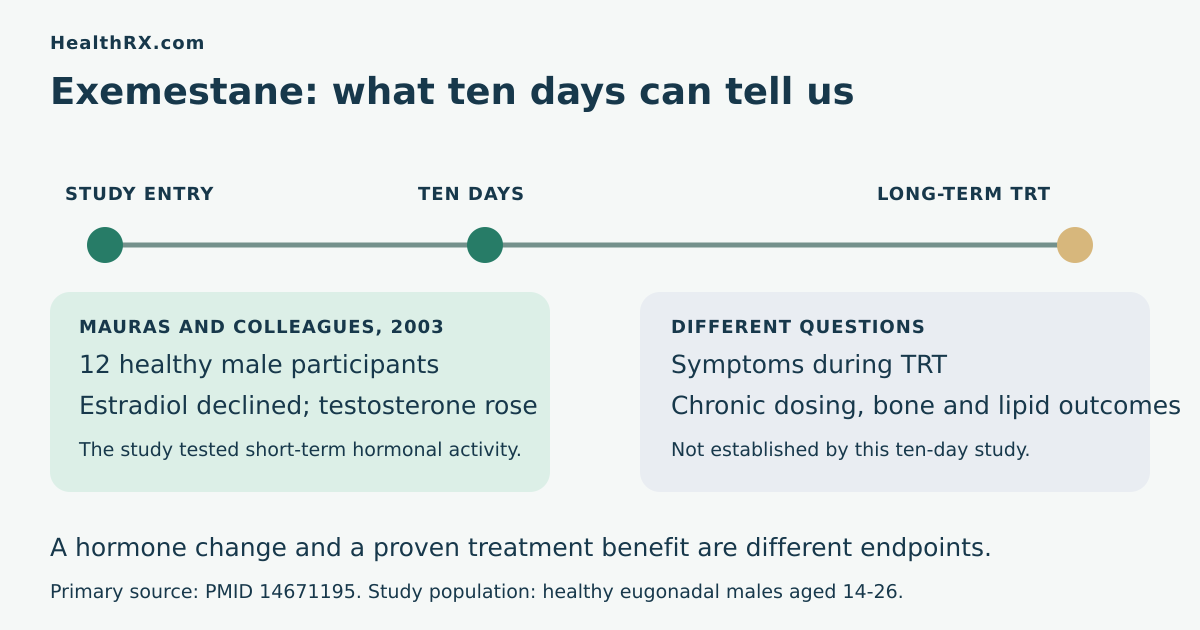
Mauras and colleagues recruited healthy eugonadal males aged 14 to 26. Twelve participants entered the crossover study, which compared 25 mg and 50 mg daily for ten days, with a fourteen-day washout between periods. Estradiol declined and testosterone rose during treatment. This establishes short-term hormonal activity in the studied population, not a tested treatment schedule for men on exogenous testosterone.
That kind of study can establish biological activity. It cannot answer whether a man on exogenous testosterone benefits from any particular milligram schedule, whether dosing on injection days differs from a fixed daily schedule, whether it treats gynecomastia, or what happens to bone density or lipids over months to years of combined testosterone and exemestane use. It did not enroll men on TRT and did not measure those outcomes.
What the AUA pathway says before an aromatase inhibitor is considered
The AUA guideline on testosterone deficiency recommends measuring estradiol in testosterone-deficient patients who have baseline breast symptoms or gynecomastia. If breast symptoms develop during therapy, it describes monitoring, since symptoms sometimes resolve on their own.
For persistent breast symptoms with elevated estradiol, the guideline points to the on-treatment testosterone result as the next decision point: it describes testosterone-dose adjustment when testosterone is in the upper range of normal, and names an aromatase inhibitor as one possible option to reduce estradiol when testosterone is low or normal.
That pathway does not name exemestane as a preferred agent, does not provide a dose, does not define a universal estradiol target, and does not say that a laboratory flag by itself, without a corresponding symptom or exam finding, justifies starting treatment.
Bone and lipid claims need the label's actual limits
Exemestane is sometimes described as "bone friendly" because it is steroidal and one metabolite has some androgen-receptor affinity. Current labeling does not support that conclusion for the approved population; it states that bone mineral density can decline over time and advises assessment and management for patients at risk. There is no male-specific bone outcome data reviewed for this page, so the direction of that risk in men on TRT is unknown, not reassuring.
The label for the approved population also describes an unfavorable change in HDL cholesterol during treatment; study 027 reports a 6-9% decrease in HDL cholesterol in the treated postmenopausal breast-cancer population. Neither the female bone finding nor the lipid finding converts into a validated male TRT risk estimate, but neither should be dismissed by an unproven theory that testosterone or an androgenic metabolite will compensate for it.
The honest position is narrow: skeletal and metabolic tradeoffs are plausible and worth monitoring, and there is not enough long-term male TRT data to call the risk established or the risk absent.
Food and drug-interaction facts that do transfer
For the approved indication, the label directs taking exemestane after a meal and reports higher drug exposure after a high-fat meal compared with fasting. If a clinician prescribes exemestane off-label, following the prescribed food instructions consistently matters, because food changes how much drug reaches circulation.
Strong CYP3A4 inducers, including rifampicin, phenytoin, carbamazepine, phenobarbital, and St. John's wort, can substantially lower exemestane exposure. The label's dose-modification guidance for these interacting drugs belongs to the approved breast-cancer regimen; it is not an instruction to double an off-label TRT dose. A relevant drug interaction should prompt the prescriber to reconsider the whole plan, not just the exemestane dose.
A symptom and a lab value do not identify the cause together
New breast tenderness or new glandular tissue is a different clinical finding from generalized water retention, mood change, low libido, or erectile symptoms. The latter group is nonspecific and can arise from many hormone states, medications, sleep problems, and mental-health or relationship factors that have nothing to do with estradiol.
An estradiol result also needs context before it becomes an actionable number:
- Which assay and reference range were used
- Whether there is a baseline or prior trend to compare against
- When the sample was drawn relative to the last testosterone dose
- The concurrent total and free testosterone results
- Whether the breast finding is new, changing, tender, or longstanding
- Whether another medicine or endocrine condition could explain the picture
A single number can support a diagnosis. It cannot substitute for one.
Fertility is a separate clinical branch, not an add-on decision
The AUA/ASRM male-infertility guideline states that clinicians may use aromatase inhibitors, hCG, selective estrogen receptor modulators, or combinations for infertile men with low serum testosterone, as a conditional recommendation. The same guideline's fertility statement is that exogenous testosterone therapy should not be prescribed to men interested in current or future fertility, because it suppresses the pituitary signals spermatogenesis depends on.
That fertility-preserving pathway is designed to support the body's own testosterone production without shutting down sperm production. It is not evidence for adding exemestane on top of exogenous testosterone, and the small male study discussed above did not measure fertility outcomes at all. A current or future fertility goal needs to be settled before testosterone therapy and an aromatase inhibitor are treated as a routine pair.
Decision framework: is this even the right question to ask an exemestane prescription
Use this before any conversation about milligrams. Work through it in order; stop at the first box that applies.
| Step | Question | If yes | If no |
|---|---|---|---|
| 1. Symptom check | Is there a specific finding, such as new breast tenderness or glandular tissue, rather than only a lab number or vague fatigue/mood complaint? | Continue to step 2 | Address the actual symptom first (sleep, mood, other medications, unrelated endocrine causes); an aromatase inhibitor is not a treatment for an undiagnosed complaint |
| 2. Testosterone exposure | Is on-treatment testosterone in the upper range of normal or above? | Consider a testosterone-dose reduction before adding a second drug | Continue to step 3 |
| 3. Fertility status | Is current or future fertility a goal? | Route through a fertility-preserving strategy (per AUA/ASRM), not exemestane added to standard TRT, and involve a clinician experienced in male fertility | Continue to step 4 |
| 4. Bone and lipid risk | Are there pre-existing bone-density concerns, osteoporosis risk factors, or lipid abnormalities? | Flag this explicitly; an unproven "steroidal AI protects bone" assumption should not override monitoring | Continue to step 5 |
| 5. Off-label decision point | Has the prescriber stated the exact indication, expected benefit, monitoring interval, and stop rule in writing? | Off-label exemestane is at least a defensible discussion | If this cannot be answered, the prescription is premature regardless of dose |
Exceptions and failure modes to watch for: a "stop rule" that never triggers (treatment continues indefinitely with no reassessment), an estradiol target chosen from an online forum rather than the patient's own baseline and symptoms, and dose increases made in response to a single lab value without re-checking the assay or timing. Any of these indicates the plan has drifted from a diagnosis-driven decision to a number-driven one.
What a prescriber's plan should be able to state
| Required plan element | Concrete question |
|---|---|
| Indication | What exact symptom, exam finding, or diagnosis is being treated? |
| Evidence | Which source supports exemestane rather than another response, such as a testosterone-dose change? |
| Baseline | What are the relevant hormone results, assay, timing, concurrent medicines, and bone history? |
| Outcome | What change would count as a meaningful benefit? |
| Reassessment | When and how will benefit and harm be checked? |
| Stop rule | What finding ends or changes the prescription? |
| Fertility | Does current or future conception change the testosterone strategy? |
If these fields cannot be completed, a dosing schedule is premature, regardless of how confident an online source sounds.
For a direct evidence comparison with the more commonly discussed TRT adjunct, see anastrozole versus exemestane on TRT. For the label and guideline boundaries around anastrozole itself, see anastrozole on TRT.
When this becomes an urgent, not routine, conversation
New breast lumps, rapidly enlarging gynecomastia, signs of a blood clot, severe mood changes, or symptoms suggesting a fracture or unexplained bone pain warrant contacting a clinician promptly rather than waiting for a routine follow-up. None of the evidence discussed here is a substitute for an in-person evaluation of a new or worsening symptom.
Frequently asked questions
Is exemestane FDA-approved for men on TRT?
What is the standard exemestane dose on TRT?
Does irreversible inhibition make exemestane safer than anastrozole?
Is exemestane better for bone health than other aromatase inhibitors?
Should exemestane be taken with food?
Can exemestane preserve fertility while staying on TRT?
References
-
DailyMed. Exemestane tablets, U.S. prescribing information. https://dailymed.nlm.nih.gov/dailymed/drugInfo.cfm?setid=abde1ccd-0ec9-40d4-b205-fbc00f5878b9
-
Effectiveness of Hormonal Therapy for Post-Menopausal Women with Hormone Receptor-Positive Advanced Breast Cancer: A Systematic Review and Meta-Analysis of Clinical Trials (2025). https://pubmed.ncbi.nlm.nih.gov/40096837/
-
American Urological Association. Evaluation and Management of Testosterone Deficiency: AUA Guideline. https://www.auanet.org/Documents/Guidelines/PDF/Testosterone%20Website%20Final%280%29.pdf
-
American Urological Association and American Society for Reproductive Medicine. Diagnosis and Treatment of Infertility in Men: AUA/ASRM Guideline (2020; amended 2024). See statements on aromatase inhibitor use and exogenous testosterone in men desiring fertility. https://www.auanet.org/documents/Guidelines/PDF/2024%20Guidelines/Male%20Infertility%20Unabridged%20Final.pdf
-
Mauras N, Lima J, Patel D, Rini A, di Salle E, Kwok A, Lippe B. Pharmacokinetics and dose finding of a potent aromatase inhibitor, aromasin (exemestane), in young males. J Clin Endocrinol Metab. 2003;88(12):5951-5956. https://pubmed.ncbi.nlm.nih.gov/14671195/
-
Finkelstein JS and colleagues. Gonadal steroids and body composition, strength, and sexual function in men. N Engl J Med. 2013;369:1011-1022. https://pubmed.ncbi.nlm.nih.gov/24024838/
Footnotes
-
Systematic review of hormonal therapy trials in postmenopausal women with hormone receptor-positive advanced breast cancer; cited here only to characterize the trial population behind exemestane's approved indication, not as evidence for male TRT use. https://pubmed.ncbi.nlm.nih.gov/40096837/ ↩