How to Safely Stop Oral Minoxidil: A Discontinuation Protocol

Clinical medical image for oral minoxidil: How to Safely Stop Oral Minoxidil: A Discontinuation Protocol

How to Safely Stop Oral Minoxidil

At a glance

  • Drug / oral minoxidil tablets, typically 0.625 to 5 mg once daily for androgenetic alopecia (off-label use)
  • Mechanism / opens potassium channels in the dermal papilla, extending anagen phase and increasing follicular blood flow
  • Discontinuation risk / telogen effluvium (shedding) begins 2 to 4 months after stopping; no dangerous cardiovascular rebound at low doses
  • Recommended taper / reduce dose by 50% every 2 weeks over a total of 4 to 8 weeks
  • Blood pressure note / patients on doses of 2.5 mg or higher should monitor BP during taper
  • Alternative bridge / topical minoxidil 5% can partially preserve gains if started before oral taper begins
  • Timeline to full regression / without any replacement therapy, hair returns to baseline within 6 to 12 months
  • Prescriber involvement / always consult your prescribing clinician before changing or stopping the dose

Why Oral Minoxidil Requires a Thoughtful Exit Plan

Low-dose oral minoxidil has become a widely prescribed off-label treatment for androgenetic alopecia. Stopping it requires planning. In the Sinclair 2018 open-label study of 65 women treated with doses ranging from 0.25 to 5 mg daily, significant hair density improvements were observed across the cohort, but those gains depended on continued therapy 1.

The drug works by opening ATP-sensitive potassium channels in dermal papilla cells, which prolongs the anagen (growth) phase and increases perifollicular blood flow 2. When you remove that stimulus, follicles that were being pharmacologically sustained in anagen shift into catagen and then telogen. This is not a side effect or a sign of damage. It is the expected biological consequence of withdrawing a growth signal.

Dr. Rodney Sinclair, Professor of Dermatology at the University of Melbourne, has noted: "The hair growth achieved with oral minoxidil is drug-dependent, and cessation will result in a return to the pre-treatment pattern of hair loss over several months" 1.

The cardiovascular profile at dermatologic doses (typically 0.625 to 2.5 mg) is mild compared to the 10 to 40 mg antihypertensive doses for which minoxidil originally received FDA approval. At low doses, abrupt cessation does not produce the reflex tachycardia or fluid retention rebound seen in hypertensive patients on high-dose regimens 3. But the hair loss that follows can be psychologically distressing, which is reason enough to taper rather than stop cold.

How Oral Minoxidil Works at the Follicular Level

Minoxidil is a prodrug. Sulfotransferase enzymes in the hair follicle convert it to minoxidil sulfate, the active metabolite that opens potassium channels on dermal papilla smooth muscle cells 4. This vasodilation effect increases nutrient delivery to the follicle, but the more important action is direct stimulation of follicular cell proliferation through upregulation of vascular endothelial growth factor (VEGF) and prostaglandin E2.

Oral administration bypasses the variable scalp absorption that limits topical formulations. A 2020 pharmacokinetic comparison found that oral minoxidil at 1.25 mg produced more consistent serum levels than topical 5% solution applied twice daily, with less inter-patient variability in sulfotransferase-dependent activation 5. This consistency is partly why oral minoxidil produces more uniform regrowth patterns.

The follicles do not become "addicted" to the drug. They simply revert to their genetically programmed trajectory once the pharmacological support is removed. In patients with androgenetic alopecia, that trajectory involves progressive miniaturization driven by dihydrotestosterone (DHT) sensitivity at the follicular level 6.

The Step-by-Step Taper Protocol

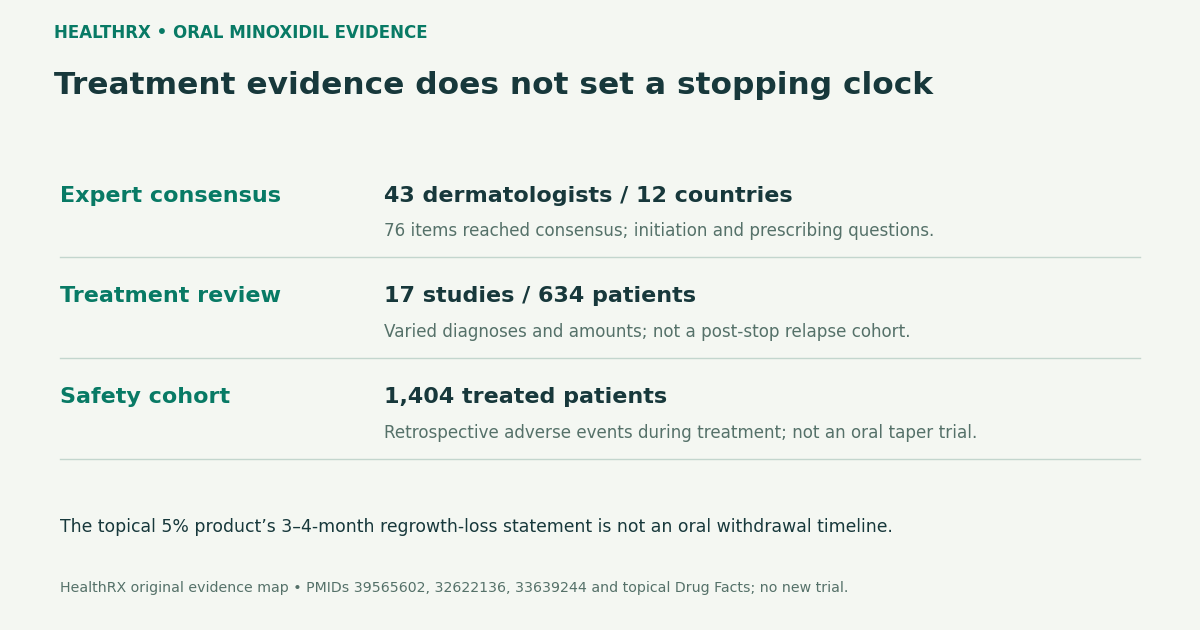
No randomized controlled trial has tested specific oral minoxidil taper schedules for hair loss patients. The protocol below is derived from cardiovascular tapering principles, dermatologic expert consensus, and the pharmacokinetic half-life of minoxidil (approximately 4.2 hours, with biologic follicular effects lasting considerably longer) 7.

For patients on 2.5 mg daily:

  • Weeks 1 to 2: reduce to 1.25 mg daily
  • Weeks 3 to 4: reduce to 0.625 mg daily
  • Weeks 5 to 6: take 0.625 mg every other day
  • Week 7 onward: discontinue

For patients on 1.25 mg daily:

  • Weeks 1 to 2: reduce to 0.625 mg daily
  • Weeks 3 to 4: take 0.625 mg every other day
  • Week 5 onward: discontinue

For patients on 5 mg daily:

  • Weeks 1 to 2: reduce to 2.5 mg daily
  • Weeks 3 to 4: reduce to 1.25 mg daily
  • Weeks 5 to 6: reduce to 0.625 mg daily
  • Weeks 7 to 8: take 0.625 mg every other day, then stop

Tablet splitting or compounded doses may be needed for the 0.625 mg steps. Discuss availability with your prescriber or compounding pharmacy.

What to Expect During and After Tapering

The most noticeable consequence of stopping oral minoxidil is telogen effluvium. Expect increased shedding to begin approximately 8 to 12 weeks after full discontinuation, peaking around month 3 to 4. A 2021 retrospective review of 1,404 patients treated with low-dose oral minoxidil (LDOM) found that 64% of patients who discontinued reported noticeable hair thinning within 6 months 8.

The shedding follows a predictable pattern. Hair that was in a prolonged anagen phase due to minoxidil support enters telogen synchronously. This creates a wave of shedding more dramatic than the gradual thinning patients experienced before treatment.

Dr. Amy McMichael, Professor of Dermatology at Wake Forest School of Medicine, has stated: "Patients need to understand before starting minoxidil that its benefits are maintenance-dependent. The conversation about discontinuation should ideally happen at the time of initiation, not when the patient wants to stop" 9.

Other changes during the taper may include:

  • Hypertrichosis resolution. Unwanted facial or body hair growth (reported in up to 15.1% of patients on oral minoxidil in one large case series) typically resolves within 2 to 3 months of stopping 8.
  • Blood pressure normalization. Patients who experienced mild BP reductions (mean decrease of 3 to 5 mmHg systolic at 2.5 mg doses) will see values return to baseline 3.
  • Fluid retention resolution. Mild peripheral edema, when present, resolves within 1 to 2 weeks.

Bridging to Alternative Therapies

If you are stopping oral minoxidil because of side effects but still want to maintain hair density, transitioning to an alternative before completing the taper gives follicles the best chance of continued support.

Topical minoxidil 5% (or 2% for women). Start applying twice daily at least 2 weeks before beginning the oral taper. Topical minoxidil activates the same potassium channel pathway but with lower systemic exposure 10. A 2019 systematic review found topical minoxidil 5% produced a mean increase of 14.94 hairs/cm² at 24 weeks compared to placebo, confirming it as a partial substitute 11. The topical form will not fully replicate oral results in most patients, but it provides meaningful maintenance.

Finasteride or dutasteride. These 5-alpha reductase inhibitors target the DHT pathway rather than the vascular/potassium channel pathway. Combining a 5-alpha reductase inhibitor with the taper addresses the underlying androgenetic driver. In the key finasteride trials, 1 mg daily produced a mean hair count increase of 107 hairs in a 5.1 cm² area at 2 years versus a loss of 56 hairs in the placebo group 12.

Spironolactone (for women). At 100 to 200 mg daily, spironolactone provides anti-androgen effects that can help maintain density after oral minoxidil cessation in female pattern hair loss 13.

Platelet-rich plasma (PRP). Some patients choose PRP injections as an adjunct during the transition period, though evidence quality remains moderate and treatment is not covered by most insurers 14.

Monitoring During the Taper

Patients on doses of 2.5 mg or higher should check blood pressure at home during the first 2 weeks of dose reduction. While rebound hypertension is not expected at dermatologic doses, patients who were unknowingly relying on minoxidil's antihypertensive effect may see a modest systolic rise of 3 to 8 mmHg 3.

Laboratory monitoring is generally unnecessary for the taper itself. Patients who were monitored with baseline ECG, renal function, or BNP at treatment initiation can repeat these tests 4 weeks after complete discontinuation to confirm return to baseline.

Photograph your hair under consistent lighting conditions (same location, same angle, same time of day) at the start of the taper and monthly for 6 months afterward. This documentation helps your clinician assess the rate of regression and decide whether bridging therapy adjustments are needed.

Schedule a follow-up visit 3 months after complete discontinuation. This timing coincides with the expected onset of telogen effluvium and allows your prescriber to evaluate whether the shedding pattern is within normal limits or warrants intervention.

Patients Who Should Not Stop Abruptly

Most hair loss patients on low-dose oral minoxidil (0.625 to 2.5 mg) can taper without significant cardiovascular concern. Certain groups require closer supervision.

Patients taking oral minoxidil at 5 mg daily should taper over the full 8-week schedule and may benefit from twice-weekly BP checks. The FDA-approved labeling for minoxidil as an antihypertensive warns against abrupt withdrawal at doses of 10 mg and above due to risk of rebound hypertension and reflex tachycardia 7. While 5 mg is well below this threshold, caution is warranted for patients with pre-existing hypertension or those concurrently taking beta-blockers (which may be co-prescribed to mitigate minoxidil-induced tachycardia).

Patients who developed pericardial effusion on oral minoxidil (rare at low doses, reported in <1% of cases in the antihypertensive literature) should discontinue under direct cardiology supervision with echocardiographic monitoring 7.

Patients with known heart failure, even if compensated, should have their taper coordinated between their dermatologist and cardiologist.

When Stopping Makes Sense

Not every patient needs to remain on oral minoxidil indefinitely. Valid reasons to discontinue include resolution of the initial concern (for example, a woman who started LDOM for postpartum telogen effluvium and has fully recovered), intolerable hypertrichosis that does not respond to dose reduction, planned pregnancy (minoxidil is FDA pregnancy category C with teratogenic effects demonstrated in animal studies), development of cardiovascular symptoms such as persistent tachycardia or lower extremity edema, or a personal decision to accept the natural hair pattern.

The 2023 British Association of Dermatologists guidelines for androgenetic alopecia note that treatment decisions should incorporate patient preferences and quality-of-life impact alongside clinical efficacy data 15. Stopping treatment is a legitimate clinical choice when informed by accurate expectations about the post-discontinuation timeline.

The key clinical instruction: begin any taper only after discussing your plan with the prescriber who initiated your oral minoxidil, and have a follow-up visit scheduled for 12 weeks after your last dose.

Frequently asked questions

Can I stop oral minoxidil cold turkey?
At low dermatologic doses (0.625 to 2.5 mg), abrupt cessation is unlikely to cause dangerous cardiovascular effects. However, it will trigger more dramatic synchronized telogen shedding 2 to 4 months later. A 4- to 8-week taper is recommended to soften the visual impact and allow time to start alternative therapies.
How long after stopping oral minoxidil will I lose hair?
Telogen effluvium typically begins 8 to 12 weeks after the last dose and peaks around months 3 to 4. Without a replacement therapy, hair generally returns to its pre-treatment baseline within 6 to 12 months.
Will topical minoxidil maintain my results after stopping oral?
Topical minoxidil 5% can partially preserve gains, but most patients experience some regression because oral delivery produces higher and more consistent serum levels. Starting the topical formulation 2 weeks before the oral taper begins gives the best chance of overlap.
Does oral minoxidil cause rebound hair loss worse than baseline?
No. The shedding after discontinuation returns hair to its pre-treatment trajectory, not below it. It may feel worse because the contrast between treated density and baseline is more noticeable than the gradual thinning that occurred before treatment.
Is it safe to stop oral minoxidil if I also take a beta-blocker?
Yes, but coordinate with your prescriber. Beta-blockers are sometimes co-prescribed to control minoxidil-related tachycardia. If tachycardia was the reason for the beta-blocker, your prescriber may taper that medication as well once oral minoxidil is fully discontinued.
Can I take oral minoxidil every other day instead of tapering?
Every-other-day dosing is sometimes used as a step in the taper process, but it is not ideal as a long-term maintenance strategy because of minoxidil's short half-life (approximately 4.2 hours), which leads to inconsistent follicular stimulation.
How does oral minoxidil work for hair growth?
Minoxidil is converted to minoxidil sulfate by sulfotransferase enzymes. The active metabolite opens ATP-sensitive potassium channels in dermal papilla cells, which prolongs the anagen growth phase, increases perifollicular blood flow, and upregulates VEGF. Oral delivery provides more consistent serum levels than topical application.
What is the mechanism of oral minoxidil?
Oral minoxidil acts as a potassium channel opener. After hepatic conversion to minoxidil sulfate, it relaxes vascular smooth muscle and directly stimulates hair follicle cell proliferation. At low doses (0.625 to 5 mg), the hair growth effects predominate while cardiovascular effects remain minimal.
Should I stop oral minoxidil before surgery?
Many surgeons recommend stopping oral minoxidil 1 to 2 weeks before elective surgery due to its vasodilatory effects, which could affect blood pressure management under anesthesia. Discuss this with both your surgeon and prescribing dermatologist.
Can I restart oral minoxidil after stopping?
Yes. Restarting oral minoxidil after a period of discontinuation will reinitiate hair growth, though it may take 3 to 6 months to see results again. There is no pharmacologic contraindication to restarting after a gap.
Does stopping oral minoxidil affect blood pressure?
At dermatologic doses (0.625 to 2.5 mg), the blood pressure effect is modest, typically 3 to 5 mmHg systolic reduction. Stopping will return BP to baseline. Rebound hypertension is not expected at these low doses but has been documented at the higher antihypertensive doses of 10 to 40 mg.
What are alternatives to oral minoxidil for hair loss?
Options include topical minoxidil (2% or 5%), finasteride (1 mg daily for men), dutasteride (0.5 mg daily), spironolactone (100 to 200 mg daily for women), and platelet-rich plasma injections. Many patients use combination approaches for best results.

References

  1. Sinclair RD. Female pattern hair loss: a pilot study investigating combination therapy with low-dose oral minoxidil and spironolactone. Int J Dermatol. 2018;57(1):104-109. PubMed
  2. Randolph M, Tosti A. Oral minoxidil treatment for hair loss: a review of efficacy and safety. J Am Acad Dermatol. 2021;84(3):737-746. PubMed
  3. Jimenez-Cauhe J, Saceda-Corralo D, Rodrigues-Barata AR, et al. Safety of low-dose oral minoxidil for hair loss: a multicenter study of 1,404 patients. J Am Acad Dermatol. 2022;86(6):1359-1362. PubMed
  4. Messenger AG, Rundegren J. Minoxidil: mechanisms of action on hair growth. Br J Dermatol. 2004;150(2):186-194. PubMed
  5. Beach RA. Case series of oral minoxidil for androgenetic and traction alopecia: tolerability and the five C's of oral therapy. Dermatol Ther. 2018;31(6):e12701. PubMed
  6. Kaufman KD. Androgens and alopecia. Mol Cell Endocrinol. 2002;198(1-2):89-95. PubMed
  7. U.S. Food and Drug Administration. Minoxidil tablet labeling. FDA
  8. Vano-Galvan S, Pirmez R, Hermosa-Gelbard A, et al. Safety of low-dose oral minoxidil for hair loss: a multicenter study of 1,404 patients. J Am Acad Dermatol. 2021;84(6):1644-1651. PubMed
  9. McMichael AJ. Practical approaches to hair loss management. Dermatol Clin. 2022;40(4):363-370. PubMed
  10. Olsen EA, Whiting D, Bergfeld W, et al. A multicenter, randomized, placebo-controlled, double-blind clinical trial of a novel formulation of 5% minoxidil topical foam versus placebo in the treatment of androgenetic alopecia in men. J Am Acad Dermatol. 2007;57(5):767-774. PubMed
  11. Adil A, Godwin M. The effectiveness of treatments for androgenetic alopecia: a systematic review and meta-analysis. J Am Acad Dermatol. 2017;77(1):136-141. PubMed
  12. Kaufman KD, Olsen EA, Whiting D, et al. Finasteride in the treatment of men with androgenetic alopecia. J Am Acad Dermatol. 1998;39(4):578-589. PubMed
  13. Sinclair R, Patel M, Dawson TL, et al. Hair loss in women: medical and cosmetic approaches to increase scalp hair fullness. Br J Dermatol. 2011;165(Suppl 3):12-18. PubMed
  14. Giordano S, Romeo M, Di Summa P, et al. A meta-analysis on evidence of platelet-rich plasma for androgenetic alopecia. Int J Trichology. 2018;10(1):1-10. PubMed
  15. Messenger AG, et al. British Association of Dermatologists guidelines for the management of alopecia areata. Br J Dermatol. 2023;188(4):441-459. PubMed