Oral Minoxidil With Food and Supplements: Swelling, Dizziness and Lab Tests
You can take oral minoxidil with or without a meal, following your prescription instructions. New swelling or dizziness needs a different conversation from meal timing. A hair supplement can also affect laboratory results: biotin may interfere with certain tests even when you feel well. [1,2,5,6,11]
Taking your tablet with meals
A published review reports that food does not affect oral minoxidil bioavailability, so taking it fed or fasted is acceptable. Follow your actual prescription instructions and choose a consistent routine. The US oral-tablet label describes treatment for severe hypertension. Its instructions for accompanying medicines should not be applied automatically to a hair-loss prescription. [1,11]
The oral-tablet label does not name grapefruit as an interaction. Have a pharmacist check your complete medicine list, because grapefruit affects some other medicines, including certain statins and blood-pressure drugs. The restriction depends on the exact drug. [1,12]
Swelling and salt: what deserves attention
Minoxidil widens blood vessels and can cause salt and water retention and an increased heart rate. Its US hypertension labeling includes serious cardiac warnings and instructions for accompanying medicines in that setting. Those instructions should not be converted into a requirement that everyone taking low-dose minoxidil for hair loss needs a diuretic or beta blocker. [1]
A lower-salt diet may be recommended individually. Ask for a sodium goal that fits your kidney function and other medicines; a fixed daily milligram target cannot promise prevention of swelling. New ankle swelling or weight gain deserves review rather than simply cutting out another food. Do not add a diuretic yourself. [1,2]
Potassium foods are different from potassium supplements
Potassium channels are structures in cells; dietary potassium is a nutrient whose blood concentration depends substantially on kidney handling. Minoxidil's channel-opening action does not establish a need to restrict bananas, avocados or other potassium-containing foods. [1,4]
Kidney impairment and medicines such as ACE inhibitors, ARBs and potassium-sparing diuretics can increase the risk of high blood potassium. That matters when considering potassium supplements or potassium-based salt substitutes. If you also take spironolactone, for example, that medicine changes the potassium discussion independently of minoxidil's channel mechanism. General potassium intake recommendations are not personal safety limits for people with impaired potassium excretion. [4]
Sort the question before changing your diet
| Item | Main concern | What cannot be inferred | Useful detail to record |
|---|---|---|---|
| Ordinary food and potassium | Kidney function and other medicines may change potassium handling. [4] | Minoxidil's potassium-channel action does not require fruit restriction. [1,4] | Potassium supplements, salt substitutes and other medicines. |
| Alcohol and caffeine | Alcohol may worsen side effects; caffeine can cause palpitations in sensitive people. [2,10] | A clock-time gap does not settle the blood-pressure concern. | Amount, product, serving size and symptoms. |
| Supplement blends | Licorice has cardiovascular risks; CoQ10 and saw palmetto require product-specific review. [7–9] | A “hair health” label does not establish combination safety. | Brand, full ingredients and start date. |
| Biotin and laboratory tests | Some assays can give misleading results. [5,6] | A result cannot be judged from the supplement dose alone. | Biotin amount and time of the last dose. |
Alcohol and caffeine: focus on symptoms
Alcohol can worsen oral minoxidil side effects. Hair-loss patient guidance recommends reducing alcohol because of blood-pressure concerns. A fixed drink count or four-hour gap should not be treated as protection from low blood pressure. Dizziness is a reason to avoid further alcohol and seek advice about the symptoms. [2,3]
Caffeine sensitivity varies. Count coffee, tea, pre-workout products and other sources together. The FDA's general adult caffeine reference is not a minoxidil-specific allowance. Palpitations, sleep disturbance or blood-pressure changes are reasons to reconsider intake; changing the clock time alone does not resolve those concerns. [10]
Supplements: inspect the ingredients
Licorice root containing glycyrrhizin can cause serious cardiovascular problems, especially in people with hypertension or heart or kidney conditions. A licorice-containing supplement should be flagged before use. This concern comes from licorice's own effects, not a demonstrated dietary-potassium interaction with minoxidil. Anise flavoring is not the same ingredient. [8]
CoQ10 should not be presented as causing a predictable blood-pressure drop. NCCIH describes limited evidence suggesting it probably does not have a meaningful blood-pressure effect. That does not establish a minoxidil combination as risk-free or justify a supplement-dose cutoff. [7]
Saw palmetto has too little evidence to draw conclusions about hair-loss benefit. That limited evidence is not a reason to add it automatically to minoxidil. Check the full blend rather than only the ingredient named on the front. [9]
Iron, zinc and vitamin D also belong on your medication list. Do not add them simply because they are marketed for hair growth. Record the reason for use and the actual product so that each can be reviewed separately. [2]
Biotin can affect a test without causing symptoms
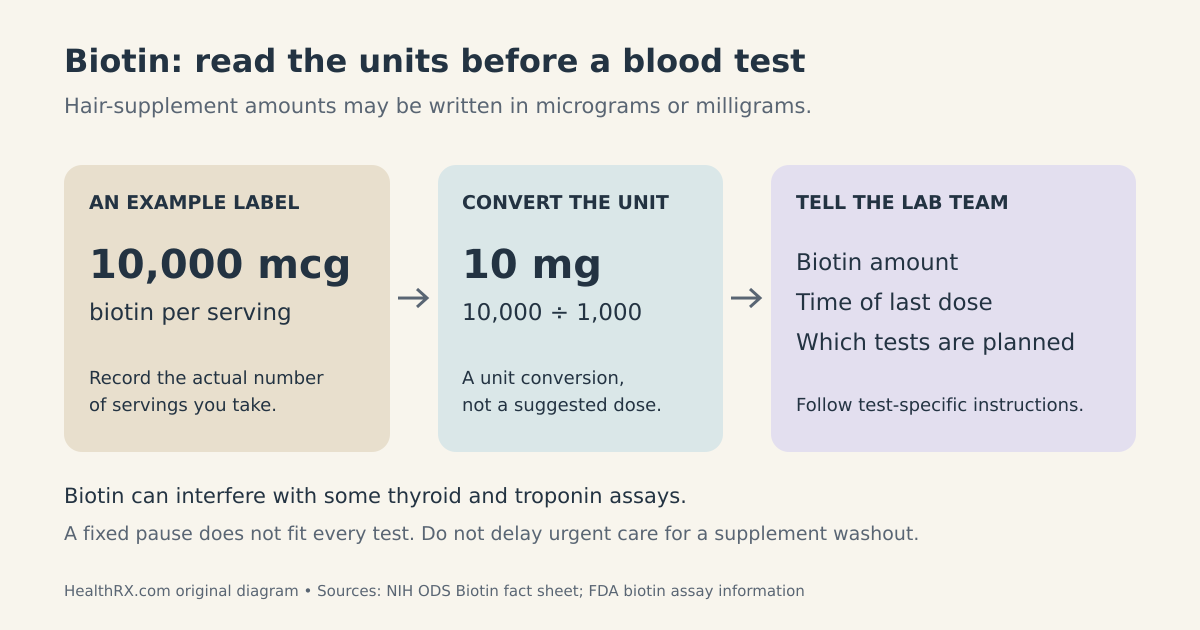
Read units carefully: 10,000 mcg = 10 mg biotin, because 1,000 micrograms equal 1 milligram. This is a unit conversion, not a recommended or safe dose. A single 10 mg dose has interfered with thyroid tests within 24 hours in research; the effect depends on the assay. [5]
Some susceptible troponin assays can read falsely low, potentially obscuring evidence of heart injury. Tell the clinical team and laboratory your biotin amount and last dose. Ask for instructions specific to the planned tests rather than using a universal 72-hour pause. Never delay urgent care to complete a supplement washout. [5,6]
Record when symptoms and product changes began
A short chronology can make review more useful: note your prescribed minoxidil dose and time, any new supplement's brand and ingredients, its start date, and when swelling or dizziness appeared. Include blood pressure and pulse if measured. This organizes information; it does not establish which product caused a symptom. Monitoring and testing should reflect your circumstances rather than an automatic electrolyte-testing schedule for everyone. [2,3]
Report new swelling, weight gain or a rapid pulse promptly. Fainting, chest pain or difficulty breathing warrants urgent assessment. Tell the team about supplements, especially biotin if blood tests are needed. [2,6]
Frequently asked questions
Can I eat bananas while taking oral minoxidil?
Does grapefruit juice interact with oral minoxidil?
Should I avoid alcohol while on oral minoxidil?
Can I take CoQ10 with oral minoxidil?
Is it safe to take iron supplements with oral minoxidil?
Does caffeine cancel out oral minoxidil for hair growth?
Can I take biotin while on oral minoxidil?
What about saw palmetto and oral minoxidil together?
Should I reduce salt intake on oral minoxidil?
Can licorice root supplements be taken with oral minoxidil?
How does oral minoxidil work for hair loss?
Does oral minoxidil need to be taken with food?
References
- DailyMed: Minoxidil oral tablet prescribing information.
- MedlinePlus: Minoxidil.
- Royal Berkshire NHS: Minoxidil for hair loss, October 2025.
- NIH Office of Dietary Supplements: Potassium—Health Professional Fact Sheet.
- NIH Office of Dietary Supplements: Biotin—Health Professional Fact Sheet.
- FDA: Biotin Interference with Troponin Lab Tests—Assays Subject to Biotin Interference.
- NCCIH: Coenzyme Q10.
- NCCIH: Licorice Root.
- NCCIH: Saw Palmetto.
- FDA: Spilling the Beans—How Much Caffeine Is Too Much?.
- Gupta et al.: Low-Dose Oral Minoxidil for Alopecia—A Comprehensive Review.
- FDA: Grapefruit Juice and Some Drugs Don't Mix.