Clinical image for Medications to Manage Injection Site Reactions on Wegovy (Semaglutide 2.4 mg): First-Line and Beyond Image: HealthRX.com clinical image
# What Medications Treat Injection Site Reactions From Wegovy?
<TLDR>
Most Wegovy injection site reactions respond to OTC oral antihistamines (cetirizine 10 mg or loratadine 10 mg daily) combined with a low-potency topical corticosteroid (hydrocortisone 1% cream applied twice daily). If swelling or induration persists beyond 7 days, a medium-potency prescription steroid or short oral corticosteroid burst may be warranted. Discontinue Wegovy only if you develop systemic symptoms or reactions worsen despite treatment.
</TLDR>
<AtAGlance>
- **Incidence:** Injection site reactions occurred in [0.6% of patients on semaglutide 2.4 mg vs. 0.5% on placebo](https://www.nejm.org/doi/full/10.1056/NEJMoa2032183) in the STEP 1 trial
- **Typical timeline:** Onset within minutes to 48 hours post-injection; most resolve in 3 to 5 days without treatment
- **First-line management:** OTC second-generation antihistamine + OTC hydrocortisone 1% cream
- **Escalation trigger:** Reactions lasting >7 days, expanding diameter >5 cm, or accompanied by systemic symptoms (fever, widespread urticaria)
- **Discontinuation threshold:** Anaphylaxis, angioedema, or confirmed hypersensitivity to semaglutide or any excipient
</AtAGlance>
## Why Wegovy Causes Injection Site Reactions
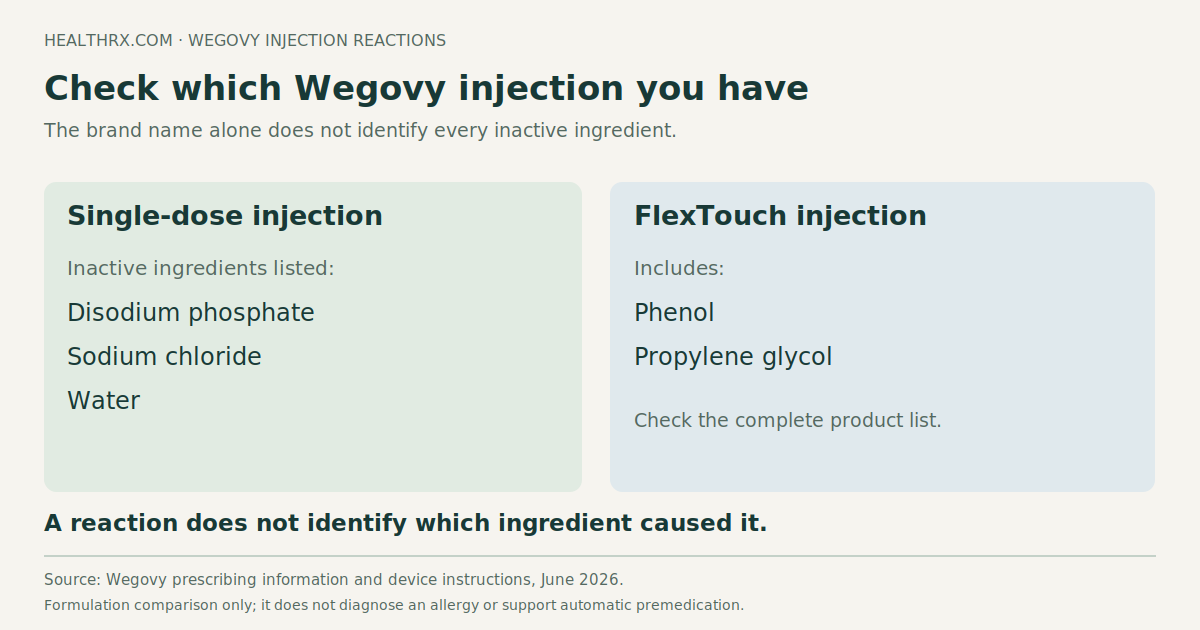
Semaglutide is administered as a weekly subcutaneous injection. The needle puncture and deposition of 0.25 to 2.4 mg of drug solution into adipose tissue triggers two overlapping responses. First, mechanical disruption of dermal and subdermal layers activates local mast cells, releasing histamine into surrounding tissue. Second, the excipient vehicle (containing disodium phosphate dihydrate and phenol as a preservative) can provoke a mild chemical irritation at the depot site. The [STEP 1 trial](https://www.nejm.org/doi/full/10.1056/NEJMoa2032183) reported injection site reactions at low rates across both active and placebo arms, suggesting the injection process itself accounts for a portion of events. The [Wegovy prescribing information](https://www.accessdata.fda.gov/drugsatfda_docs/label/2021/215256s000lbl.pdf) lists erythema, pruritus, pain, and induration as the primary local manifestations.
Understanding these two mechanisms (histamine-driven and irritant-driven) matters because each responds to a different class of medication.
## First-Line OTC Medications
### Oral Antihistamines (H1 Blockers)
Second-generation antihistamines are the cornerstone of first-line treatment. They block peripheral H1 receptors, reducing the itch-scratch cycle and limiting wheal formation at the injection depot.
{/* HRX:framework */}
**The HealthRX.com ISR Medication Ladder for Wegovy**
| Step | Medication | Dose | Route | When to use |
|------|-----------|------|-------|-------------|
| 1A | Cetirizine (Zyrtec) | 10 mg once daily | Oral | Pruritus or erythema within 48 h of injection |
| 1B | Loratadine (Claritin) | 10 mg once daily | Oral | Alternative if cetirizine causes drowsiness |
| 1C | Fexofenadine (Allegra) | 180 mg once daily | Oral | Preferred in patients sensitive to sedation |
| 2A | Hydrocortisone 1% cream | Thin layer twice daily | Topical | Localized redness or swelling <5 cm |
| 2B | Triamcinolone 0.1% cream | Thin layer once to twice daily | Topical (Rx) | Induration or erythema persisting >5 days |
| 3 | Prednisone | 20 to 40 mg daily x 3 to 5 days | Oral (Rx) | Expanding reaction >5 cm with significant discomfort |
Cetirizine at 10 mg daily is the most studied option. It has rapid onset (1 hour), a 24-hour duration of action, and minimal CNS penetration compared to first-generation agents like diphenhydramine. Patients who find cetirizine mildly sedating can switch to [fexofenadine 180 mg](https://dailymed.nlm.nih.gov/dailymed/drugInfo.cfm?setid=8caboref-3c57-4025-b067-3a8e80654e41), which has the lowest sedation profile in its class.
**Timing matters.** Taking the antihistamine 1 to 2 hours before the scheduled Wegovy injection can blunt the initial histamine surge. Patients who consistently develop reactions may benefit from a 48-hour pre- and post-dose antihistamine window.
**What to avoid:** Diphenhydramine (Benadryl) 25 to 50 mg works but causes significant sedation, dry mouth, and urinary retention. Reserve it for acute flares that break through second-generation agents, not routine prophylaxis. The [American Academy of Allergy guidelines](https://www.aaaai.org/tools-for-the-public/conditions-library/allergies/antihistamines) recommend second-generation agents as first choice for chronic or recurrent histamine-mediated reactions.
### Topical Corticosteroids
Applied directly to the injection site, low-potency corticosteroids suppress the inflammatory cascade downstream of histamine release. Hydrocortisone 1% cream or ointment, available OTC, is appropriate for mild erythema and itch. Apply a thin layer to the affected area twice daily for up to 7 days.
Do not occlude the site with bandages, which increases steroid absorption and raises the risk of skin atrophy. Do not apply topical steroids to broken skin or open wounds at the injection site.
## Second-Line Prescription Options
When OTC measures fail to control symptoms within 5 to 7 days, prescription escalation is appropriate.
### Medium-Potency Topical Steroids
[Triamcinolone acetonide 0.1% cream](https://dailymed.nlm.nih.gov/dailymed/drugInfo.cfm?setid=b3e3cb6a-2a86-4e95-9ee2-1284401062d7) applied once to twice daily offers greater anti-inflammatory potency than hydrocortisone. It is classified as a Group IV (medium-potency) topical corticosteroid in the [Stoughton-Cornell classification](https://www.aad.org/member/clinical-quality/guidelines/topical-corticosteroids). Limit use to 14 days at the injection site to avoid skin thinning.
For patients with significant induration (a palpable lump or nodule persisting beyond one week), betamethasone valerate 0.1% cream once daily for 7 to 10 days provides Group III potency while maintaining a reasonable safety profile for short-term localized use.
### Oral Corticosteroid Burst
A short prednisone taper (20 to 40 mg daily for 3 to 5 days) is occasionally necessary for reactions that expand beyond 5 cm in diameter or produce enough discomfort to interfere with daily activities. This approach is borrowed from contact dermatitis management protocols. No taper is required for courses lasting 5 days or fewer.
**Drug interaction note:** Prednisone can transiently raise blood glucose levels, which may partially counteract the glycemic benefits of semaglutide. In patients using Wegovy for weight management with concurrent prediabetes or type 2 diabetes, monitor fasting glucose during and for 3 days after the steroid course.
### Topical Calcineurin Inhibitors
For patients who cannot tolerate topical steroids (e.g., thin or atrophic skin from repeated injections in the same region), tacrolimus 0.1% ointment applied twice daily is a steroid-sparing alternative. It suppresses local T-cell activation without causing dermal atrophy. Tacrolimus carries an [FDA boxed warning](https://www.accessdata.fda.gov/drugsatfda_docs/label/2011/050777s018lbl.pdf) regarding theoretical lymphoma risk, though short-term localized use at injection sites falls well within accepted practice per dermatology consensus.
## Medications to Avoid or Use With Caution
**NSAIDs (ibuprofen, naproxen):** Oral NSAIDs are not effective for histamine-driven injection site reactions. They target the cyclooxygenase pathway, which plays a minor role in acute mast cell degranulation. They also carry GI side-effect risk that compounds with the nausea already common on GLP-1 therapy. The [STEP 1 data](https://www.nejm.org/doi/full/10.1056/NEJMoa2032183) showed nausea rates of 44% on semaglutide 2.4 mg; adding NSAIDs to an already irritated GI tract is counterproductive.
**Topical antibiotics (neomycin, bacitracin):** Unless there are signs of secondary infection (purulent drainage, warmth spreading beyond the injection site, fever), topical antibiotics add no benefit and can cause contact sensitization, worsening the reaction.
**High-potency topical steroids (clobetasol, halobetasol):** Group I steroids are excessive for injection site reactions. They cause rapid skin atrophy with repeated use, and the abdominal and thigh injection sites are already thinner-skinned areas prone to this effect.
**First-generation antihistamines as maintenance:** Hydroxyzine and diphenhydramine are acceptable for one-off acute flares but should not be used as standing prophylaxis due to anticholinergic burden, particularly in older adults where the [Beers Criteria](https://agsjournals.onlinelibrary.wiley.com/doi/full/10.1111/jgs.18372) classify them as potentially inappropriate.
## Non-Pharmacologic Measures That Complement Medication
Cold compresses applied for 10 to 15 minutes immediately after injection can reduce histamine-mediated vasodilation and limit erythema spread. Allow the Wegovy pen to reach room temperature (15 to 30 minutes out of refrigeration) before injecting, as cold solution deposited into tissue increases local irritation.
Rotate injection sites systematically among the abdomen, thigh, and upper arm. The [Wegovy prescribing information](https://www.accessdata.fda.gov/drugsatfda_docs/label/2021/215256s000lbl.pdf) recommends site rotation, and consistent rotation reduces cumulative tissue trauma at any single depot. Space injection sites at least 2 inches apart from previous puncture marks.
## When to Contact Your Prescriber
Seek medical evaluation if any of the following occur:
- Reaction diameter expands beyond 5 cm or grows after 48 hours
- Systemic symptoms develop: widespread hives, lip or tongue swelling, difficulty breathing, lightheadedness
- The site becomes warm, tender, and drains pus (possible secondary cellulitis)
- Reactions consistently worsen with each successive dose despite prophylactic antihistamines
- Induration persists beyond 14 days
Anaphylaxis to semaglutide is rare but is an absolute contraindication to continued use. The prescribing label lists [angioedema and anaphylaxis](https://www.accessdata.fda.gov/drugsatfda_docs/label/2021/215256s000lbl.pdf) as known risks.
<FAQAccordion>
<FAQ question="Can I take Benadryl before my Wegovy injection to prevent a reaction?">
You can, but second-generation antihistamines like cetirizine or fexofenadine are preferred. They last 24 hours, cause less drowsiness, and are better suited for weekly prophylaxis. Diphenhydramine (Benadryl) lasts only 4 to 6 hours and carries sedation and anticholinergic risks that make it a poor routine choice.
</FAQ>
<FAQ question="How long should I use hydrocortisone cream on the injection site?">
Apply hydrocortisone 1% cream for up to 7 days. If the reaction has not resolved by day 7, contact your prescriber about stepping up to a prescription-strength topical steroid like triamcinolone 0.1%.
</FAQ>
<FAQ question="Will ibuprofen help with the redness and swelling at my injection site?">
Ibuprofen is not effective for histamine-mediated injection site reactions. It targets a different inflammatory pathway. An oral antihistamine paired with topical hydrocortisone will address the actual mechanism. Ibuprofen may also worsen the GI symptoms that are common with Wegovy.
</FAQ>
<FAQ question="Should I stop Wegovy if I get a reaction at the injection site?">
Most injection site reactions are mild and manageable with OTC medications. You should not discontinue Wegovy for localized redness, itching, or small lumps. Discontinuation is appropriate only for anaphylaxis, angioedema, or reactions that worsen despite appropriate treatment. Always discuss discontinuation with your prescriber.
</FAQ>
<FAQ question="Can I use ice on the injection site after my Wegovy shot?">
Yes. A cold compress or ice pack wrapped in a cloth for 10 to 15 minutes after injection can reduce swelling and itch by constricting blood vessels and slowing histamine diffusion. Do not apply ice directly to skin.
</FAQ>
<FAQ question="Is it normal to get a lump at the Wegovy injection site?">
Small, painless nodules (induration) at the subcutaneous depot are common and typically resolve within 3 to 7 days. If a lump persists beyond 14 days, grows in size, becomes painful, or shows signs of infection, have it evaluated by your prescriber.
</FAQ>
<FAQ question="Can I use Neosporin on my Wegovy injection site?">
Topical antibiotics like Neosporin are unnecessary unless there are signs of infection (pus, spreading redness, fever). Applying them to a sterile injection site reaction risks contact sensitization, which can make future reactions worse. Stick with hydrocortisone cream for non-infected reactions.
</FAQ>
<FAQ question="Does the Wegovy dose affect how bad injection site reactions are?">
The STEP trial program did not demonstrate a clear dose-response relationship for injection site reactions specifically, though the dose-escalation schedule means patients spend the first 16 weeks at lower doses. Some patients report more pronounced reactions after reaching the 2.4 mg maintenance dose, possibly because of the larger injection volume. Prophylactic antihistamine use can be timed to the dose increase.
</FAQ>
<FAQ question="Are injection site reactions a sign of Wegovy allergy?">
Localized injection site reactions (redness, itch, mild swelling confined to the puncture area) are typically irritant or histamine responses, not true allergic reactions. A genuine allergy to semaglutide would present with systemic symptoms: widespread hives, lip or tongue swelling, breathing difficulty, or anaphylaxis. Report any systemic symptoms immediately.
</FAQ>
<FAQ question="Can switching injection sites reduce how often I get reactions?">
Yes. Rotating among the abdomen, thigh, and upper arm reduces cumulative tissue irritation at any single area. The Wegovy label specifically recommends site rotation. Spacing each injection at least 2 inches from the previous site also helps tissue recover between doses.
</FAQ>
</FAQAccordion>
<References>
1. Wilding JPH, Batterham RL, Calanna S, et al. Once-weekly semaglutide in adults with overweight or obesity (STEP 1). *N Engl J Med*. 2021;384(11):989-1002. https://www.nejm.org/doi/full/10.1056/NEJMoa2032183
2. Novo Nordisk. Wegovy (semaglutide) injection prescribing information. FDA. 2021. https://www.accessdata.fda.gov/drugsatfda_docs/label/2021/215256s000lbl.pdf
3. American Academy of Allergy, Asthma & Immunology. Antihistamines. https://www.aaaai.org/tools-for-the-public/conditions-library/allergies/antihistamines
4. American Geriatrics Society. 2023 Updated AGS Beers Criteria. *J Am Geriatr Soc*. 2023. https://agsjournals.onlinelibrary.wiley.com/doi/full/10.1111/jgs.18372
5. Astellas Pharma. Protopic (tacrolimus) ointment prescribing information. FDA. 2011. https://www.accessdata.fda.gov/drugsatfda_docs/label/2011/050777s018lbl.pdf
</References>